Blog · Digestion
Chronic diarrhoea in dogs: causes, tests and what to do
Chronic diarrhoea in a dog lasts 3 weeks or longer or keeps returning. The vet finds the cause step by step: stool, blood, diet, ultrasound. Keep a diary.
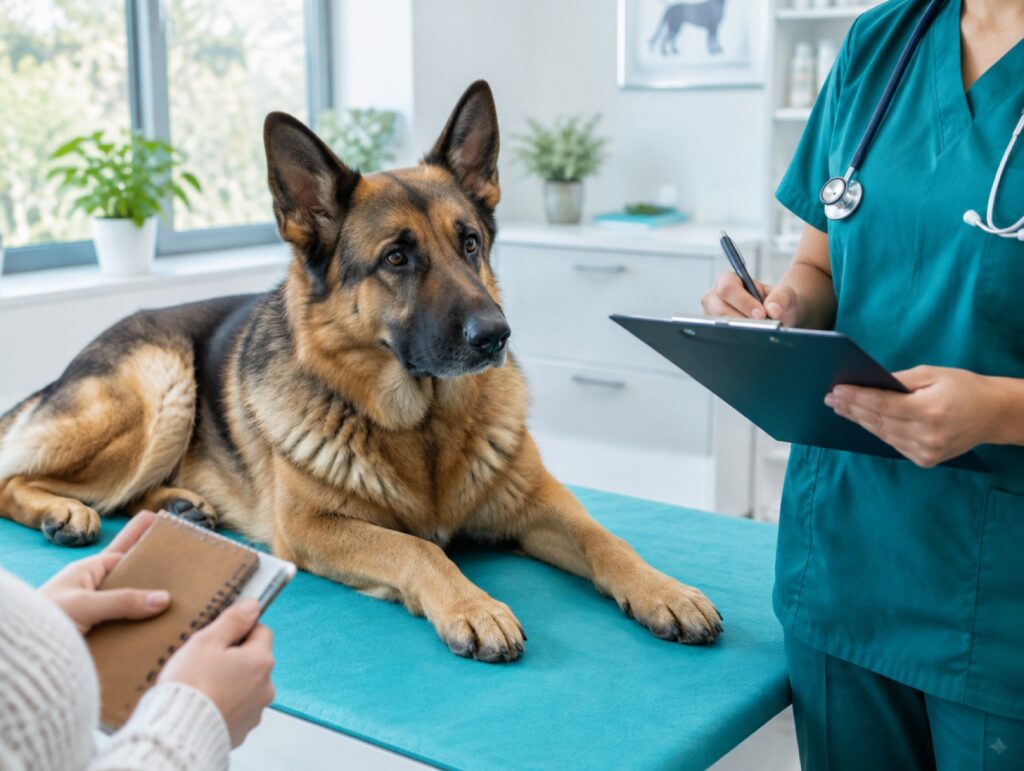
Loose poop again yesterday, last week too, and at the weekend it looked like it was over. But the diarrhoea keeps coming back. Chronic diarrhoea in a dog is diarrhoea that lasts three weeks or longer or keeps recurring, and it belongs with a vet even if your dog is otherwise lively. Here you will find what may be behind it, how the vet proceeds and how you can help.
- Chronic diarrhoea in a dog is diarrhoea that lasts three weeks or longer, or keeps coming back (Merck Veterinary Manual).
- You cannot tell the cause from the poop. The vet proceeds step by step: parasites, blood, pancreas, elimination diet, ultrasound, possibly biopsy.
- According to the Merck Veterinary Manual, a change of diet alone resolves the signs in more than half of dogs with chronic enteropathy. In some studies it was considerably fewer, and even so a diet is usually the first treatment trial.
- Antibiotics and immune-suppressing medicines do not belong in your own hands. Your vet decides based on the response to the earlier steps.
- You help most with a symptom diary: stool score, frequency, blood, mucus, vomiting, weight and feeding.
What is chronic diarrhoea in a dog and when is it no longer acute?
Chronic diarrhoea in a dog is diarrhoea that lasts three weeks or longer, or repeatedly returns after relief. Both the Merck Veterinary Manual and the review by Dandrieux and Mansfield (2019) call bowel problems lasting three weeks or longer chronic enteropathy. The review of acute diarrhoea (Candellone et al., 2020) gives 14 to 21 days. Diarrhoea that eases and comes back a week later should be handled the same as continuous diarrhoea.
Long-term bowel problems with no other cause found are technically called chronic enteropathy. According to Dandrieux (2016), this is a better term for dogs than “IBD”, because treatment and outcome differ from inflammatory bowel disease in people. The first days of diarrhoea are covered in the article Diarrhoea in dogs, and an overview of problems in the article Digestive problems in dogs.
How can you tell small bowel from large bowel diarrhoea?
Small bowel diarrhoea tends to be bulky and the dog passes it only slightly more often than before, whereas large bowel diarrhoea is frequent, in small portions and with straining (Merck Veterinary Manual). The table is only a guide, signs can mix.
| Sign | Small bowel | Large bowel |
|---|---|---|
| Number of bowel movements | Normal or slightly higher | Very frequent |
| Amount of stool | Normal to larger | Small portions |
| Urgency and straining | Absent | Usually present |
| Mucus | Usually absent | Common |
| Blood | Dark to black, digested (melaena) | Fresh red |
| Weight loss | Possible | Rare |
You will find more about mucus in the article Mucus in dog poop, and about colours and shapes in the article Dog poop.
What are the causes of chronic diarrhoea in a dog?
A vet diagnoses chronic enteropathy only after ruling out other causes, such as a foreign object, parasites or a tumour (Merck Veterinary Manual).
- Parasites. Giardia are shed intermittently, so samples from several days may need testing (Companion Animal Parasite Council).
- Food-responsive enteropathy. The dog improves on a suitable diet.
- Antibiotic-responsive enteropathy. The dog improves on an antibiotic, but the problems often return after it is stopped. The Merck Veterinary Manual also suggests the term “microbiota-modulation responsive”.
- Immunosuppressant-responsive enteropathy. Inflammation in the bowel wall that settles only after immune-suppressing medicines. Of the canine forms, it is closest to human Crohn’s disease (Dandrieux and Mansfield, 2019).
- Protein loss through the gut. The gut lets protein leak from the blood. According to VCA Animal Hospitals, fluid in the belly or swelling of the limbs may appear.
- Exocrine pancreatic insufficiency (EPI). The pancreas does not supply digestive enzymes. According to VCA Animal Hospitals, it shows as weight loss despite a good appetite and bulky greasy stool.
- Diseases outside the gut. For example Addison’s disease (insufficient adrenal function). According to the Merck Veterinary Manual, bowel problems often dominate in it and the signs fluctuate.
- Bowel tumours, such as lymphoma.
The causes of chronic enteropathy are not clear. The Merck Veterinary Manual mentions as possible influences immune hypersensitivity, impaired gut permeability, disordered gut motility, infections, allergens in food and changes in gut bacteria.
Why does a dog with diarrhoea lose weight?
A dog with chronic diarrhoea loses weight because the body is not getting enough nutrients: because of poor digestion (EPI), poor absorption in the small bowel or protein loss through the gut. Always tell your vet about weight loss, even if your dog eats well.
- Blood in the stool or vomit, black tarry stool.
- Repeated vomiting, lethargy, weakness or refusing water.
- Rapid weight loss or loss of muscle.
- A swollen belly (build-up of fluid) or swollen limbs.
- A painful or hard belly, fever.
- Diarrhoea in a puppy or a senior.
How does the vet proceed with chronic diarrhoea, step by step?
The vet goes from the simplest to the more demanding, and usually not all steps are needed. According to the Merck Veterinary Manual, the diagnosis rests on the course, the signs, ruling out other causes and the response to treatment.
- Interview and examination. The start of the problems, feeding, medicines, weight. Your diary comes in handy here.
- Stool test for parasites. They look mainly for intestinal worms and giardia, often in samples from several days.
- Blood tests. Biochemistry and a blood count show, for example, low protein. Cobalamin (vitamin B12) and folate are measured too. Low cobalamin is common in chronic enteropathy (Merck Veterinary Manual). It is linked to a worse prognosis (Toresson et al., 2016).
- TLI test. A blood test that shows whether the pancreas makes enough digestive enzymes. The Merck Veterinary Manual recommends it.
- Elimination diet. The dog gets only the diet, for example with a hydrolysed or novel protein, with no treats, for at least two weeks (Merck Veterinary Manual). The ACVIM consensus (Heilmann et al., 2026) recommends, where possible, trying at least three different diets one after another. The choice and length are set by the vet.
- Abdominal ultrasound. It shows the bowel wall and the surrounding organs.
- Endoscopy and biopsy. A series of samples of the gut lining is taken for histology. According to the ACVIM consensus it comes after other diseases have been ruled out and diet trials have not helped. In a dog in a severe state, the vet may proceed faster.
What share of dogs respond to diet, antibiotics or immunosuppressants?
The share of dogs that respond to diet differs a lot between studies. Dandrieux and Mansfield (2019) summarise that the response to diet was above 60% in most studies, and only 45% in one. In a Swedish study of 814 dogs from two hospitals, however, only about 11% turned out to be food-responsive and 55% responded only to immune-suppressing medicines (Holmberg et al., 2022).
- More than 50%of dogs with chronic enteropathy improve through a change of diet aloneMerck Veterinary Manual
- 15 to 40%of dogs do not respond in the short term to any of the treatment trialsMerck Veterinary Manual
- 6 to 73%of dogs with chronic enteropathy have low cobalamin, the figure differs between studiesToresson et al., 2016
| Group | What happens | What we know about it |
|---|---|---|
| Food-responsive | The dog improves on a suitable diet | The long-term outcome is good in most dogs (Dandrieux and Mansfield, 2019) |
| Antibiotic-responsive | The dog improves on an antibiotic | The long-term outcome tends to be poor, the problems often return after stopping and resistance is a risk (Dandrieux and Mansfield, 2019) |
| Immunosuppressant-responsive | The dog improves on immune-suppressing medicines | The outcome is worse than in the food-responsive group (Allenspach et al., 2016, as reviewed by Dandrieux and Mansfield, 2019) |
| Non-responsive | The dog does not respond to any of the steps | Needs further examination and an individual plan |
| With protein loss | The gut lets protein leak from the blood | The prognosis is more guarded according to the Merck Veterinary Manual |
In a study of 70 dogs followed for three years, 13 dogs (18%) were euthanised because of a disease that did not respond to treatment (Allenspach et al., 2007). Risks included high disease activity, low cobalamin and low albumin (a blood protein). That is also why these values are checked right at the start.
Do the microbiome and antibiotics affect chronic diarrhoea?
The microbiome is often altered in dogs with chronic enteropathy, but it is not clear whether the change is the cause or the result of inflammation. The Dysbiosis Index compares the bacteria in stool with the values of healthy dogs. In the original study (AlShawaqfeh et al., 2017) it distinguished 106 dogs with chronic bowel inflammation from 95 healthy ones with a sensitivity of 74% and a specificity of 95%. So roughly a quarter of the sick dogs had an index within the normal range. The index does not make the diagnosis; more in the articles Dysbiosis in dogs and Dog microbiome analysis.
For probiotics, strong data are lacking. According to Dandrieux and Mansfield (2019), probiotics bring no obvious benefit in food-responsive enteropathy, and larger studies are needed for conclusions. A product must not delay the examination. More in the article Probiotics for dogs.
Do antibiotics belong in chronic diarrhoea?
Antibiotics are not the first choice. The ENOVAT guidelines (Jessen et al., 2024) apply only to acute diarrhoea. For chronic bowel inflammation, the ACVIM consensus (Heilmann et al., 2026) does not recommend starting antibiotics blindly and reserves them for dogs that did not respond to other steps. The reason: the problems often return after stopping and resistance is a risk (Dandrieux and Mansfield, 2019). So never give leftover antibiotics from an earlier treatment.
How do you keep a symptom diary for a dog with recurring diarrhoea?
A diary is the cheapest basis for your vet. It shows what happens after which meal, when the diarrhoea returns and whether your dog is losing weight.
- Date and stool score. Use the scale of 1 to 7 from the Purina Fecal Scoring Chart, the ideal is 2. A photo of the poop is better than a description.
- Number of bowel movements per day and whether your dog strains or rushes urgently outside.
- Mucus and blood. Write down whether there is mucus in the poop and whether the blood is fresh red or dark.
- Vomiting, appetite and energy.
- Weight. Once every two weeks, on the same scale, in the same way before a meal.
- Everything your dog ate. Food, treats, chews, scraps, medicines and worming. With an elimination diet this is a must.
Bring the diary to the vet, along with a fresh stool sample, photos and a list of everything your dog is given.
What should you take away from this?
Diarrhoea that lasts three weeks or keeps coming back is not a matter of patience but a reason for an examination. Many dogs can be managed, some already with a properly led diet. Your greatest strength is the diary and consistency: no extra treats during the diet, no medicines on your own and straight to the vet for blood, lethargy or weight loss.
Frequently asked questions
How long can a dog have diarrhoea before it is chronic?
Diarrhoea is usually considered chronic from three weeks (Merck Veterinary Manual), and the review of acute diarrhoea gives 14 to 21 days (Candellone et al., 2020). Diarrhoea that returns after short relief is judged the same. Do not put off an examination in a lively adult dog, and for a puppy or a senior call straight away.
Why does my dog’s diarrhoea keep coming back?
There are several possible causes: parasites, intolerance of an ingredient in the food, chronic enteropathy, pancreatic insufficiency or a disease outside the gut, such as Addison’s disease. You cannot tell them apart from the poop, only an examination can. A good basis for your vet is a diary with the date, stool score, feeding and weight.
Is chronic diarrhoea in a dog always IBD?
No. Bowel inflammation that settles only after immune-suppressing medicines is just one possibility and is found only after ruling out parasites, food intolerance and other causes, usually by biopsy. Many dogs improve on diet alone. In dogs, therefore, we speak of chronic enteropathy and divide it by response to treatment (Dandrieux, 2016).
Can diet solve chronic diarrhoea?
In some dogs, yes. According to the Merck Veterinary Manual, a change of diet alone resolves the signs in more than half of dogs with chronic enteropathy, in some studies fewer. The diet must be chosen properly, with no treats and for the time your vet sets. Trying different foods at once spoils the result.
Why does my dog lose weight when its stool does not look that bad?
Weight loss can mean the body is not absorbing nutrients even though your dog eats well. The cause tends to be EPI, a small bowel disease or protein loss through the gut. Weight loss is a reason for an examination even without marked diarrhoea, because it may be a serious illness. With rapid weight loss, call your vet straight away.
Will a microbiome test help a dog with chronic diarrhoea?
The test can show the composition of bacteria in stool and be another basis for a conversation with your vet. It does not diagnose an illness, does not replace an examination or an elimination diet, and does not change treatment. In the original study, roughly a quarter of dogs with chronic bowel inflammation had a normal index (AlShawaqfeh et al., 2017).
Sources
- Merck Veterinary Manual. Chronic Enteropathies in Small Animals. merckvetmanual.com
- Merck Veterinary Manual. Differentiation of Small Intestinal from Large Intestinal Diarrhea (table). merckvetmanual.com
- Merck Veterinary Manual. Addison Disease (Hypoadrenocorticism) in Animals. merckvetmanual.com
- VCA Animal Hospitals. Exocrine Pancreatic Insufficiency in Dogs. vcahospitals.com/know-your-pet/exocrine-pancreatic-insufficiency-in-dogs
- VCA Animal Hospitals. Protein-Losing Enteropathy (PLE) in Dogs. vcahospitals.com/know-your-pet/proteinlosing-enteropathy-ple-in-dogs
- Companion Animal Parasite Council. Giardia. capcvet.org/guidelines/giardia
- Dandrieux JRS (2016). Inflammatory bowel disease versus chronic enteropathy in dogs: are they one and the same? Journal of Small Animal Practice 57(11):589–599. doi.org/10.1111/jsap.12588
- Dandrieux JRS, Mansfield CS (2019). Chronic enteropathy in canines: prevalence, impact and management strategies. Veterinary Medicine: Research and Reports 10:203–214. doi.org/10.2147/vmrr.s162774
- Allenspach K et al. (2007). Chronic enteropathies in dogs: evaluation of risk factors for negative outcome. Journal of Veterinary Internal Medicine 21(4):700–708. doi.org/10.1892/0891-6640(2007)21[700:ceideo]2.0.co;2
- Allenspach K, Culverwell C, Chan D (2016). Long-term outcome in dogs with chronic enteropathies: 203 cases. Veterinary Record 178(15):368. doi.org/10.1136/vr.103557
- Holmberg J et al. (2022). Chronic Enteropathy in Dogs: Epidemiologic Aspects and Clinical Characteristics of Dogs Presenting at Two Swedish Animal Hospitals. Animals 12(12):1507. doi.org/10.3390/ani12121507
- Toresson L et al. (2016). Oral cobalamin supplementation in dogs with chronic enteropathies and hypocobalaminemia. Journal of Veterinary Internal Medicine 30(1):101–107. doi.org/10.1111/jvim.13797
- Heilmann RM et al. (2026). ACVIM-endorsed statement: consensus statement and systematic review on guidelines for the diagnosis and treatment of chronic inflammatory enteropathy in dogs. Journal of Veterinary Internal Medicine. doi.org/10.1093/jvimsj/aalaf017
- AlShawaqfeh MK et al. (2017). A dysbiosis index to assess microbial changes in fecal samples of dogs with chronic inflammatory enteropathy. FEMS Microbiology Ecology 93(11):fix136. doi.org/10.1093/femsec/fix136
- Candellone A et al. (2020). Acute Diarrhea in Dogs: Current Management and Potential Role of Dietary Polyphenols Supplementation. Antioxidants 9(8):725. doi.org/10.3390/antiox9080725
- Jessen LR et al. (2024). European Network for Optimization of Veterinary Antimicrobial Therapy (ENOVAT) guidelines for antimicrobial use in canine acute diarrhoea. The Veterinary Journal 307:106208. doi.org/10.1016/j.tvjl.2024.106208
- Purina. Faecal Scoring Chart. Purina Vet Centre (UK). vetcentre.purina.co.uk
This article is educational and does not replace a veterinary examination. If you are not sure, ask your vet.
This article was proofread with the help of AI. This is a translation from Czech, so it may contain inaccuracies.