Blog · Digestion
Digestive problems in dogs: signs, causes, what to do
Digestive problems in dogs are usually mild and pass in a few days. If they last over two days, there is blood in the stool or vomiting repeats, see a vet.
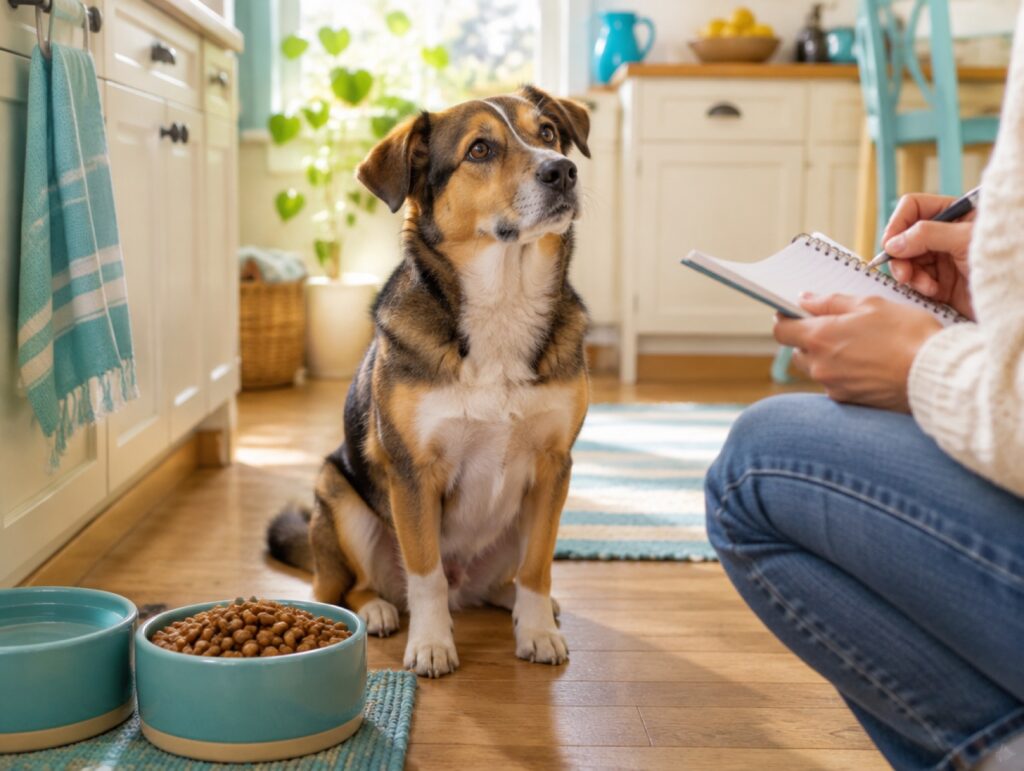
In the morning your dog skips breakfast, then throws up grass, in the afternoon its belly rumbles and by evening the poop is mushy. Digestive problems in dogs show up in the stool, vomiting, gas and appetite. They are mostly mild and pass within a few days. Sometimes, though, they are part of a serious illness, so it is good to know what to watch for and when not to wait.
- Digestive problems in dogs are common. A lively adult dog with an appetite and no blood in the stool can be watched at home for a day or two.
- Acute problems last days. Those that last three weeks or longer are usually considered chronic (Merck Veterinary Manual).
- The most common causes are dietary indiscretion, a sudden change of food, stress, parasites, infections and medicines including antibiotics. The cause cannot be determined from a distance.
- Blood or black stool, repeated vomiting, a hard swollen belly and lethargy are reasons to go to the vet straight away.
What are digestive problems in dogs and how do they show?
“Digestive problems” is an umbrella term for everything that disrupts the journey of food from the mouth to the rectum. They are also called an upset stomach or tummy trouble. They show up as diarrhoea, soft stool, vomiting, gas, constipation, rumbling, loss of appetite or weight loss.
A single symptom does not say where the problem is. Vomiting can be caused by something unsuitable from the rubbish, but also by a blocked bowel. That is why vets judge mainly how long the problems last, how the dog is doing and what other signs there are.
What might each symptom mean?
The table is a rough guide and does not replace an examination. You will find details in the linked articles.
| Symptom | What it may mean | When to see a vet |
|---|---|---|
| Diarrhoea | Dietary indiscretion, a change of food, stress, parasites, infections, medicines | When it lasts longer than 2 days or there is blood in it, in a puppy or senior straight away. More in the article Diarrhoea in dogs |
| Soft stool | A mild form of diarrhoea, often a reaction to food or stress | When it lasts longer than 2 days or keeps coming back. More in the article Soft stool in dogs |
| Vomiting | Something unsuitable eaten, intolerance, infection, a foreign body | Repeated vomiting, blood, lethargy, pain or a suspected foreign body or poison: straight away |
| Gas | Composition of the food, gulping, fibre, a sensitive gut | When it comes with pain, vomiting or weight loss, or lasts for weeks |
| Constipation | Indigestible things (bones), too little water, pain, large bowel disease | When the dog has not passed stool for 48 to 72 hours since the last one, or strains in vain |
| Belching and rumbling belly | Gulping, air, hunger, gas | When pain, vomiting or a swollen belly joins in, or it lasts a long time |
| Loss of appetite | Nausea, pain, stress, illness affecting the whole body | When the dog does not eat for longer than a day or two or is also lethargic |
| Eating grass | Often a normal habit, sometimes goes with nausea | When it is regular and comes with vomiting, diarrhoea or weight loss. More in the article Why dogs eat grass |
| Weight loss | Chronic bowel disease, inadequate digestion, other illnesses | Always book an examination, especially with a good appetite |
What is the difference between acute and chronic problems?
Acute digestive problems start suddenly and last days. Typically it is diarrhoea after eating something from the rubbish or after a change of food. A 2020 review of acute diarrhoea in dogs (Candellone et al.) gives a division in which acute diarrhoea lasts 3 to 7 days and chronic diarrhoea longer than 14 to 21 days. The Merck Veterinary Manual counts as chronic those problems that last three weeks or longer. The exact limit therefore differs a little between sources.
Chronic problems include so-called chronic enteropathy. It is a long-term bowel disease in which inflammation is assumed and which is identified by ruling out other causes. Exocrine pancreatic insufficiency (EPI) is a chapter of its own. According to VCA Animal Hospitals it shows as weight loss despite a good appetite and bulky, greasy stool. Only a vet can confirm it, mainly with a blood test.
So do not deal with chronic digestive problems in your dog by trying things at home, even if the dog seems content.
What are the most common causes of digestive problems?
There are more causes than it seems, and they often combine. The most common are these:
- A dietary slip. Rubbish, table scraps, fatty food or something off the ground. The 2020 review (Candellone et al.) also lists dietary indiscretion among the common causes of acute diarrhoea. What a dog must not eat is summarised in the article Foods dogs cannot eat.
- A sudden change of food. The gut needs time for a new diet. You will find how to do it gradually in the article Switching your dog to a new food.
- Stress. Moving house, a trip or boarding can show up in the stool. More in the article Stress diarrhoea in dogs.
- Parasites. Intestinal worms or single-celled organisms, such as giardia or coccidia. They are looked for by analysing a stool sample at the vet, sometimes repeatedly.
- Infections. Bacterial or viral. In insufficiently vaccinated puppies they tend to be more serious.
- Antibiotics and other medicines. Treatment can temporarily upset the gut bacteria. More in the article Dog after antibiotics.
- Food intolerance. The dog does not tolerate an ingredient in its food or treat. Look for it together with your vet.
- Illnesses that only accompany the gut. For example pancreatitis, liver and kidney diseases. That is why chronic problems are a reason for an examination.
- Blood in the stool or in the vomit, black tarry stool.
- Repeated vomiting, especially with lethargy or refusal of water.
- A hard, swollen belly and unproductive retching when nothing comes up. It may be gastric torsion, which requires immediate treatment (Merck Veterinary Manual).
- Severe pain: the dog hunches or whimpers.
- A suspicion that the dog has eaten poison, a bone or a foreign body (a sock, a stone, a toy).
- Lethargy, weakness, fever, refusal of water or obvious dehydration.
- Any digestive trouble in a puppy, a senior or a dog with a chronic illness.
What can you do at home and what not?
With a lively adult dog and mild problems you can help with rest and attention. None of this replaces a vet, though, if the problems do not improve.
- Provide fresh water. Drinking is the basis during diarrhoea and vomiting, so that the dog does not lose more fluid than it takes in. If your dog refuses to drink, go to the vet.
- Do not try fasting or human medicines. We do not recommend fasting on your own, especially with puppies. Human medicines can harm a dog. Your vet will advise what and how to feed.
- Change food gradually. Introduce new things over several days and in small amounts, not overnight.
- Keep a routine. A steady feeding time and a calm environment suit the gut.
- Mind the fibre. Fibre can stabilise stool, but the suitable type and amount differ by cause. According to VCA Animal Hospitals, constipation may need low or high fibre, depending on the specific cause. More in the article Fibre for dogs.
- Keep a stool diary. Write down the date, shape, colour, anything unusual and what your dog ate. It helps you and your vet. How to read poop is explained in the article Dog poop: colour, shape and consistency.
What will the vet do?
They begin with a conversation: what the dog ate, how long the problems have lasted, whether it was on any medicines. Then they examine the dog. For vomiting, according to VCA Animal Hospitals, a few tests for parasites and infections are enough in mild cases. In more serious cases blood and urine tests, X-rays, ultrasound and sometimes endoscopy with sampling follow, and with a suspected foreign body also abdominal surgery. When chronic enteropathy is suspected, according to the Merck Veterinary Manual diagnosis relies on ruling out other causes and on the response to treatment. A hypoallergenic diet is often tried (with a hydrolysed protein or a protein the dog has not eaten before). The dog gets it exclusively, with no treats, for at least 2 weeks.
The European guidelines for acute diarrhoea in dogs (ENOVAT, Jessen et al., 2024) recommend not giving antibiotics to dogs with mild or moderate acute diarrhoea. They take no position for or against probiotics. The decision on treatment always rests with the vet.
What role does the gut microbiome play?
An enormous number of bacteria and other microorganisms live in the gut and take part in digestion. How the microbiome works is covered in the article The dog gut microbiome: an invisible organ.
In dogs with chronic bowel problems a changed composition of bacteria is often found, that is, dysbiosis. The Merck Veterinary Manual states that a disrupted microbiome may be associated with chronic enteropathy. But dysbiosis is not a disease of its own and does not prove that it is the cause of the problems. It may also be their consequence. For specialists there is a laboratory calculation called the Dysbiosis Index, which expresses the degree of dysbiosis from a single stool sample as one number (AlShawaqfeh et al., 2017). Even such an analysis does not diagnose a disease by itself, it only completes the picture. You will find what exactly it reveals in the article Dog microbiome test: what a stool analysis can show.
Be realistic about probiotics: the Merck Veterinary Manual states that there is little evidence of benefit in chronic enteropathy, and the 2024 ENOVAT meta-analysis (Scahill et al.) found no clinically significant shortening of acute diarrhoea with products containing probiotics, prebiotics or synbiotics (certainty of evidence very low to moderate). How to choose is explained in the article Probiotics for dogs. The influence of the gut on the skin is covered in the article The gut and skin in dogs.
How can you prevent digestive problems?
There is no sure way to avoid problems, but simple things help the gut:
- a good-quality, complete food suited to the dog’s age and size, with no frequent changes,
- slow introduction of new things and treats,
- watching what your dog eats on walks,
- calm, a steady routine and always fresh water.
If digestive problems keep spoiling your dog’s day, do not wait for them to sort themselves out. Write down when they come and take the diary to your vet.
Frequently asked questions
What should I do when my dog has digestive problems?
Provide fresh water, watch appetite, energy and stool, and write down what your dog ate. Do not give human medicines and do not try fasting. If the problems last longer than two days, get worse or there is blood in the stool, call your vet. With a puppy or a senior do not wait.
How long can digestive problems in a dog last before I go to the vet?
With a lively adult dog and no blood in the stool you can watch for one to two days. If the problems last longer than two days or get worse, call your vet. With blood, repeated vomiting, pain or lethargy, and with puppies and seniors, go straight away.
Why does my dog throw up grass and is it normal?
Eating grass is common in dogs and often means nothing serious. But if your dog throws up grass regularly or often, also has diarrhoea or loss of appetite, or is losing weight, have it examined. There may be several causes and neither you nor anyone else can tell them apart without an examination.
Can stress cause digestive problems?
Yes, stress can show up as soft stool or diarrhoea, for example during a move or a trip. Calm, a steady routine and gradual changes help. If the problems last longer than two days or blood appears, stress may no longer be the only cause and your dog needs a vet.
How do I recognise gastric torsion?
Typical signs are a hard, swollen belly, unproductive retching when nothing comes up, drooling and restlessness, later weakness. According to the Merck Veterinary Manual it is a life-threatening condition that requires immediate treatment and surgery. Do not wait, go straight to the nearest vet, even at night.
Does it make sense to give my dog probiotics for digestive problems?
The evidence is weak. The 2024 meta-analysis (Scahill et al.) found no clinically significant shortening of acute diarrhoea with products containing probiotics, and the Merck Veterinary Manual states there is little evidence of benefit of probiotics in chronic enteropathy. Probiotics are therefore not a treatment. Ask your vet whether it is suitable to add them.
What is chronic enteropathy?
It is a long-term bowel disease in which diarrhoea, vomiting or loss of appetite last three weeks or longer. It is identified by ruling out other causes. According to the Merck Veterinary Manual, more than half of dogs improve markedly after switching to a hypoallergenic diet. In a Swedish study of dogs from two veterinary hospitals it was only about 11% (Holmberg et al., 2022).
How does a sensitive tummy differ from an illness?
A sensitive tummy is not a medical diagnosis, just a label for a dog that does not do well with changes or with certain ingredients. Repeated mild problems after a certain food are a hint. Only a vet can tell it apart from an illness, so always have recurring problems examined and do not try anything on your own.
Can constipation be linked to digestion?
Yes. According to VCA Animal Hospitals a common cause of constipation is an indigestible thing the dog has eaten, such as a bone or plant material. Call your vet if your dog has not passed stool for 48 to 72 hours since the last one. Constipation can mimic diarrhoea, because a little liquid stool flows around the hard mass.
Sources
- Merck Veterinary Manual. Chronic Enteropathies in Small Animals. merckvetmanual.com
- Merck Veterinary Manual. Gastric Dilation and Volvulus in Small Animals. merckvetmanual.com
- VCA Animal Hospitals. Vomiting in Dogs. vcahospitals.com/know-your-pet/vomiting-in-dogs
- VCA Animal Hospitals. Constipation in Dogs. vcahospitals.com/know-your-pet/constipation-in-dogs
- VCA Animal Hospitals. Exocrine Pancreatic Insufficiency in Dogs. vcahospitals.com/know-your-pet/exocrine-pancreatic-insufficiency-in-dogs
- Candellone A et al. (2020). Acute Diarrhea in Dogs: Current Management and Potential Role of Dietary Polyphenols Supplementation. Antioxidants 9(8):725. doi.org/10.3390/antiox9080725
- Jessen LR et al. (2024). European Network for Optimization of Veterinary Antimicrobial Therapy (ENOVAT) guidelines for antimicrobial use in canine acute diarrhoea. The Veterinary Journal 307:106208. doi.org/10.1016/j.tvjl.2024.106208
- Scahill K et al. (2024). Efficacy of antimicrobial and nutraceutical treatment for canine acute diarrhoea: a systematic review and meta-analysis for European Network for Optimization of Antimicrobial Therapy (ENOVAT) guidelines. The Veterinary Journal 303:106054. doi.org/10.1016/j.tvjl.2023.106054
- AlShawaqfeh MK et al. (2017). A dysbiosis index to assess microbial changes in fecal samples of dogs with chronic inflammatory enteropathy. FEMS Microbiology Ecology 93(11):fix136. doi.org/10.1093/femsec/fix136
- Holmberg J et al. (2022). Chronic Enteropathy in Dogs: Epidemiologic Aspects and Clinical Characteristics of Dogs Presenting at Two Swedish Animal Hospitals. Animals 12(12):1507. doi.org/10.3390/ani12121507
This article is educational and does not replace a veterinary examination. If you are not sure, ask your vet.
This article was proofread with the help of AI. This is a translation from Czech, so it may contain inaccuracies.