Blog · Digestion
Diarrhoea in dogs: what to do and when to see a vet
Acute diarrhoea in a lively adult dog often clears in days; water and rest are key. With blood, repeated vomiting, lethargy or in a puppy, call your vet now.
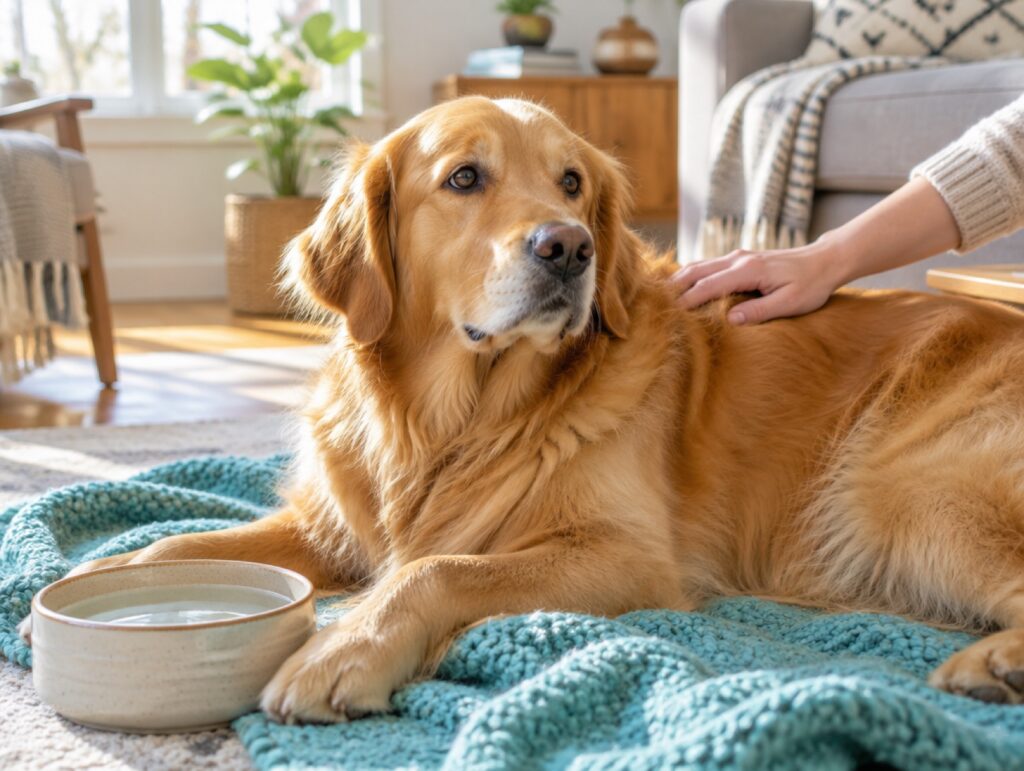
On your morning walk the poop is loose or completely runny, and you immediately wonder whether it is time for the vet. According to the European ENOVAT guidelines (Jessen et al., 2024), acute diarrhoea is one of the common reasons dogs come to the clinic. Most of the time it is nothing dramatic. What matters is being able to tell when rest and water are enough and when you must not wait.
- Diarrhoea in a dog is loose or unformed stool in larger amounts or more often than usual. It is not a disease in itself, but a symptom.
- Acute diarrhoea in an otherwise lively adult dog often clears up within a few days. What matters is that the dog always has fresh water.
- A dog with blood in the stool, repeated vomiting, lethargy, refusal of water or a painful belly needs a vet straight away, and so does every puppy and senior.
- Antibiotics and human medicines should not be given on your own for uncomplicated acute diarrhoea. Your vet decides.
What is diarrhoea in a dog and how do you recognise it?
According to VCA Animal Hospitals, diarrhoea is stool without a firm shape that comes in larger amounts or more often than usual. It can be mushy, loose or watery, sometimes with mucus or traces of blood. Colour and shape are covered in the article Dog poop: colour, shape and consistency, and the milder form in Soft stool in dogs.
The main distinction is duration. A review of acute diarrhoea in dogs (Candellone et al., 2020) describes acute diarrhoea as lasting 3 to 7 days and chronic diarrhoea as loose stool lasting longer than 14 to 21 days. The Merck Veterinary Manual calls chronic bowel problems those that last 3 weeks or longer.
| Type | How long it lasts | What it usually means |
|---|---|---|
| Acute diarrhoea | Started suddenly, lasts roughly 3 to 7 days (Candellone et al., 2020) | Often a dietary slip, stress or infection, in a lively dog it often clears up on its own |
| Prolonged diarrhoea | Roughly 8 to 13 days (Candellone et al., 2020) | Time for an examination at the vet |
| Chronic diarrhoea | Longer than 2 to 3 weeks or keeps coming back (Candellone et al., 2020; Merck Veterinary Manual) | Always an examination, even if the dog seems content |
Small bowel and large bowel diarrhoea
The Merck Veterinary Manual describes large bowel diarrhoea as often frequent, in small amounts and with mucus or blood, while weight loss appears more often with small bowel problems. The table is only a guide, it does not determine the cause.
| Sign | Large bowel | Small bowel |
|---|---|---|
| Urgency and straining | Typical | Less typical |
| Amount of stool | Smaller portions | Larger portions |
| Mucus and fresh blood | More common | Less typical |
| Weight loss | Less common | More common |
What are the most common causes of diarrhoea in dogs?
There are many causes and they cannot be told apart from a distance. The 2020 review (Candellone et al.) lists infections, dietary indiscretion and stress among the causes of acute diarrhoea. Often no cause is found at all and the problem passes on its own.
- A dietary slip. Rubbish, table scraps, something off the ground. You can find what harms your dog in the article Foods dogs cannot eat.
- A sudden change of food. The gut needs time. How to do it gradually is described in the article Switching your dog to a new food.
- Stress. Moving house, a trip, boarding or fireworks. More in the article Stress diarrhoea in dogs.
- Parasites. For example coccidia and intestinal worms (according to VCA) or giardia (according to the Companion Animal Parasite Council).
- Infections. Bacterial or viral, in puppies they tend to be more serious.
- Medicines, especially antibiotics. Treatment can temporarily upset the gut bacteria. More in the article Dog after antibiotics.
- Food intolerance. The dog does not tolerate an ingredient in its food or treat (according to VCA it is among the possible causes).
- Chronic enteropathy. A long-term bowel disease with recurrent or persistent diarrhoea. Only an examination can uncover it, not trying things at home.
What to do at home when an otherwise lively dog has diarrhoea?
This applies only to an adult dog that is lively, drinks, does not vomit and has no blood in the stool. According to the review (Candellone et al., 2020), water is the most important thing a dog needs during diarrhoea, because it loses fluids and is at risk of dehydration.
- Offer fresh water. Keep it within your dog’s reach at all times.
- Watch your dog. Notice energy, appetite, drinking and vomiting.
- Keep a stool diary. Write down the date, appearance, anything unusual in the stool and what your dog ate.
- Leave feeding to your vet. VCA states that for a healthy adult dog the vet may recommend a short break from food or small portions of a special digestive diet. Leave the length and type of diet to your vet, and do not try fasting or a home-made diet on your own, and never with a puppy. Once the stool has settled, VCA says to return to the normal food gradually over about 7 to 10 days.
- Do not give human medicines or leftover medicines. What is ordinary for a person can harm a dog.
- Prepare a sample. If you go to the vet, take fresh poop in a clean bag or container.
According to VCA, talk to your vet if frequent loose or semi-liquid stool lasts longer than two days.
Why is diarrhoea riskier in a puppy?
Diarrhoea in a puppy has the same causes as in an adult dog, but a puppy has smaller fluid reserves. The American Kennel Club warns that even mild diarrhoea dehydrates a puppy, and recommends calling the vet if diarrhoea lasts longer than one day, and straight away if there is blood, fever, vomiting or pain. So do not watch a puppy for two days the way you would an adult dog.
Another reason for caution is parvovirus, which according to the AKC can end in death and requires immediate veterinary care. If a puppy that has not finished its vaccinations has diarrhoea, always get in touch with your vet.
What will the vet do?
The vet will ask when the problems began and what your dog ate, examine it and usually ask for a fresh stool sample. According to VCA, blood tests, a stool test for parasites, tests for infections, bacterial culture, X-rays, ultrasound or endoscopy may follow. Your dog will not need most of these. According to VCA, further tests are done mainly when the initial treatment does not work or the condition gets worse.
A stool sample may be collected repeatedly over several days, because according to the Companion Animal Parasite Council giardia cysts are shed intermittently.
Antibiotics for diarrhoea: why vets do not prescribe them automatically
A vet often does not prescribe antibiotics, and that is not an oversight. A meta-analysis from the European ENOVAT network (Scahill et al., 2024) found that antibiotics had no clinically significant effect in dogs with mild or moderate acute diarrhoea, and the certainty of the evidence was high. The ENOVAT guidelines (Jessen et al., 2024) therefore explicitly advise against antibiotics in mild and moderate acute diarrhoea, with or without blood in the stool. They suggest antibiotics for a severe course, when signs of systemic illness persist even after fluids have been replaced. Your vet decides, after an examination, which group your dog belongs to.
What role do the microbiome and probiotics play?
During diarrhoea the composition of the gut bacteria changes. In a study (Suchodolski et al., 2012), dogs with acute diarrhoea, especially bloody diarrhoea, had the most markedly changed microbiome. They had fewer of the groups of bacteria that the authors consider important producers of short-chain fatty acids. But this is an association in a sample of 25 dogs with acute diarrhoea and 32 healthy dogs, not proof of a cause. What the microbiome is, is summarised in the article The dog gut microbiome: an invisible organ.
The evidence for probiotics in acute diarrhoea is mixed. A randomised study with 148 enrolled dogs (Nixon et al., 2019) found that a paste with the strain Enterococcus faecium 4b1707, clay, pectin and a prebiotic shortened diarrhoea from a median of 47 to 32 hours compared with placebo (in 109 dogs evaluated per protocol). The authors themselves call the difference of 15 hours clinically questionable, and the study was funded by the manufacturer of the paste. A smaller study of 60 dogs (Shmalberg et al., 2019) showed no statistically significant difference: with the probiotic combination stool normalised in an average of 3.5 days, with placebo in 4.8 days. According to the authors, a larger sample would be needed to show an effect. The ENOVAT meta-analysis (Scahill et al., 2024) concludes that nutraceuticals (prebiotics, probiotics, synbiotics) did not show a clinically significant shortening of diarrhoea, with very low to moderate certainty of evidence, and reported no adverse effects. The ENOVAT guidelines (Jessen et al., 2024) therefore take no position for or against probiotics in acute diarrhoea. Probiotics are not a substitute for a vet. According to VCA, the quality and effectiveness of products are not always known, so talk to your vet before giving one. How to find your way among them is in the article Probiotics for dogs, and the role of fibre in the article Fibre for dogs.
How can you prevent diarrhoea in a dog?
You cannot avoid it completely, but you can lower the risk. Make sure your dog does not eat rubbish or things off the ground, change food gradually and keep a steady routine. Discuss worming and vaccination with your vet, especially for puppies.
Frequently asked questions
How long can a dog have diarrhoea before I go to the vet?
With an adult, lively dog that drinks and does not vomit, you can watch for one to two days. According to VCA, call your vet if frequent loose stool lasts longer than two days. With puppies, seniors and dogs with a chronic illness, call straight away. The same goes for blood, vomiting or lethargy.
What should I give my dog for diarrhoea?
The most important thing is fresh water. Feeding during diarrhoea is for your vet to decide: in a healthy adult dog they may recommend a short break or small portions of a special diet. Do not try human medicines or a new food. Then return to the normal food gradually. Do not let a puppy go hungry and always ask about food first.
Is loose stool in a dog always diarrhoea?
Not always. A one-off soft stool can be a reaction to new treats. We talk about diarrhoea when the stool has no firm shape and comes more often or in larger amounts than usual (VCA). What matters is whether it repeats and how your dog is doing. With blood or vomiting, call your vet.
When is diarrhoea in a dog chronic?
Diarrhoea is usually considered chronic when it lasts or recurs for 3 weeks or longer (Merck Veterinary Manual). The causes range from food intolerance to bowel inflammation, which is why an examination is important. Have such a dog examined even if it seems content and eats well.
Should I give my dog probiotics for diarrhoea?
The evidence is mixed: one study showed shorter diarrhoea after a paste with a specific strain and other ingredients, another smaller one showed no difference, and the ENOVAT meta-analysis did not confirm a clinically significant effect. The ENOVAT guidelines therefore take no position for or against. Leave the product and the length of use to your vet, especially with a puppy.
Why did my vet not prescribe antibiotics?
In uncomplicated acute diarrhoea, antibiotics according to the ENOVAT meta-analysis (Scahill et al., 2024) do not help in a clinically significant way and also affect beneficial gut bacteria. The ENOVAT guidelines suggest them mainly for a severe course, when signs of systemic illness do not ease even after fluids have been replaced. If your dog is lively, that is good news, not neglect.
How can I tell if my dog is dehydrated?
Dehydration is the main risk during diarrhoea, which is why your dog should always have water. Signs such as lethargy, refusing water, vomiting or weakness are a reason to call your vet straight away. Puppies dehydrate especially quickly: according to the American Kennel Club even mild diarrhoea dehydrates a puppy, so do not hesitate with them and call your vet.
Sources
- VCA Animal Hospitals. Diarrhea in Dogs. vcahospitals.com/know-your-pet/diarrhea-in-dogs
- Candellone A et al. (2020). Acute Diarrhea in Dogs: Current Management and Potential Role of Dietary Polyphenols Supplementation. Antioxidants. doi.org/10.3390/antiox9080725
- Scahill K et al. (2024). Efficacy of antimicrobial and nutraceutical treatment for canine acute diarrhoea: A systematic review and meta-analysis for European Network for Optimization of Antimicrobial Therapy (ENOVAT) guidelines. The Veterinary Journal. doi.org/10.1016/j.tvjl.2023.106054
- Jessen LR et al. (2024). European Network for Optimization of Veterinary Antimicrobial Therapy (ENOVAT) guidelines for antimicrobial use in canine acute diarrhoea. The Veterinary Journal. doi.org/10.1016/j.tvjl.2024.106208
- Nixon SL et al. (2019). Efficacy of an orally administered anti-diarrheal probiotic paste (Pro-Kolin Advanced) in dogs with acute diarrhea: A randomized, placebo-controlled, double-blinded clinical study. Journal of Veterinary Internal Medicine. doi.org/10.1111/jvim.15481
- Shmalberg J et al. (2019). A Randomized Double Blinded Placebo-Controlled Clinical Trial of a Probiotic or Metronidazole for Acute Canine Diarrhea. Frontiers in Veterinary Science. doi.org/10.3389/fvets.2019.00163
- Suchodolski JS et al. (2012). The fecal microbiome in dogs with acute diarrhea and idiopathic inflammatory bowel disease. PLoS ONE. doi.org/10.1371/journal.pone.0051907
- Merck Veterinary Manual. Chronic Enteropathies in Small Animals. merckvetmanual.com
- Merck Veterinary Manual. Colitis in Small Animals. merckvetmanual.com
- American Kennel Club. Puppy Diarrhea: Causes, Treatment, and Symptoms. akc.org/expert-advice/health/puppy-diarrhea
- Companion Animal Parasite Council. Giardia. capcvet.org/guidelines/giardia
This article is educational and does not replace a veterinary examination. If you are not sure, ask your vet.
This article was proofread with the help of AI. This is a translation from Czech, so it may contain inaccuracies.