Blog · Digestion
Dog poop: what colour, shape and consistency reveal
Healthy dog poop is brown, firm but not hard (score 2 out of 7). Learn what colour, mucus or blood can mean and when to call your vet straight away.
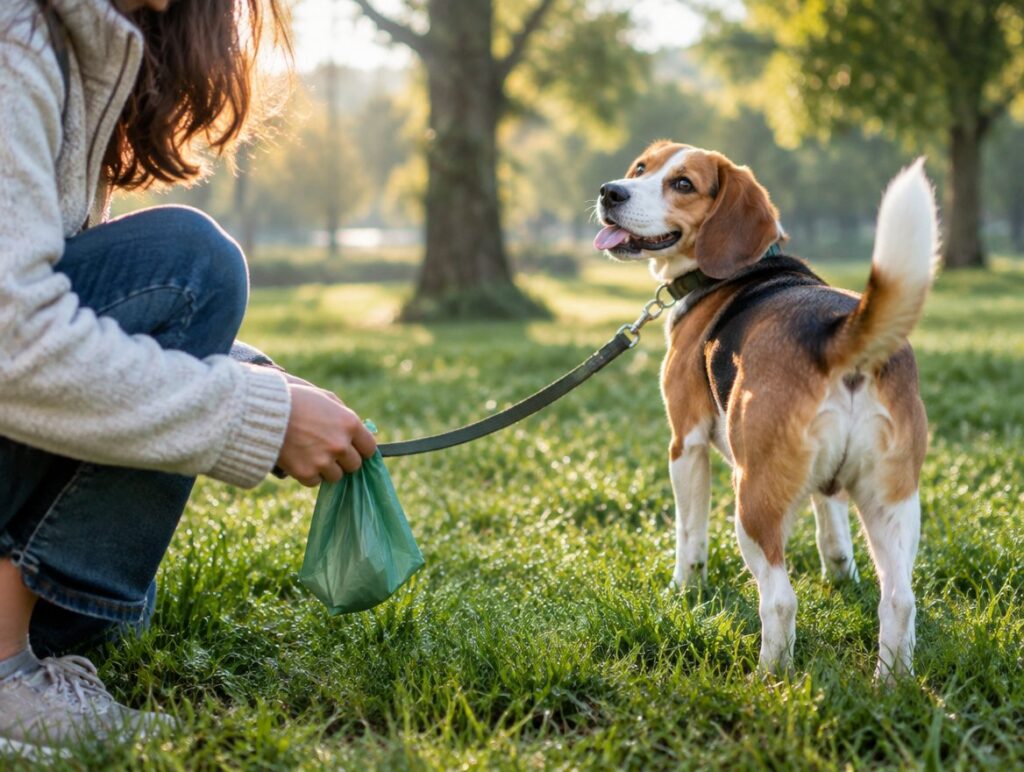
Bag in hand, your dog already turning towards the next scent trail, and you pause for a moment over what has just been left on the grass. There is nothing embarrassing about it: it is a good habit. Your dog’s stool is one of the few pieces of health information that arrives free every day, and you just have to know how to read it.
- A healthy poop is chocolate brown, firm but not hard, and easy to pick up. That corresponds to a score of 2 on the Purina Fecal Scoring Chart.
- Dog stool is assessed by three things: colour, consistency (from hard pellets to water) and anything extra in it, such as mucus, blood or foreign objects.
- Black tarry stool, blood, white grains like rice or pale greasy stool are a matter for a vet, not for home experiments.
What should a healthy dog poop look like?
A healthy dog stool is chocolate brown, formed and segmented. That is how vets at VCA Animal Hospitals describe it too.
How many times a day should a dog poop? The American Kennel Club (AKC) says that an adult dog normally goes once or twice a day, and up to three times with a higher fibre intake. More important than the number is what is normal for your dog.
How do you read the consistency scale (faecal score 1 to 7)?
The faecal score is an assessment of the consistency of dog stool on a scale. There are several scales, and the best known is the seven-point Purina Fecal Scoring Chart. According to it, the ideal score is 2: stool that is firm but not hard, pliable and visibly segmented. The numbers are not school grades, just a description of moisture from 1 (driest) to 7 (most watery).
| Score | What the stool looks like | How to read it |
|---|---|---|
| 1 | Very hard and dry, often separate pellets, your dog strains to go, leaves no mark on the ground | Too little water in the stool |
| 2 | Firm but not hard, pliable, visibly segmented | Ideal |
| 3 | Log-shaped, almost without segments, moist surface, leaves a mark on the ground but holds its shape when picked up | Moister than the ideal, Purina considers only score 2 ideal |
| 4 | Very moist, soft, log-shaped but falling apart when picked up | Soft stool, watch how it develops |
| 5 | Very moist, still has some shape, but more piles than logs | Loose stool |
| 6 | Has texture but no shape, spread-out splotches, leaves a trace after pick-up | Diarrhoea |
| 7 | Watery, without texture, flat puddles | Severe diarrhoea |
Judging by eye is subjective, though. In a study by Cavett et al. (2021), three vets and 126 members of the public assessed the fresh stools of 126 dogs, using two scales, Purina and Waltham.
Agreement between vets and laypeople on the Purina scale was only weak (kappa 0.38). The vets agreed with each other the most. So your number may differ from your vet’s by one step. That is why a photo to show your vet is worth taking.
What does the colour of a dog’s poop mean?
The colour of dog stool hints at where and how fast the food passed through the gut. Shades other than brown are sometimes harmless and sometimes warn of a problem that only a vet can handle. The table is not a diagnosis, just a guide to when to take notice.
| Colour | What it may mean | When to see a vet |
|---|---|---|
| Brown (from light to chocolate) | Normal, depends on the food | Without other symptoms you do not need to do anything |
| Black, tarry, sticky | Often bleeding in the stomach or small intestine, the blood is digested on the way (VCA, MedVet) | Call your vet straight away, even if your dog is otherwise lively |
| Red (fresh blood, streaks) | Blood from the large intestine or from the area around the anus (VCA) | Call your vet straight away and agree how quickly to come in. If there is a larger amount, it repeats, or your dog is vomiting or lethargic, go straight away |
| Yellow | Food passing through the gut too fast, infection, liver or gallbladder problems (VCA) | If it lasts longer than 24 to 48 hours or your dog is lethargic |
| Green | Sometimes after eating grass or other plants, but also fast passage through the gut (VCA, MedVet) | If it is also loose, persists or vomiting starts too |
| Pale, greasy, bulky and fatty | Poor digestion of fats, for example from a lack of pancreatic digestive enzymes (Merck Veterinary Manual) | Always, even if your dog is otherwise lively |
| White grains like rice | Tapeworm segments (VCA) | Call: your dog needs an examination and worming treatment from your vet |
- Black tarry stool or a larger amount of fresh blood.
- Diarrhoea that lasts longer than 24 to 48 hours.
- Diarrhoea or blood in the stool of a puppy, a senior dog or a dog with a chronic illness.
- The stool changes and your dog is lethargic or weak, has pale gums, is vomiting, refusing food or has a painful belly.
- Your dog has swallowed something it should not have (suspected poison, chocolate, grapes, medication or a foreign object). Call immediately.
What if there is mucus or blood in the stool?
Mucus in a dog’s stool is usually a sign of problems with the large intestine. The Merck Veterinary Manual states that the most common sign of colitis is large-bowel diarrhoea, typically with mucus, fresh blood, straining to pass stool and sometimes pain on defecation.
Blood in a dog’s stool comes in two forms. According to VCA, bright red fresh blood comes from the large intestine or from the area around the anus. Black stool, according to VCA, often means bleeding in the stomach or small intestine. The causes vary and you cannot tell them apart from a distance. So blood means calling your vet straight away, and with black stool that always applies (more in the article Blood in dog poop: see a vet now or within 24 hours?).
What if your dog has swallowed a foreign object?
A foreign object in a dog’s intestine can cause a blockage that, without intervention, is life-threatening.
VCA lists vomiting, diarrhoea, a painful belly, lethargy and straining to pass a small amount of stool as common signs. If you know your dog has swallowed something like that, or you find a piece of fabric, string or plastic in the stool, call your vet. Do not induce vomiting on your own and do not pull on string hanging from the rectum.
Pale, smeary, greasy stool should always be examined. You can find what may cause it and how to proceed in the article Greasy stool in dogs: causes, EPI and when to see a vet. If your dog is also losing weight despite eating while the stool keeps changing, read the article Dog losing weight and not eating: when to see a vet and arrange an examination.
What affects the colour and volume of stool?
The colour and shape of a dog’s stool are also influenced by what your dog has eaten. According to VCA, a change of food or intolerance to some food is among the causes of looser stool. After a diet that your vet recommends for diarrhoea, return to the usual food gradually, over seven to ten days (VCA). What to do with diarrhoea step by step is summarised in the article Diarrhoea in dogs: what to do and when to see a vet.
Bones are risky for dogs: the Merck Veterinary Manual lists poorly digestible material, such as bones or hair, as one cause of constipation, because it mixes with the stool and makes it harder to pass through the large intestine. Discuss with your vet what belongs in your dog’s bowl.
How does stool change in a puppy and an older dog?
Loose stool in a puppy is a reason to contact your vet sooner than you would with an adult dog. Diarrhoea quickly leads to dehydration (VCA), and in puppies it may be parvovirus. According to the Merck Veterinary Manual, the most susceptible are young dogs aged 6 weeks to 6 months and dogs that are unvaccinated or incompletely vaccinated. The diarrhoea is often bloody, but about a quarter of affected dogs have it without blood.
In older dogs, a vet will consider other possibilities. Among conditions linked to constipation, VCA lists painful arthritis, for example, which makes defecating uncomfortable for a dog. So do not ignore a change in an older dog’s stool: have it examined.
What if your dog has hard stool or strains?
Constipation is infrequent or difficult defecation of stool that tends to be dry and hard (Merck Veterinary Manual). It corresponds to score 1. Among the causes, VCA lists bones, hair, dehydration, little exercise, a sudden change of food and some medications.
VCA advises calling your vet after 48 to 72 hours without stool, and the AKC after 24 to 36 hours. Contact your vet sooner if your dog strains and nothing comes, cries out or vomits. Do not give your dog human laxatives or an enema: these are for a vet to administer.
How to collect a stool sample for your vet
A fresh, clean sample makes your vet’s work easier and makes the test more reliable. According to VCA, a piece about 2.5 cm long is enough, ideally without grass and gravel.
- Collect the stool right after your dog has passed it.
- Put it into a clean, dry container or bag. VCA recommends a tight seal, such as a jar.
- Take it in for testing in good time. VCA says within 6 hours without refrigeration, or within 24 hours if you keep the sample in the fridge (away from food).
Checklist: 6 steps for inspecting your dog’s poop
- Look at the colour. Brown is fine. Note down black, red, pale greasy stool or white grains and follow the table above.
- Work out the score from 1 to 7. The ideal according to Purina is 2. A score of 3 is slightly moister, so watch whether it is getting worse. Do not ignore several stools in a row scoring 5 to 7.
- Check for anything extra. Mucus, blood, grass, pieces of fabric or plastic, or grains that look like rice.
- Count how many times a day. For an adult dog, once or twice is usual (AKC). A noticeable increase in the number of stools or more than 24 to 36 hours without stool are a reason to call your vet (AKC).
- Notice how your dog is doing. A lively dog with an appetite copes with a small deviation better than a lethargic one in pain.
- Take a photo. A photo and a date save your vet from guesswork.
What to do today
If you look closely at your dog’s stool today, you will know how long any change has lasted. You can read more about what a laboratory stool test can and cannot do in the article Dog microbiome test: what a stool analysis can show.
Frequently asked questions
What does a healthy dog stool look like?
A healthy dog stool is chocolate brown, firm but not hard, pliable and visibly segmented. On the Purina Fecal Scoring Chart it corresponds to a score of 2. More important than the number is what is normal for your dog. If you are in doubt, take a photo of the poop and show it to your vet.
What does black stool in a dog mean?
Black, tarry and sticky stool is called melena. According to VCA, it often means bleeding in the stomach or small intestine, and the blood gets digested on its way through the gut. It is a serious sign even if your dog is otherwise lively. Do not try to deal with it at home: call your vet straight away.
Is mucus in a dog’s stool dangerous?
Mucus is a typical sign of inflammation of the large intestine (Merck Veterinary Manual), often together with fresh blood, straining and pain on defecation. If it keeps recurring, there is more of it or there is also blood in the stool, have your dog examined. With puppies and older dogs, contact your vet sooner.
How many times a day should a dog poop?
According to the AKC, an adult dog normally goes once or twice a day, and up to three times with a higher fibre intake. More important than the number is what is normal for your dog. If there is no stool for 24 to 36 hours or your dog strains to go, call your vet.
How long can a dog’s stool be loose before I see a vet?
VCA advises contacting your vet if frequent loose stools last longer than two days. With puppies, seniors and dogs with an illness, call sooner. Call straight away if there is blood in the stool or your dog is vomiting or lethargic. A photo of the stool and the date the problems began will help.
What are the white grains in a dog’s stool?
White grains resembling rice or cucumber seeds are most often tapeworm segments. According to VCA, a dog gets infected by swallowing a flea carrying a tapeworm larva. Your dog needs an examination and worming treatment from your vet, as well as protection against fleas. Do not try to deal with it at home: call your vet and show them a photo of the grains.
Sources
- Cavett CL, Tonero M, Marks SL, Winston JA, Gilor C, Rudinsky AJ (2021). Consistency of faecal scoring using two canine faecal scoring systems. Journal of Small Animal Practice 62(3):167–173. doi.org/10.1111/jsap.13283
- Purina. Faecal Scoring Chart. Purina Vet Centre (UK). vetcentre.purina.co.uk
- VCA Animal Hospitals. Puppy poop colors and eco-friendly scooping. vcahospitals.com
- VCA Animal Hospitals. Ingestion of foreign bodies in dogs. vcahospitals.com
- VCA Animal Hospitals. Tapeworm infection in dogs. vcahospitals.com
- Merck Veterinary Manual. Colitis in small animals. merckvetmanual.com
- Merck Veterinary Manual. Exocrine pancreatic insufficiency in dogs and cats. merckvetmanual.com
- MedVet. What your pet’s poop can tell you about their health. medvet.com
- VCA Animal Hospitals. Diarrhea in dogs. vcahospitals.com
- VCA Animal Hospitals. Constipation in dogs. vcahospitals.com
- VCA Animal Hospitals. Importance of fecal tests in dogs and cats. vcahospitals.com
- Merck Veterinary Manual. Constipation, obstipation, and megacolon in small animals. merckvetmanual.com
- Merck Veterinary Manual. Canine parvovirus infection (parvoviral enteritis in dogs). merckvetmanual.com
- American Kennel Club. How often should my dog be pooping? akc.org
This article is educational and does not replace a veterinary examination. If you are not sure, ask your vet.
This article was proofread with the help of AI. This is a translation from Czech, so it may contain inaccuracies.