Blog · Digestion
Puppy diarrhoea: when to see a vet straight away
Puppy with diarrhoea? Loose stool in puppies is a reason to call your vet, mainly if unvaccinated, or with blood, vomiting or lethargy. Puppies dehydrate fast.
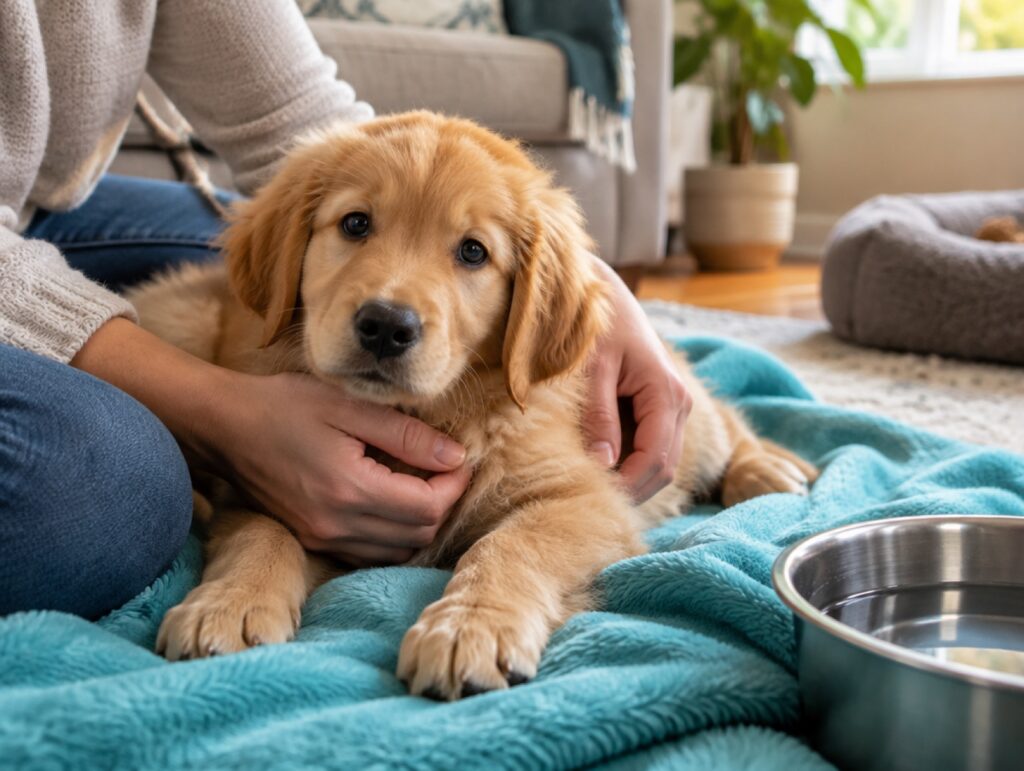
Your puppy has settled in, the first days went smoothly, and then one morning you find a poop in the pen that is easier to pour than to pick up. A puppy with diarrhoea is a different situation from an adult dog, and the same goes for loose stool in puppies in general. A puppy has small reserves of fluid and energy, so it can go downhill faster, and you should not wait two days as you would with an adult dog. Here you will find when to call your vet straight away, what often upsets a puppy’s stomach and what to do until you get to the vet.
- Diarrhoea in a puppy is loose or watery poop that comes more often than usual. For a puppy the bar for calling the vet is low, because it dehydrates faster than an adult dog.
- Call straight away if there is blood in the stool, vomiting, lethargy, refusal of water, pale gums, and for any puppy that has not finished its vaccinations.
- Common causes are stress from the new home, a change of food, unsuitable food and parasites. The same sign also comes with parvovirus, which you cannot tell from ordinary diarrhoea at home.
- Until the vet visit, give your puppy fresh water, do not give human medicines and do not let it go hungry. Your vet decides about feeding.
- A puppy’s gut microbiome changes fastest in the first six weeks of life. How this relates to diarrhoea is not yet certain.
When should you take your puppy to the vet straight away?
Call your vet straight away about a puppy with diarrhoea if it has not finished its vaccinations, has blood in the stool, vomits, is lethargic, refuses to drink or has pale gums. The American Kennel Club (AKC) adds fever, pain and a suspicion of poison or a foreign object, and advises talking to a vet when diarrhoea lasts longer than a few hours.
- The puppy is not vaccinated or has not finished its vaccinations, even if it is otherwise lively.
- There is blood in the stool, or the stool is black and tarry.
- The puppy vomits, especially repeatedly, or vomits and has diarrhoea at the same time.
- It is lethargic, weak, trembling, stumbling or fainting.
- It refuses to drink, has dry and sticky or pale gums, or sunken eyes.
- It is a small breed, has diarrhoea and hardly eats.
- The diarrhoea keeps coming back or lasts longer than a few hours, especially in a very young puppy.
- You suspect it has eaten something poisonous or a foreign object.
If you suspect parvovirus, call the clinic before you set off so that it can prepare for you.
| What you see | What to do |
|---|---|
| A lively, vaccinated puppy, one softer poop after arriving home or after a new bowl | Offer water, watch and make notes. If the diarrhoea repeats or lasts longer than a few hours, call your vet. |
| A puppy that has not finished its vaccinations, with any diarrhoea | Call your vet straight away, even if it is lively. |
| Blood, black stool, vomiting, lethargy, pale gums, refusing water | Vet or emergency clinic straight away, even at night. |
Adult dogs are covered in the article Diarrhoea in dogs.
Why is diarrhoea riskier in a puppy than in an adult dog?
A puppy is riskier because it has small reserves of fluid and energy and does not yet have full protection against infections. The AKC warns that even mild diarrhoea dehydrates a dog, and lists puppies among the dogs at higher risk of dehydration.
Hypoglycaemia is a low level of sugar in the blood. According to the AKC it threatens mainly puppies under 12 weeks and toy breeds, because they have little fat and immature livers and cannot store enough energy. It shows as drowsiness, weakness, trembling, poor balance or vomiting, and in severe cases as seizures or collapse. Untreated, it can be fatal, so a puppy with these signs goes to the vet immediately.
The third reason is vaccination. Puppies are vaccinated against parvovirus in a series of several doses up to about 16 weeks of age, and VCA Animal Hospitals gives for example 8, 12 and 16 weeks. According to the Merck Veterinary Manual, the most susceptible are puppies aged 6 weeks to 6 months that are unvaccinated or incompletely vaccinated. Vaccination dates are set by your vet.
What are the most common causes of diarrhoea in a puppy?
The AKC lists six main causes of diarrhoea in a puppy: a change of food or intolerance of a food, a bacterial infection, a viral infection, eating rubbish or poisons, parasites and stress. You cannot tell the cause by eye, only an examination decides.
- Stress and a new home. According to the AKC, even getting used to new people, surroundings and household routines can bring on diarrhoea. More in the article Stress diarrhoea in dogs.
- A change of food. The AKC points out that even a plain swap of food is enough, and advises introducing a new diet slowly.
- Unsuitable food. A big portion, table scraps or something off the ground. See the article Foods dogs cannot eat.
- Intestinal parasites. Roundworms, giardia and coccidia.
- Viruses. Mainly parvovirus, less often coronavirus.
- A foreign object or poison. Diarrhoea is often combined with vomiting and belly pain.
Ask the breeder what and how many times a day the puppy ate, and keep the same food at first. Make any change gradually, following the article Switching your dog to a new food.
Can parasites or worming cause diarrhoea in a puppy?
Yes, intestinal parasites are a common cause of diarrhoea in puppies. The Companion Animal Parasite Council (CAPC) states that, according to American surveys, more than 30% of dogs under six months old shed roundworm eggs. It therefore recommends worming puppies from two weeks of age and repeatedly. Your vet decides the product and the schedule.
Giardia are single-celled intestinal parasites. According to VCA, most infected dogs have no signs, but young animals show them more often, as sudden foul-smelling diarrhoea, vomiting or weight loss. A routine stool test may miss giardia, so a vet may look for them with special methods. According to VCA, coccidia are dangerous mainly for puppies with an undeveloped immune system, in which they can cause severe watery diarrhoea and dehydration.
If your puppy has diarrhoea after worming, call your vet and do not give another product on your own. Parasites spread through stool, so pick up poop straight away and wash your hands after clearing up.
My puppy has diarrhoea and vomits: is it parvovirus?
Diarrhoea with vomiting in a puppy is always urgent and may be parvovirus, a viral infection of the gut that threatens mainly unvaccinated puppies. You cannot tell it from other causes at home. According to VCA it usually starts with vomiting, then comes diarrhoea, which tends to be very foul-smelling, sometimes with mucus or blood. Loss of appetite, marked lethargy and fever follow.
According to VCA, the virus is shed in stool from just before signs appear until about 14 days after they have gone. It has been found infectious on surfaces soiled with stool even after three months, and outdoors it can, according to the Merck Veterinary Manual, persist for many months. It is also carried on shoes, clothing and objects, so a puppy does not have to come into contact with a sick dog. Keep a sick puppy away from unvaccinated dogs.
Treatment belongs to the vet. According to VCA, the basis is fluids that make up for dehydration and loss of salts, and medicines against vomiting. The chances are best when care starts before the puppy becomes severely dehydrated.
Canine coronavirus also spreads through stool. According to Ohio State University and the AKC Canine Health Foundation, it mostly causes only mild problems, and serious illness occurs mainly in puppies that also have parvovirus or another infection. You will find more about vomiting in the article Vomiting in dogs.
How can you tell that a puppy is dehydrated?
You recognise dehydration in a puppy by its gums and its general condition. The AKC lists dry and sticky gums, sunken dry eyes, thick saliva, lethargy, loss of appetite and loss of skin elasticity among the signs.
- Look at the gums. Healthy gums are pink and moist. Dry and sticky gums are a warning.
- Try the colour return. Gently press a finger on the gum and let go. The white spot should turn pink almost immediately; in a dehydrated puppy it takes noticeably longer (AKC).
- Skin fold only as a rough guide. Gently lift the skin between the shoulder blades and let go. Healthy skin springs straight back. According to the AKC, however, in wrinkly breeds the skin is less elastic even in a healthy dog.
None of these tests replaces an examination. With any sign of dehydration, call your vet; fluids under the skin or into a vein cannot be replaced at home.
What should you do with your puppy at home until you get to the vet?
Until the vet visit, leave your puppy fresh water, write down what is happening and do not give human medicines. Do not let the puppy go hungry.
- Fresh water always within reach. Even mild diarrhoea dehydrates a puppy.
- Call your vet. Have ready the age, weight, vaccinations, worming, when the diarrhoea started, how many times the puppy pooped or vomited and what it ate.
- Do not give human medicines or home and pharmacy remedies without advice. What helps a person can harm a puppy.
- Do not let the puppy go hungry and do not experiment. A short break from feeding, a special diet or a light meal is a matter for your vet, more in the article Bland diet for dog diarrhoea.
- Separate the sick puppy. Keep it away from unvaccinated dogs, pick up poop straight away and wash your hands and shoes.
- Photograph the poop and take a sample. Fresh poop in a clean bag is useful for a parasite test. What blood in the stool means is explained in the article Blood in dog poop.
What will the vet do for diarrhoea in a puppy?
The vet will examine the puppy, weigh it, take its temperature, assess hydration and, depending on the suspicion, test the stool, and for giardia, according to VCA, also with an antigen test. The next steps depend on the cause: for dehydration they give fluids, for parasites a suitable product, and a puppy with parvovirus is isolated and often hospitalised. The product, dose and length of treatment are decided by the vet.
How can you prevent diarrhoea in a puppy?
You lower the risk of diarrhoea in a puppy with gradual changes of food, vaccination and worming as advised by your vet, hygiene and a calm start in the new home. Nothing can be guaranteed.
- Vaccination and worming. Follow your vet’s plan and, until vaccinations are finished, ask where you can take your puppy.
- Hygiene. Clear up poop straight away, wash the bowls and wash your hands after clearing up stool.
- Calm and routine. A fixed routine and few new stimuli in the first days after arrival.
What do we know about a puppy’s microbiome and why does it matter?
The microbiome is the collection of bacteria and other microorganisms in the gut. In the study by Guard et al. (2017), scientists followed 30 puppies of ten breeds from one French kennel from day 2 to day 56 of life. The number of bacterial species was significantly higher on days 21 and 42 than on day 2, the composition roughly settled by day 42, and diarrhoea appeared at some point in 16 of the 30 puppies. The authors did not evaluate the link between diarrhoea and the microbiome.
The Dysbiosis Index is a laboratory indicator that compares the representation of selected gut bacteria in stool with a healthy dog. Blake et al. (2020) found that puppies up to 5 to 6 weeks old had a significantly higher index than adult dogs, but at 7 to 9 weeks it no longer differed significantly from adults. The youngest puppies also had less of the bacterium Clostridium hiranonis, which is linked to the production of secondary bile acids.
Both studies followed healthy puppies, mainly from kennels, and say nothing about how to treat diarrhoea or whether the microbiome protects a puppy against it. They show that the biggest changes happen in the first six weeks, that is, mostly still with the breeder. Why dogs’ microbiomes differ is explained in the article Why every dog has a different microbiome.
Frequently asked questions
What should I give a puppy for diarrhoea?
Until the vet visit, give your puppy mainly fresh water. Do not try human medicines or home remedies and leave feeding to your vet, but do not let the puppy go hungry. Diarrhoea in a puppy is a reason to call your vet, not to try a home fix, because a puppy dehydrates faster than an adult dog.
Is loose stool in puppies normal?
A once-softer poop after a change of food or stress from a new home can happen and does not have to mean illness straight away. If loose stool in a puppy repeats, turns watery, contains blood or the puppy is tired and does not want to eat, call your vet. A puppy dehydrates faster than an adult dog, so do not wait two days.
My puppy has diarrhoea but is lively. Should I wait?
It is best to call your vet and describe the condition, especially if the puppy has not finished its vaccinations. A lively puppy with one looser poop may be fine, but diarrhoea in a puppy can get worse within hours. Until the visit, give your puppy fresh water and no human medicines.
When is diarrhoea in a puppy dangerous?
It is dangerous in a puppy that has not finished its vaccinations, with blood, black stool, vomiting, lethargy, pale gums or refusal of water. According to the AKC you should talk to a vet even when diarrhoea lasts longer than a few hours. With small breeds and very young puppies, call sooner rather than later.
Is diarrhoea after a change of food normal in a puppy?
It can happen, because the AKC lists a change of food among the main causes of diarrhoea in puppies. It is not normal if the puppy is lethargic, vomits or there is blood in the stool. Otherwise offer water, call your vet and ask whether to postpone the change and how to make it gradually.
Can a puppy get diarrhoea after worming?
It can, but the cause is not clear: it may be parasites, the product or a completely different problem. Call your vet, tell them what the puppy was given and when, and do not give another dose on your own. Your vet will assess what is going on. With blood, vomiting or lethargy, go to the vet straight away.
My puppy has diarrhoea and vomits, is it parvovirus?
It may be, but you cannot tell at home. According to VCA, parvovirus usually starts with vomiting and then comes foul-smelling diarrhoea, sometimes with blood. If the puppy is unvaccinated or incompletely vaccinated, call the clinic straight away and say you suspect parvovirus so that it can prepare for you.
How can I tell if a puppy is dehydrated?
Typical signs are dry and sticky gums, sunken eyes, lethargy, loss of appetite and a slower return of colour after pressing on the gum. The skin fold is only a rough guide and differs by breed. With these signs, call your vet, because they give fluids under the skin or into a vein.
Sources
- American Kennel Club. Puppy Diarrhea: Causes, Treatment, and Symptoms. akc.org/expert-advice/health/puppy-diarrhea
- American Kennel Club. Dehydration in Dogs: Signs, Symptoms, Treatments. akc.org/expert-advice/health/warning-signs-dehydration-dogs
- American Kennel Club. Hypoglycemia in Dogs: Signs, Symptoms, and Treatments. akc.org/expert-advice/health/hypoglycemia-in-dogs
- The Ohio State University College of Veterinary Medicine, AKC Canine Health Foundation (2020). Canine Enteric Coronavirus (CECoV): Information for Dog Owners. vet.osu.edu
- VCA Animal Hospitals. Parvovirus in Dogs. vcahospitals.com/know-your-pet/parvovirus-in-dogs
- Gallagher A. Canine Parvovirus Infection. Merck Veterinary Manual (2025). merckvetmanual.com
- VCA Animal Hospitals. Giardia Infection in Dogs. vcahospitals.com/know-your-pet/giardia-in-dogs
- VCA Animal Hospitals. Coccidiosis in Dogs. vcahospitals.com/know-your-pet/coccidiosis-in-dogs
- Companion Animal Parasite Council. Ascarid (Roundworm) Guidelines. capcvet.org/guidelines/ascarid
- Blake AB et al. (2020). Developmental stages in microbiota, bile acids, and clostridial species in healthy puppies. Journal of Veterinary Internal Medicine. doi.org/10.1111/jvim.15928
- Guard BC et al. (2017). Characterization of the fecal microbiome during neonatal and early pediatric development in puppies. PLoS ONE. doi.org/10.1371/journal.pone.0175718
This article is educational and does not replace a veterinary examination. If you are not sure, ask your vet.
This article was proofread with the help of AI. This is a translation from Czech, so it may contain inaccuracies.