Blog · Care
Probiotics for dogs: what they are and how to choose
Probiotics for dogs: which strains are used, 4 details on the label, what studies say and when a microbiome test comes first. No promises, just verified facts.
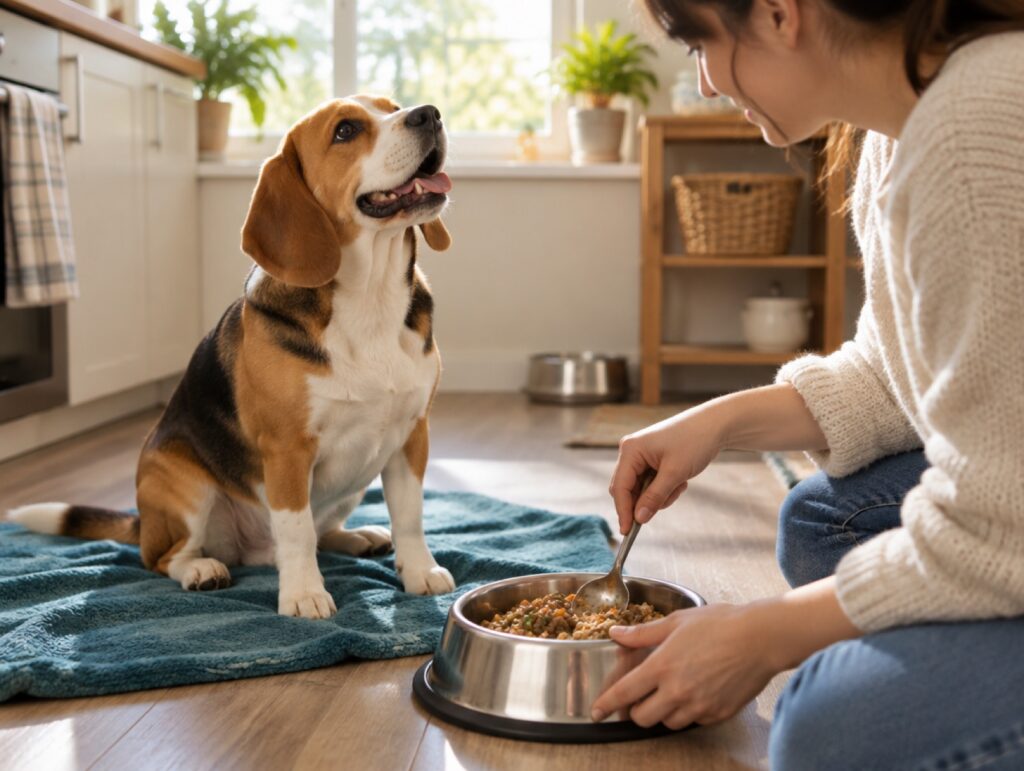
Probiotics for dogs come in dozens of forms: powders, pastes, tablets and treats. The labels all say much the same thing. In this article you will find out what the terms mean, what to look for on the label, what studies in dogs say about probiotics and when to talk to your vet first.
- Probiotics are live microorganisms that, when administered in adequate amounts, benefit health, and in dogs they are meant to support the balance of the gut microbiota.
- When choosing, look for the exact strain name, the number of live bacteria (CFU) until the end of shelf life, the number of an approved feed additive (for probiotics it usually starts with 4b) and clear dosing instructions from the manufacturer.
- Studies in dogs with acute diarrhoea so far show a rather small and inconsistent effect, and no group of probiotic strains has strong evidence in dogs, so probiotics are not a universal fix or a substitute for your vet.
- Human probiotics, yoghurt and kefir are no substitute for probiotics made for dogs: they have no proven strain and may contain lactose or xylitol.
- For puppies, sick dogs and dogs on medication, talk to your vet first.
What are probiotics, prebiotics and postbiotics?
Probiotics are live microorganisms that, when administered in adequate amounts, benefit health. Four similar-sounding words mean four different things, and this is how the international scientific society ISAPP defines them:
- ProbioticsLive microorganisms that, when administered in adequate amounts, benefit health.Hill et al., 2014
- PrebioticsSubstances that are selectively utilised by host microbes and thereby benefit health. Typically certain kinds of fibre.Gibson et al., 2017
- PostbioticsA preparation of inanimate microorganisms or their components that benefits health.Salminen et al., 2021
- SynbioticsA mixture of live microorganisms and substances that are selectively utilised by gut microbes (added or the dog’s own), with a health benefit.Swanson et al., 2020
You can read more about prebiotic fibre in the article Fibre for dogs, and about gut bacteria in the article Dog gut microbiome: what it is and why it matters.
How to choose probiotics for dogs: 4 things on the label
You can recognise a well-labelled probiotic for your dog by four details on the packaging.
- The exact strain name. Effects differ from strain to strain, so a general “lactobacilli” or “probiotic cultures” is not enough. You can recognise a strain by the combination of letters and numbers after the bacterium’s name, for example Enterococcus lactis NCIMB 10415.
- The number of live bacteria (CFU). CFU tells you how many live bacteria the product contains. Look for a number that is valid until the end of shelf life, not just on the day of manufacture.
- The number of an approved feed additive. Probiotics for dogs in the EU must state on the label the identification number of the approved feed additive, which for probiotics usually starts with 4b. For example, the strain Enterococcus lactis NCIMB 10415 has the number 4b1705ii.
- Clear dosing instructions. How much, how often and for how long. Follow the manufacturer’s instructions and your vet’s advice.
Weese and Martin, 2011
Which form of probiotic to give: powder, paste, tablet or treat?
The form of a probiotic depends mainly on what your dog will happily eat. The strain and the CFU count matter more than the shape. A general comparison:
| Form | Pros | What to watch for |
|---|---|---|
| Powder | Can be mixed into food and suits dogs of various sizes. | Your dog may refuse food with powder in it. Follow the label on how and with what to mix it. |
| Paste | Easy to give, good for fussy dogs and for those who struggle to swallow tablets. | After opening, store it as the label says. |
| Tablet or capsule | A fixed portion that is easy to store. | Some dogs spit the tablet out. Do not crush a hard tablet unless the label allows it. |
| Treat | Your dog takes it as a reward, so it is given without stress. | Check the same details as for other forms: strain, CFU and the 4b number. A treat is usually more of an extra than a foundation. |
What do studies say about probiotics in dogs?
Studies in dogs with acute diarrhoea so far show a rather small and inconsistent effect of probiotics. For a broader overview, see the article Digestive problems in dogs: signs, causes, what to do, and for what to do about diarrhoea, the article Diarrhoea in dogs: what to do and when to see a vet.
The systematic review by Jensen and Bjørnvad from 2019 screened 165 studies, and 17 of them met the criteria for evaluation (12 on acute and 5 on chronic intestinal disease in dogs). The authors concluded that the effect in acute disease is very limited and possibly not clinically significant, and that in chronic problems diet plays the main role, while according to the data to date probiotics do not seem to bring a significant improvement. They also pointed out that the studies were often too small. A 2024 meta-analysis by the European group ENOVAT (Scahill et al.) reached a similar conclusion: across six randomised studies with prebiotics, probiotics and synbiotics, it found no clinically significant shortening of diarrhoea, and the certainty of the evidence ranged from very low to moderate. No adverse effects were reported in the studies included in this meta-analysis.
Which probiotic strains are used in dog food and supplements?
Five main groups of probiotics appear in dog foods and supplements. None of them has strong evidence in dogs. Most studies are small and often done on healthy dogs, so they show a change in stool or bacteria, not a health benefit.
| Group (example strain) | Form | What we know in dogs | Strength of evidence | Note |
|---|---|---|---|---|
| Enterococcus faecium (strain NCIMB 10415, also called SF68 in the literature, now classified in the species Enterococcus lactis) | Lactic acid bacteria. | In an animal shelter (182 dogs) the groups did not differ in diarrhoea, which was rare in the dogs (Bybee et al., 2011). In shelter dogs with diarrhoea that received metronidazole, the dogs given the probiotic had more days with normal stool (Fenimore et al., 2017). In 11 healthy dogs, owners reported 0.6 days less loose stool (Nybroe et al., 2022). | Limited | Authorised in the EU as a feed additive for dogs and cats (4b1705ii), authorisation renewed in 2024. The name change is described by Franz et al. (2024). |
| Lactobacillus and related genera (Lactiplantibacillus, Lacticaseibacillus, Limosilactobacillus) | Lactic acid bacteria in powders, pastes and fermented products. | In a study of 60 dogs with acute or intermittent diarrhoea, a mix of three strains (L. fermentum, L. rhamnosus, L. plantarum) normalised stool compared with placebo (Gómez-Gallego et al., 2016). It was one product in one study. | Limited | The genus Lactobacillus was split into several genera in 2020 (Zheng et al., 2020), which is why names on labels differ. The strain Limosilactobacillus reuteri DSM 32203 (4b1850) has been authorised in the EU for dogs since 2023. |
| Bifidobacterium (e.g. B. animalis subsp. lactis CECT 8145) | Bacteria in powders and capsules, both live and heat-treated. | In a study of 36 dogs given it for 90 days, the stool score did not differ from placebo, the concentration of propionic acid in stool rose and the diversity of the microbiome did not change (Kayser et al., 2024). | Little data so far | Strains differ between products, so look for the full strain name on the label. |
| Bacillus (e.g. B. coagulans GBI-30, 6086; B. subtilis DE-CA9) | Spores that withstand feed processing and the acidic stomach (Wilson et al., 2025; Allenspach et al., 2023). | In 12 healthy dogs, B. coagulans gave firmer stool and did not change nutrient digestion (Wilson et al., 2025). A study in 10 healthy beagles looked at B. subtilis mainly for blood and metabolic markers (Allenspach et al., 2023). | Little data so far | The studies were done in healthy dogs; data on dogs with problems are missing. |
| Saccharomyces boulardii (S. cerevisiae var. boulardii) | A yeast, not a bacterium. | In 25 healthy dogs neither the stool score nor the composition of the microbiome changed, while faecal calprotectin and immunoglobulin A decreased (Meineri et al., 2022). The clinical meaning of that change remains open. | Little data so far | In the EU the yeasts S. cerevisiae MUCL 39885 (4b1710) and DSM 34246 (4b1873) are authorised for dogs; according to Lonigro et al. (2025) the second strain is the variety boulardii. |
Authorisation of a feed additive in the EU does not mean a therapeutic effect; a probiotic remains a complement to care. Publication bias also calls for caution: of the conference abstracts on probiotics for dogs and cats that were examined, 5 of 7 reporting a clinical effect were later published in journals, but only 1 of 5 not reporting one (Weese, 2025).
When do probiotics make sense for a dog, and when do they not?
Probiotics can be a reasonable addition to gut care if your vet recommends them, or if your dog is healthy and you simply want to support the balance of the gut microbiota. They are not the answer to every digestive problem.
- They may make sense: after antibiotics (see the article Dog after antibiotics for details), during a switch to a new food (see Switching dog food: a 7 to 10 day plan) or during a demanding period, such as after travelling. Always at a time when your dog is otherwise doing well, and ideally after agreeing it with your vet.
- They do not make sense: as a substitute for an examination when your dog is ill, or as a solution for stool that has not improved for a long time. The causes of soft stool are covered in the articles Soft stool in dogs and Dog poop: what colour, shape and consistency reveal.
- for puppies,
- for sick dogs and dogs with a chronic illness,
- for dogs that take medication, including antibiotics.
How to give and store probiotics
Give and store probiotics exactly as the label of the specific product says, because live bacteria are sensitive to conditions. What the label usually specifies:
- Temperature and humidity. Store the product as the packaging instructs (dry and cool, or in the fridge), and close it tightly after opening.
- With food or apart from it. The label tells you whether the product is mixed into food. Do not sprinkle it onto hot food unless the manufacturer expressly allows it.
- Shelf life. The CFU count should be valid until the date on the packaging.
- Dosing and duration. Stick to the instructions and your vet’s advice.
Is yoghurt or kefir the same as a probiotic for dogs?
No, yoghurt and kefir are no substitute for probiotics made for dogs. They are dairy products where you do not know which strain or how many live bacteria your dog will get, and they contain lactose.
Myth: “yoghurt always helps a dog”. Fact: according to the Merck Veterinary Manual, dogs can develop lactose intolerance after damage to the surface of the intestinal lining, which is why dairy products should not be given to dogs with diarrhoea.
A kefir study in 12 healthy adult dogs (Metras et al., 2023) also found only minor changes in gut bacteria and no effect on stool consistency. Be careful with sugar-free products too, which may contain sweeteners, among them xylitol. Read the ingredients.
Do not give your dog human probiotics
Human probiotics are not intended or dosed for dogs. Some chewable vitamins and supplements for people also contain xylitol, a sweetener that is toxic to dogs. The US Food and Drug Administration (FDA) explicitly lists chewable vitamins and supplements among the products that may contain xylitol.
Probiotics, or a microbiome test first?
It depends on why you are thinking about a probiotic. A test does not diagnose and a probiotic does not replace it; they are two different tools.
- A general probiotic is enough: your dog is healthy and you simply want to support the gut during a short change, such as switching food or after a trip. Choose by the label and check it with your vet beforehand.
- It makes sense to find out the composition: digestive problems keep coming back, you are looking for the cause with your vet and want another piece of information. A microbiome test of a stool sample shows which bacteria live in the gut and how they differ from healthy dogs. What it can and cannot do is described in the article Dog microbiome analysis: what the results show and don’t, and you can order the test on the microbiome test page.
Choosing a probiotic based on a test is a reasonable idea, but studies showing in dogs that it works better than a general product are still missing. Acute problems belong with the vet first, not in the laboratory.
Frequently asked questions
What is the difference between probiotics and prebiotics?
Probiotics are live microorganisms that, when administered in adequate amounts, benefit health. Prebiotics are substances that are selectively utilised by gut microbes, typically certain kinds of fibre. There are also postbiotics, meaning preparations of inanimate microbes or their components, and synbiotics, a mixture of live microbes and substances that gut microbes utilise.
Can I give my dog human probiotics?
No, do not give your dog human probiotics. They are not intended or dosed for dogs, and some chewable vitamins and supplements for people contain xylitol, a sweetener that is toxic to dogs. Choose a product made for dogs and talk to your vet before giving it.
What should I look for on the label of probiotics for dogs?
Look for four things on the label: the exact strain name, the number of live bacteria (CFU) valid until the end of shelf life, the number of the approved feed additive (for probiotics it usually starts with 4b) and clear dosing instructions. If the strain name or the CFU count is missing, that is a warning sign that the product may not contain what it promises.
Do probiotics help a dog with diarrhoea?
Studies in dogs with acute diarrhoea so far show a small and inconsistent effect, and according to the 2024 ENOVAT meta-analysis the certainty of the evidence is very low to moderate. So do not regard a probiotic as a treatment. If diarrhoea lasts longer than one to two days, gets worse or there is blood in the stool, see a vet.
Can a dog have yoghurt or kefir instead of probiotics?
This is not recommended. Yoghurt and kefir have no proven strain or number of live bacteria for dogs and they contain lactose, which can soften the stool. Dairy products should not be given to dogs with diarrhoea. Watch out too for products sweetened with xylitol, which is toxic to dogs, so always read the ingredients.
How long should I give my dog probiotics?
There is no general rule for how long to give them. Follow the manufacturer’s information on the label and the advice of your vet, who knows your dog’s condition. With puppies, sick dogs and dogs on medication, talk to your vet before giving them. If problems get worse after you start, stop the probiotic and contact your vet.
Do probiotics help a dog against fungal infections (yeasts)?
Reliable evidence that probiotics help dogs against yeast or fungal infections is still lacking, so do not regard them as a treatment. Behind “fungus” on the skin or in the ears there is often the yeast Malassezia, sometimes skin fungi (dermatophytes). Redness, itching, odour or discharge from the ears need a vet. A probiotic can at most be a supplement to gut care.
How do I choose probiotics for a medium-sized dog?
Choose a product made for dogs and follow the information on the label. The manufacturer sets how much your dog gets, often by weight. Check the strain name, the live bacteria count until the end of shelf life and the authorised additive number. We give no doses here, as they depend on the product. Whether to use a probiotic is for your vet to decide with you.
Which probiotic strains are authorised in the EU for dogs?
Several strains are authorised in the EU as a feed additive for dogs, for example Enterococcus lactis NCIMB 10415 (4b1705ii), Limosilactobacillus reuteri DSM 32203 (4b1850) and the yeasts Saccharomyces cerevisiae MUCL 39885 and DSM 34246. The authorisation concerns safety and conditions of use, not a therapeutic effect. You will find the number on the label.
Sources
- Hill C et al. (2014). Expert consensus document: The International Scientific Association for Probiotics and Prebiotics consensus statement on the scope and appropriate use of the term probiotic. Nature Reviews Gastroenterology & Hepatology 11(8):506–514. doi.org/10.1038/nrgastro.2014.66
- Gibson GR et al. (2017). Expert consensus document: The International Scientific Association for Probiotics and Prebiotics (ISAPP) consensus statement on the definition and scope of prebiotics. Nature Reviews Gastroenterology & Hepatology 14(8):491–502. doi.org/10.1038/nrgastro.2017.75
- Salminen S et al. (2021). The International Scientific Association of Probiotics and Prebiotics (ISAPP) consensus statement on the definition and scope of postbiotics. Nature Reviews Gastroenterology & Hepatology 18(9):649–667. doi.org/10.1038/s41575-021-00440-6
- Swanson KS et al. (2020). The International Scientific Association for Probiotics and Prebiotics (ISAPP) consensus statement on the definition and scope of synbiotics. Nature Reviews Gastroenterology & Hepatology 17(11):687–701. doi.org/10.1038/s41575-020-0344-2
- Weese JS, Martin H (2011). Assessment of commercial probiotic bacterial contents and label accuracy. Canadian Veterinary Journal 52(1):43–46. PMID 21461205
- Commission Implementing Regulation (EU) 2024/2394 of 9 September 2024, renewal of the authorisation of Enterococcus lactis NCIMB 10415 (4b1705ii) as a feed additive for cats and dogs. eur-lex.europa.eu
- U.S. Food and Drug Administration. Paws Off Xylitol; It’s Dangerous for Dogs. fda.gov/consumers/consumer-updates/paws-xylitol-its-dangerous-dogs
- Jensen AP, Bjørnvad CR (2019). Clinical effect of probiotics in prevention or treatment of gastrointestinal disease in dogs: a systematic review. Journal of Veterinary Internal Medicine 33(5):1849–1864. doi.org/10.1111/jvim.15554
- Scahill K et al. (2024). Efficacy of antimicrobial and nutraceutical treatment for canine acute diarrhoea: a systematic review and meta-analysis for European Network for Optimization of Antimicrobial Therapy (ENOVAT) guidelines. The Veterinary Journal 303:106054. doi.org/10.1016/j.tvjl.2023.106054
- Schmitz SS (2024). Evidence-based use of biotics in the management of gastrointestinal disorders in dogs and cats. Veterinary Record 195(S2):26-32. doi.org/10.1002/vetr.4916
- Metras BN, Oba PM, Miller MJ, Swanson KS (2023). Effects of commercial and traditional kefir supplementation on apparent total tract macronutrient digestibility and the fecal characteristics, metabolites, and microbiota of healthy adult dogs. Journal of Animal Science 101:skad316. doi.org/10.1093/jas/skad316
- Merck Veterinary Manual. Malabsorption Syndromes in Small Animals (section on lactose intolerance). merckvetmanual.com
- Bybee SN, Scorza AV, Lappin MR (2011). Effect of the probiotic Enterococcus faecium SF68 on presence of diarrhea in cats and dogs housed in an animal shelter. Journal of Veterinary Internal Medicine 25(4):856–860. doi.org/10.1111/j.1939-1676.2011.0738.x
- Fenimore A, Martin L, Lappin MR (2017). Evaluation of metronidazole with and without Enterococcus faecium SF68 in shelter dogs with diarrhea. Topics in Companion Animal Medicine 32(3):100–103. doi.org/10.1053/j.tcam.2017.11.001
- Nybroe S et al. (2022). Alterations in healthy adult canine faecal microbiome and selected metabolites as a result of feeding a commercial complete synbiotic diet with Enterococcus faecium NCIMB 10415. Animals 13(1):144. doi.org/10.3390/ani13010144
- Franz CMAP et al. (2024). An update on the taxonomy and functional properties of the probiotic Enterococcus faecium SF68. Beneficial Microbes 15(2):211–225. doi.org/10.1163/18762891-bja00005
- Gómez-Gallego C et al. (2016). A canine-specific probiotic product in treating acute or intermittent diarrhea in dogs: a double-blind placebo-controlled efficacy study. Veterinary Microbiology 197:122–128. doi.org/10.1016/j.vetmic.2016.11.015
- Zheng J et al. (2020). A taxonomic note on the genus Lactobacillus: description of 23 novel genera. International Journal of Systematic and Evolutionary Microbiology 70(4):2782–2858. doi.org/10.1099/ijsem.0.004107
- Kayser E et al. (2024). Effects of supplementation of live and heat-treated Bifidobacterium animalis subspecies lactis CECT 8145 on glycemic and insulinemic response, fecal microbiota, systemic biomarkers of inflammation, and white blood cell gene expression of adult dogs. Journal of Animal Science 102:skae291. doi.org/10.1093/jas/skae291
- Wilson SM et al. (2025). Effects of Bacillus coagulans (GBI-30, 6086) supplementation on apparent total tract nutrient digestibility and the fecal characteristics and metabolites, immunity, and microbiota of healthy adult dogs. Journal of Animal Science 103:skaf251. doi.org/10.1093/jas/skaf251
- Allenspach K et al. (2023). Effect of the probiotic Bacillus subtilis DE-CA9 on fecal scores, serum oxidative stress markers and fecal and serum metabolome in healthy dogs. Veterinary Sciences 10(9):566. doi.org/10.3390/vetsci10090566
- Meineri G et al. (2022). Effects of Saccharomyces boulardii supplementation on nutritional status, fecal parameters, microbiota, and mycobiota in breeding adult dogs. Veterinary Sciences 9(8):389. doi.org/10.3390/vetsci9080389
- Lonigro N et al. (2025). How does Saccharomyces cerevisiae DSM 34246 (Canobios-BL) var. boulardii supplementation impact the fecal parameters of healthy adult dogs? Veterinary Sciences 12(1):45. doi.org/10.3390/vetsci12010045
- Weese JS (2025). Evaluation of publication bias in the assessment of probiotic treatment for gastrointestinal disease in dogs and cats. Canadian Veterinary Journal 66:250–254. PMID 40084240
- Commission Implementing Regulation (EU) 2023/256 of 6 February 2023, authorisation of Limosilactobacillus reuteri DSM 32203 (4b1850) as a feed additive for dogs. eur-lex.europa.eu
- Commission Implementing Regulation (EU) 2022/272 of 23 February 2022, authorisation of Saccharomyces cerevisiae MUCL 39885 (4b1710) as a feed additive for, among others, dogs. eur-lex.europa.eu
- Commission Implementing Regulation (EU) 2025/154 of 29 January 2025, authorisation of Saccharomyces cerevisiae DSM 34246 (4b1873) as a feed additive for dogs and cats. eur-lex.europa.eu
This article is educational and does not replace a veterinary examination. If you are not sure, ask your vet.
This article was proofread with the help of AI. This is a translation from Czech, so it may contain inaccuracies.