Blog · Feeding
Switching dog food: a 7 to 10 day plan
Introduce new food over at least 7 days, starting with a small share. If the stool softens, go back a step and slow down. Table, daily plan and warning signs.
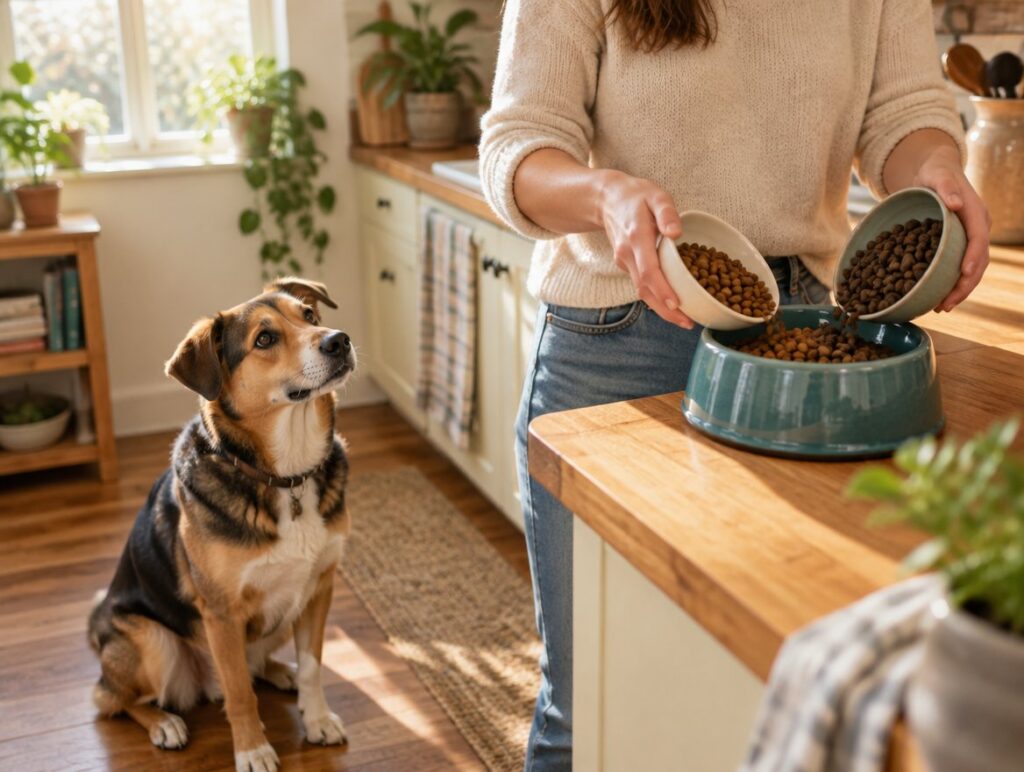
The new food has arrived, the full bowl disappears in a minute and your dog is thrilled. The next morning you are standing in the garden with a poop bag and the stool is looser than usual. The gut simply could not keep up with the change. You can prevent this with a simple routine that takes a week to ten days.
- Introduce new food gradually over at least a week, in practice often 7 to 10 days, and start with a small share of the new food.
- Gut bacteria begin to change within a few days of a change of diet, so they need time to adjust.
- If the stool gets softer, go back a step and add the new food more slowly.
- With puppies, senior dogs and dogs with a sensitive tummy, be more careful, feel free to stretch the transition and go by the stool.
- Blood in the stool, vomiting or lethargy mean a trip to the vet, not home experiments.
Why does a dog’s gut need time to adjust to new food?
A dog’s gut microbiome, the community of bacteria in the digestive tract, changes according to what the dog eats. Every food has different proteins, fats and fibre, and the bacteria have to rearrange themselves to suit the new menu.
In a 2022 study of 12 adult female beagles, the composition of bacteria in the stool settled in roughly 6 days after an abrupt change of food. Meanwhile the stool quickly softened after the switch to both new foods (Lin et al., 2022). A healthy gut adapts; it just needs time.
A 2017 study by Herstad and colleagues also showed that in healthy adult dogs, a switch from kibble to a diet with a high share of cooked beef changed the composition of bacteria in the stool, and it reverted once the dogs were back on kibble (Herstad et al., 2017).
- 6 dayswas how long it took for the composition of bacteria in the stool to settle in 12 beagles after an abrupt change of food.Lin et al., 2022
- 7 daysis what the American Animal Hospital Association (AAHA) recommends for switching a dog, and Tufts University says at least a week.AAHA, 2021; Linder, 2019
- 4 to 6 weeksis what some dogs need, according to Tufts, to avoid stomach upsets.Linder, 2019
- 13 beagle puppieswere followed in a study in which the puppies had firmer stool with a gradual transition than with an abrupt change.Liao et al., 2023
What should a plan for switching to new food look like?
A plan for switching to new food takes at least seven days, and the new food is gradually added to the old food in the bowl. The schedule below is based on the recommendations of veterinary nutrition specialist Deborah Linder of Tufts University (Linder, 2019).
| Day | Old food | New food |
|---|---|---|
| 1 | 90% | 10% |
| 2 | 75% | 25% |
| 3–4 | 50% | 50% |
| 5 | 25% | 75% |
| 6 | 10% | 90% |
| 7 | 0% | 100% |
The proportions are calculated from the daily portion. The new food may have a different calorie content, though, so the same cup of new food gives a dog more or less energy than a cup of the old one. You will find how much new food to give for your dog’s weight on its packaging, or ask your vet (Linder, 2019). AAHA recommends spreading a dog’s transition over seven days. It begins by replacing a quarter of the old food with the new and raises the share of new food according to how well the dog accepts it (AAHA, 2021).
Seven days is a minimum, though, not a ceiling. If you have doubts, extend each step by a day or two, so the transition is spread over 10 days or more. Linder also points out that every dog is different: some cope with a change from one bowl to the next without trouble, while others need 4 to 6 weeks (Linder, 2019). You cannot tell in advance, which is why a gradual transition is the safest default.
What should you do on each day of the transition?
- Before you start. Make sure your dog is healthy and the stool is firm. Do not plan the change for a house move or fireworks, because stress upsets digestion all by itself (Stress diarrhoea in dogs).
- Mix well. Mix the new and old food in the bowl so your dog does not pick out only the tastier part.
- Check the stool and appetite every day. Firm stool and an empty bowl mean you can move on a step.
- Finish the transition. Switch to 100% new food only when your dog has coped with the previous step without problems.
What should you watch for in the stool and appetite?
Mainly watch the consistency of the stool and whether your dog eats with appetite. A good stool is firm and easy to pick up. You will find a detailed guide to colour, shape and consistency in the article Dog poop: what colour, shape and consistency reveal.
A slightly softer stool may appear during the transition, as Linder (2019) also points out. Repeatedly loose stool, mucus or frequent passing of small amounts, however, can mean the pace is too fast for your dog or that the new food does not agree with it (Linder, 2019).
What should you do if the stool gets soft during the transition?
If the stool gets soft during the transition, go back to the last ratio your dog coped with and hold it for a few days longer. For minor signs such as looser stool or a rumbling tummy, veterinary nutrition specialist Deborah Linder of Tufts University advises stretching out the transition if the dog is otherwise behaving normally (Linder, 2019).
- Slow down. Stay at the last well-tolerated ratio, for example half and half.
- Make the steps smaller. Add the new food in smaller amounts, for example 10% instead of 25%.
- Wait for firm stool. Move on only when the stool is back to normal. The transition may easily stretch to two weeks or more.
If loose stool lasts longer than two days, stop experimenting and call your vet. With watery diarrhoea, repeated vomiting, pain or lethargy, do not wait and call straight away. You can find an overview of causes and what to do in the article Diarrhoea in dogs: what to do and when to see a vet.
When should you switch more slowly, and when all at once?
With puppies, senior dogs and dogs with a sensitive tummy, it is better to switch more slowly. There is no set length for them. Go by the stool and expect that for some dogs the transition may take several weeks (Linder, 2019).
Change food all at once only on your vet’s instruction. It may be, for example, a veterinary diet for which the vet decides how quickly and in what way to switch to it. In that case follow their instructions exactly.
How should you switch food for puppies and senior dogs?
For puppies a gradual transition is even more important than for adult dogs. In a study of 13 healthy beagle puppies that compared an abrupt and a gradual change of diet over a week, the puppies with a gradual transition had firmer stool and did not develop diarrhoea, whereas diarrhoea did occur after an abrupt change (Liao et al., 2023). The difference in the incidence of diarrhoea was not statistically significant, though, and the study is small and covers only one breed.
With puppies, do not wait: diarrhoea counts as a warning sign in a puppy, so contact your vet straight away if it appears. Your vet will advise you on when to move your puppy to a different food and which one.
For senior dogs, expert sources give no special transition schedule, so the general rule applies: slowly and by the stool. If an older dog takes medicines or has chronic problems, go through the change of food with your vet beforehand. And if the food is prescribed by a vet, follow their instructions for the transition.
Why does a dog refuse new food, and what can you do?
If your dog refuses the new food, first slow down and stay at the ratio your dog still eats. AAHA advises something similar: the share of new food rises over roughly seven days according to how well the dog accepts it (AAHA, 2021).
- Go back a step. Stay at the ratio your dog still finishes and hold it for a few more days.
- Try adding flavour. As a simple aid, AAHA mentions a small amount of tinned food on top of the kibble (AAHA, 2021). Count it in the daily portion.
- Watch the time. If your dog refuses to eat for more than 24 hours, see a vet, because the reason may be something other than taste.
How do you choose new food so the change is worth it?
According to the recommendations of the World Small Animal Veterinary Association (WSAVA), choose a food that is labelled on the packaging as complete, meaning it contains all the necessary nutrients, and intended for your dog’s life stage (WSAVA, 2021).
- Complete food. Foods labelled as complementary, intermittent or supplemental should make up only a small part of the diet, at most 10% (WSAVA, 2021).
- The right life stage. The European Pet Food Industry Federation FEDIAF and the American AAFCO set recommended nutrient levels separately for reproduction, growth and adulthood. A food “for all life stages” is designed for growth and reproduction (WSAVA, 2021).
- Calories and a manufacturer contact. The manufacturer should be able to state the calories and answer questions. Marketing terms such as “holistic” or “premium” are not regulated in any way and, according to WSAVA, say little about nutrition.
A change of food is worth it when you have a reason for it: a different life stage, your vet’s recommendation, or the fact that your dog does not tolerate the current food. There is no need to upset your dog’s digestion just for a discount.
What about treats, chews and table scraps?
During the transition keep treats to a minimum, and only those your dog is used to. A new treat, bone or piece from your plate strains the gut and muddies what caused the change in stool.
- Count treats in the daily portion.
- Introduce only one new thing at a time, so do not change treats at the same time as the food.
- Leave table scraps out. Grapes, raisins, onions, chocolate and xylitol (a sugar substitute) are dangerous.
- There is blood in the stool, or it is black and tarry.
- Your dog is vomiting, refuses to eat for more than a day, is lethargic or has a painful belly.
- Diarrhoea appears in a puppy, a senior dog or a dog with a chronic illness. For them, get in touch right away.
If the belly is hard and swollen, if there are unsuccessful attempts to vomit, or if your dog is restless, call your vet immediately.
Frequently asked questions
How long does it take to switch a dog to new food?
At least seven days, during which the new food is gradually added to the old. In practice the plan is often stretched to 10 days or more. Some dogs need 4 to 6 weeks. Adjust the pace by the stool, not by the calendar. If the stool gets soft, stay at the last ratio your dog tolerated and carry on more slowly.
What should I do if my dog has diarrhoea after a change of food?
Go back to the last ratio your dog tolerated and hold it for a few days longer. Then add the new food in smaller steps. If loose stool lasts longer than two days, call your vet. If there is blood in the stool, the diarrhoea is watery, your dog vomits repeatedly or is lethargic, call straight away.
Can food be changed all at once, from one day to the next?
Some healthy adult dogs cope without trouble, but you cannot tell in advance. In a small study, puppies had softer stool after an abrupt change than with a gradual transition. Change food all at once only on your vet’s instruction, for example with a veterinary diet. For other dogs a gradual transition is safer.
How do I switch from kibble to tinned food or BARF?
Use the same approach in small steps and watch the stool. Tinned food and raw feeding have a different composition from kibble, so it pays to slow down. Raw feeding also has its own hygiene rules and must be balanced. So go through the menu with your vet or a nutrition adviser before the first change.
What should I do if my dog refuses the new food?
Go back to the ratio your dog still eats and add the new food more slowly. You can put a little tinned food on top and count it in the daily portion. The new food may simply not taste good to your dog. If your dog does not eat for more than 24 hours, call your vet, because the reason may be an illness.
Should I give treats during the transition?
Only those your dog is used to, and in small amounts. Count them in the daily portion. Leave new treats, bones and table scraps until the transition is finished and the stool is firm. Otherwise you cannot tell whether any problems were caused by the new food or by the extra novelty.
Sources
- Lin CY, Jha AR, Oba PM, Yotis SM, Shmalberg J, Honaker RW, Swanson KS (2022). Longitudinal fecal microbiome and metabolite data demonstrate rapid shifts and subsequent stabilization after an abrupt dietary change in healthy adult dogs. Animal Microbiome. doi.org/10.1186/s42523-022-00194-9
- Herstad KMV et al. (2017). A diet change from dry food to beef induces reversible changes on the faecal microbiota in healthy, adult client-owned dogs. BMC Veterinary Research. doi.org/10.1186/s12917-017-1073-9
- Liao P, Yang K, Huang H, Xin Z, Jian S, Wen C, He S, Zhang L, Deng B (2023). Abrupt dietary change and gradual dietary transition impact diarrheal symptoms, fecal fermentation characteristics, microbiota, and metabolic profile in healthy puppies. Animals. doi.org/10.3390/ani13081300
- Linder DE (2019). How do I switch my pet’s food? Tufts Petfoodology, Cummings School of Veterinary Medicine. sites.tufts.edu/petfoodology
- AAHA (2021). Tips and timelines for transitioning your pet to a new food. American Animal Hospital Association. aaha.org
- WSAVA Global Nutrition Committee (2021). Guidelines on selecting pet foods. wsava.org
This article is educational and does not replace a veterinary examination. If you are not sure, ask your vet.
This article was proofread with the help of AI. This is a translation from Czech, so it may contain inaccuracies.