Blog · Digestion
Enterococcus faecium for dogs: strain NCIMB 10415
Enterococcus faecium for dogs is a probiotic where the strain matters. An overview of EU authorisation, studies in dogs, safety and how to read the label.
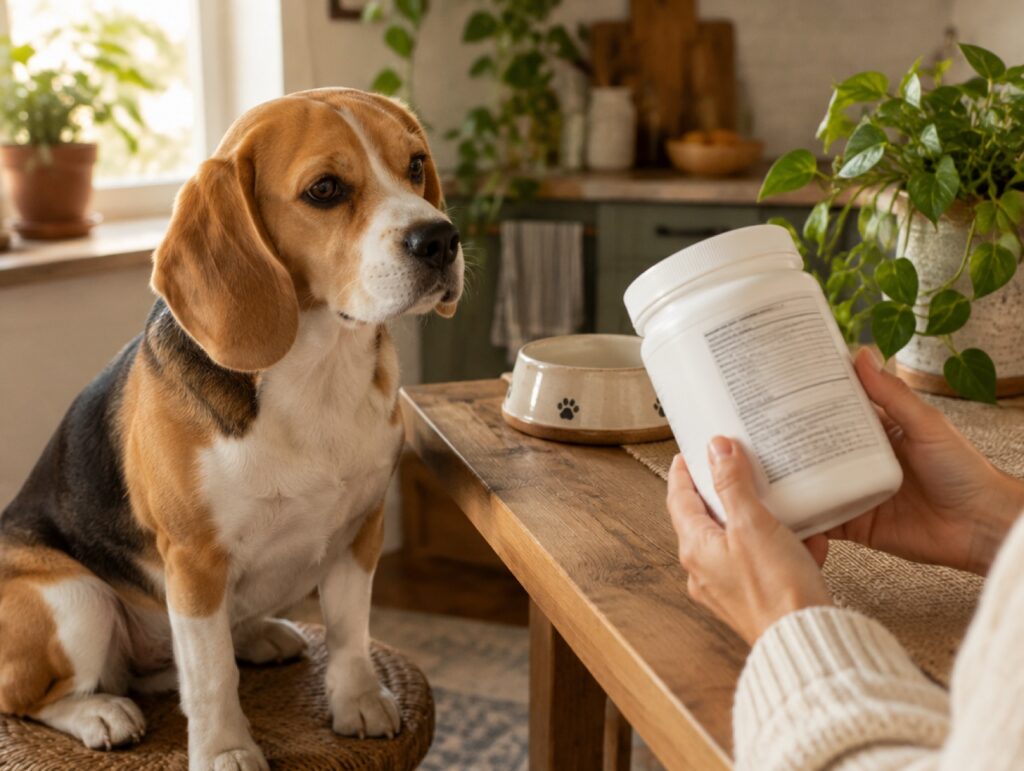
On the label of a dog probiotic you spot the Latin name Enterococcus faecium and a question pops into your head: isn’t that the bacterium people talk about in hospitals? Enterococcus faecium for dogs is indeed one of the best-known probiotics in canine care, and at the same time a species where the specific strain matters. We will go through what it is, what we know about it from studies in dogs, how its safety is assessed and how to recognise it on a label.
- Enterococcus faecium is a lactic acid bacterium that lives naturally in the gut of animals and people. Strains differ greatly, though.
- Strain NCIMB 10415 (also known as SF68 in the literature) is authorised in the EU as a feed additive for dogs and cats. The authorisation was renewed by Regulation (EU) 2024/2394.
- Studies in dogs are small and the results are mixed. They show observed changes, not a guarantee that a product will stop diarrhoea.
- The species as a whole does not have QPS status with EFSA, which is why strains are assessed one by one. Rely only on a product with the strain named on the label.
- Blood in the stool, lethargy, repeated vomiting or diarrhoea in a puppy are for your vet, not for a probiotic.
What is Enterococcus faecium and where does it come from in a dog’s gut?
Enterococcus faecium is a round bacterium that makes lactic acid from sugars. It belongs to the lactic acid bacteria and occurs naturally in the gut of many mammals, including people and dogs. You can find the wider context in the article Dog gut microbiome: what it is and why it matters.
Selected strains of this species are used as probiotics. A probiotic means live microorganisms that, in the right amount, can benefit the host.
A small note on the name. Strain NCIMB 10415 was long listed as Enterococcus faecium, but European regulations now list it as Enterococcus lactis. The change of name is described by Franz et al. (2024). On older labels and in older articles you will therefore find both versions, and it is the same strain.
Why does the strain matter with Enterococcus faecium?
A strain is a finer classification than a species. Two bacteria of the same species can differ, for example, in how they survive an acidic environment, whether they can attach to the gut lining or which antibiotic resistance genes they carry. That is why the name of the species alone tells you nothing. With Enterococcus faecium this is doubly true, because there are strains used as feed additives and also strains linked to hospital infections in people.
The strain Enterococcus faecium NCIMB 10415, also called SF68 in the literature, is the one that has been repeatedly studied in dogs and officially assessed. You can find a general overview in the article Probiotics for dogs: what they are and how to choose.
Is Enterococcus faecium NCIMB 10415 authorised for dogs in the EU?
Yes. The strain Enterococcus lactis NCIMB 10415 (formerly Enterococcus faecium) is authorised in the EU as a feed additive for cats and dogs. The authorisation was renewed by Commission Implementing Regulation (EU) 2024/2394 of 9 September 2024 (identification number 4b1705ii). The regulation replaced the original authorisation from 2013 (Regulation No 1061/2013).
The renewal was preceded by an assessment by the European Food Safety Authority (EFSA). The FEEDAP Panel concluded in 2024 that the product remains safe for cats and dogs. For the person handling it, EFSA considers it a substance that can cause an allergy when inhaled, which mainly concerns manufacturers. Efficacy was not reassessed during this renewal.
What matters is what the authorisation means. It says that the product is safe under the given conditions and may be placed on the market as a feed additive. It does not promise that it will remove diarrhoea or any other illness. For dogs it is classed among zootechnical additives aimed at improving the gut flora. The authorised form is microencapsulated with shellac, with a minimum content of 5 × 10⁹ CFU per gram of additive.
What do studies of Enterococcus faecium SF68 in dogs show?
There are several studies in dogs and all of them have a limited scope. Here is an overview of what the authors actually observed.
| Study | Who and what | What the authors observed | Strength of evidence |
|---|---|---|---|
| Bybee et al. (2011) | Shelter, dogs and cats, occurrence of diarrhoea when given SF68 | In dogs (182 animals) the groups did not differ, and diarrhoea was uncommon in dogs in both groups | Limited, no difference in dogs in this study |
| Fenimore et al. (2017) | Shelter dogs with diarrhoea given metronidazole, with or without SF68 | Dogs given the probiotic had more days with normal stool | Limited, small study |
| Benyacoub et al. (2003) | Puppies from weaning to one year old, food with or without SF68 | Higher antibodies after distemper vaccination and higher IgA in the stool in the SF68 group | Limited, markers of immunity, not health |
| Nybroe et al. (2022) | 11 healthy adult dogs, food with a synbiotic containing this strain | Owners reported 0.6 days fewer loose stools over 16 days. Changes in the microbiome appeared with both foods, not only the one with the strain | Very limited, small sample |
What follows from this? The studies describe observed changes in specific groups of dogs under specific conditions. None of them means that a product will stop your dog’s diarrhoea or prevent it. In puppies they were laboratory markers of immunity, which make sense but do not by themselves say that a dog will be less ill. The picture is also skewed by the fact that studies with a favourable result appear in journals more often than those without an effect. Weese (2025) points out this publication bias for probiotics in dogs and cats.
An honest conclusion is this: the evidence is limited, but the strain is among the best described probiotic strains in dogs.
Is Enterococcus faecium safe? What does EFSA say?
For the specific authorised strain NCIMB 10415 the answer is well supported: EFSA assessed it in 2024 as safe for dogs and cats under the conditions of use. For the species Enterococcus faecium as a whole, though, the picture is more cautious, and that is exactly why this part is worth reading.
EFSA keeps a list of microorganisms with Qualified Presumption of Safety (QPS). Enterococcus faecium is not on it. According to EFSA (BIOHAZ, 2019), this species was excluded from QPS assessment because it is not expected to gain QPS status in the foreseeable future. Assessment is therefore done for each strain separately. Besides harmless strains, the species also includes strains that cause hospital infections in people. This does not mean that every strain is dangerous. It means that safety cannot be derived from the name of the species.
What is examined in a strain? Mainly two things:
- Antibiotic resistance. The strain must not carry acquired resistance genes that could be passed on to other bacteria. Intrinsic resistance, which the species has by nature, is not considered a risk.
- Virulence. The strain should not have properties that allow it to cause infection.
In practice one thing follows: buy only a product whose label gives the full name of the strain and the authorisation number. Hospital strains of enterococci and a strain approved as a feed additive are different bacteria, even though they share the name of the species. If your dog has a seriously weakened immune system, ask your vet before any probiotic.
How do you recognise an Enterococcus probiotic for a dog on the label?
A good label gives answers you can check. Look for these things:
- The full name of the strain. For example Enterococcus faecium NCIMB 10415 or Enterococcus lactis NCIMB 10415. Just “Enterococcus” or “probiotic cultures” is not enough.
- The identification number of the authorised additive. For this strain in dogs and cats it is 4b1705ii. The number shows that the strain has been assessed in the EU.
- The amount of live bacteria in CFU. CFU gives the number of live bacteria. The value should hold until the end of the shelf life.
- The words “complementary feed” or “complete feed”. It is feed, not a medicine. There should be no claims about treating or preventing disease on the pack.
- Clear instructions from the manufacturer. Do not look for dosing in an article, follow the manufacturer’s instructions and your vet’s advice.
Checking the label makes sense: in the study by Weese and Martin (2011), the content and the information on the labels of the tested commercial probiotics often differed from reality.
Does it make sense to give a dog Enterococcus faecium after antibiotics or for diarrhoea?
This is a common reason why owners consider a probiotic, and also the place where you need to be most careful. After antibiotics the gut community changes, and we cover this in detail in the articles Dog after antibiotics and Probiotics for dogs after antibiotics. The study by Fenimore et al. (2017) followed dogs with diarrhoea treated with metronidazole and observed more days with normal stool in the group given the probiotic. It was a small study and the result cannot be taken as a guarantee.
With diarrhoea, the first step is observation, water and deciding whether a calm routine is enough or whether a vet is needed. You can find the procedure in the article Diarrhoea in dogs: what to do and when to see a vet. A probiotic should not replace an examination. Especially with a puppy, a senior or a dog with another illness, decide on giving it with your vet first.
- Diarrhoea or vomiting with blood, or black and tarry stool.
- Your dog is lethargic, weak, has pale gums or collapses.
- Repeated vomiting, your dog does not drink or cannot keep water down.
- A painful, swollen, hard belly, restlessness and retching without bringing anything up.
- Diarrhoea in a puppy, a senior or a small dog, who lose fluids quickly.
- Your dog may have eaten poison, a foreign object or something unknown.
Do not treat this with a probiotic or by waiting. Call your vet or an emergency clinic straight away and describe what happened.
What should you watch for the first time you give it?
A probiotic is a supplement, not a shortcut. Keep to a few rules:
- Start in a calm period, when your dog is healthy and nothing new is going on. Do not start a new product during stress, travel or a change of food.
- Change one thing at a time. Change food gradually following the plan in the article Switching dog food: a 7 to 10 day plan.
- Watch the poop and your dog’s behaviour and take notes. Dog poop: what colour, shape and consistency reveal will help too.
- If vomiting, diarrhoea or itching appears after giving it, stop the product and contact your vet.
Frequently asked questions
What is Enterococcus faecium in dogs?
It is a lactic acid bacterium that lives naturally in the gut of animals and people. Some of its strains are used as probiotics for dogs, for example in feed supplements. Properties and safety are therefore assessed for each strain separately, not by the name of the species.
Is Enterococcus faecium safe for a dog?
EFSA assessed strain NCIMB 10415 in 2024 as safe for dogs and cats under the conditions of use. The species Enterococcus faecium as a whole does not have QPS status, though, so strains are assessed individually. That is why you should choose a product with the strain and authorisation number stated, and give it to dogs with a seriously weakened immune system only after talking to your vet.
Is Enterococcus faecium NCIMB 10415 the same as SF68?
Yes, the literature uses both names for the strain. In European regulations it is now listed as Enterococcus lactis NCIMB 10415, formerly as Enterococcus faecium. The change of name is described by Franz et al. (2024). On older labels you will therefore find both forms, and you can recognise the strain by the number NCIMB 10415.
Does Enterococcus faecium stop diarrhoea in a dog?
No, that cannot be claimed. Studies describe, for example, more days with normal stool in shelter dogs given the probiotic during metronidazole treatment (Fenimore et al., 2017), but they are small, and another shelter study found no difference in diarrhoea in dogs (Bybee et al., 2011). Diarrhoea that lasts or gets worse is for your vet.
What does the number 4b1705ii on the label mean?
It is the identification number of the authorised feed additive in the EU, that is the strain Enterococcus lactis NCIMB 10415 for cats and dogs. It says that the strain has passed a safety assessment and may be used as a feed additive. It is not a medicine and not a promise of a therapeutic effect.
Should I give my dog a probiotic with Enterococcus after antibiotics?
It can be considered, but decide with your vet, especially for a puppy, a senior or a sick dog. The evidence is limited, one small study in shelter dogs observed more days with normal stool, and a probiotic does not replace treatment or an examination. You can find the context in the article Probiotics for dogs after antibiotics.
Sources
- Commission Implementing Regulation (EU) 2024/2394 of 9 September 2024, renewal of the authorisation of the preparation Enterococcus lactis NCIMB 10415 (4b1705ii) as a feed additive for cats and dogs. eur-lex.europa.eu/eli/reg_impl/2024/2394/oj
- EFSA FEEDAP Panel (2024). Assessment of the feed additive consisting of Enterococcus lactis NCIMB 10415 (Cylactin) for cats and dogs for the renewal of its authorisation (DSM Nutritional Products Ltd). EFSA Journal 22(3):e8622. doi.org/10.2903/j.efsa.2024.8622
- EFSA BIOHAZ Panel (2019). Update of the list of QPS-recommended biological agents intentionally added to food or feed as notified to EFSA 9: suitability of taxonomic units notified to EFSA until September 2018. EFSA Journal 17(1):e05555. doi.org/10.2903/j.efsa.2019.5555
- Bybee SN, Scorza AV, Lappin MR (2011). Effect of the probiotic Enterococcus faecium SF68 on presence of diarrhea in cats and dogs housed in an animal shelter. Journal of Veterinary Internal Medicine 25(4):856–860. doi.org/10.1111/j.1939-1676.2011.0738.x
- Fenimore A, Martin L, Lappin MR (2017). Evaluation of metronidazole with and without Enterococcus faecium SF68 in shelter dogs with diarrhea. Topics in Companion Animal Medicine 32(3):100–103. doi.org/10.1053/j.tcam.2017.11.001
- Benyacoub J et al. (2003). Supplementation of food with Enterococcus faecium (SF68) stimulates immune functions in young dogs. Journal of Nutrition 133(4):1158–1162. doi.org/10.1093/jn/133.4.1158
- Nybroe S et al. (2022). Alterations in healthy adult canine faecal microbiome and selected metabolites as a result of feeding a commercial complete synbiotic diet with Enterococcus faecium NCIMB 10415. Animals 13(1):144. doi.org/10.3390/ani13010144
- Franz CMAP et al. (2024). An update on the taxonomy and functional properties of the probiotic Enterococcus faecium SF68. Beneficial Microbes 15(2):211–225. doi.org/10.1163/18762891-bja00005
- Weese JS, Martin H (2011). Assessment of commercial probiotic bacterial contents and label accuracy. Canadian Veterinary Journal 52(1):43–46. PMID 21461205
- Weese JS (2025). Evaluation of publication bias in the assessment of probiotic treatment for gastrointestinal disease in dogs and cats. Canadian Veterinary Journal 66:250–254. PMID 40084240
This article is educational and does not replace a veterinary examination. If you are not sure, ask your vet.
This article was proofread with the help of AI. This is a translation from Czech, so it may contain inaccuracies.