Blog · Digestion
Bloated belly in dogs: emergency or not?
A bloated belly in a dog can be harmless overeating, but a hard belly with unproductive retching is an emergency (gastric torsion). Learn to tell them apart.
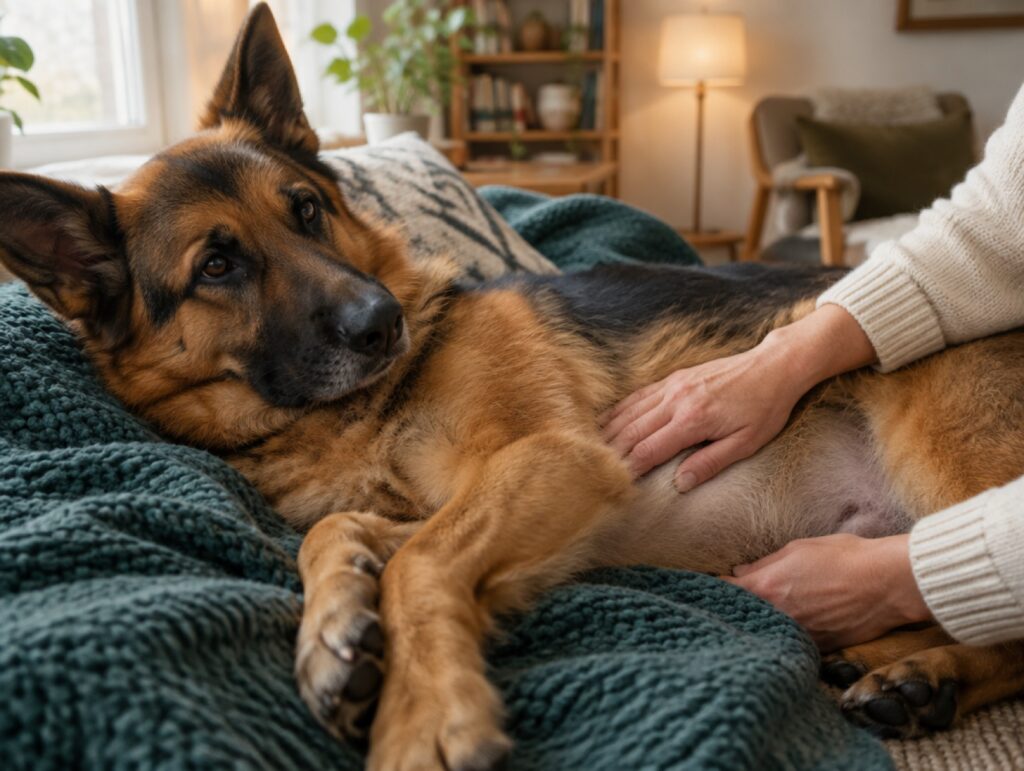
Your dog is lying on his side and his belly is suddenly bigger than it was this morning. A bloated belly in a dog can be frightening, and rightly so: behind it there can be ordinary overeating, but also a condition that will not wait even an hour. The difference can be recognised by a few specific signs. Here you will find what to look for, when to call your vet immediately and what it means when the belly is round but soft.
- A bloated hard belly with unproductive retching, drooling and restlessness is an emergency. According to the ACVS the condition progresses rapidly and mortality is around 15 percent.
- A round but soft belly after a large meal, swallowed air or gas tends to be harmless and settles within a few hours if your dog is otherwise well.
- A belly that gradually gets bigger (over days to weeks) can mean fluid in the abdominal cavity. This belongs at the vet within 24 hours, not in home care.
- In a senior, a large belly can be caused by Cushing’s syndrome or a tumour, in a puppy by intestinal parasites. Only an examination can determine the cause.
- The belly grows quickly and is tight and hard as a drum.
- Your dog tries to vomit without success: he retches but nothing comes up.
- He drools a lot, cannot lie down, paces and is restless.
- He breathes fast and heavily, has pale gums, is weak or collapses.
- The belly is bloated and your dog whimpers or will not let you touch it.
This is what gastric torsion can look like, especially in a large dog with a deep chest. Do not wait to see whether it passes and do not try anything at home. Call your vet or an emergency clinic, say that you suspect gastric torsion, and set off. Time is critical.
What is a bloated belly in a dog and how do you recognise it?
A bloated belly in a dog is a visible enlargement of the abdomen caused by gas, food, fluid or an enlarged organ. In itself it is only a sign, not a diagnosis. What matters is how quickly it appeared, how the belly feels to the touch and how your dog looks.
| Cause | How the belly looks and feels | What next |
|---|---|---|
| Gastric torsion (GDV) | Rapid growth within hours, tight, hard, painful; unproductive retching, drooling, restlessness | Vet or emergency clinic immediately |
| Overeating, swallowed air, gas | Round but soft; your dog is otherwise lively and in no pain | Observe, rest, vet if it gets worse |
| Fluid in the abdomen (ascites) | Grows over days to weeks, the fluid sloshes to the touch, sometimes tiredness and breathlessness | Vet within 24 hours, do not wait |
| Cushing’s syndrome, a tumour in a senior | Sagging, large belly, often thirst, marked hunger, thinning coat | Examination at the vet |
| Intestinal parasites in a puppy | Rounded little belly with a thin body, poor weight gain, dull coat | Stool test and worming as advised by the vet |
Is a bloated hard belly in a dog gastric torsion?
A hard bloated belly together with unproductive retching, drooling and restlessness is the classic picture of gastric torsion, so treat it as an emergency. Gastric torsion (medically gastric dilatation and volvulus, abbreviated GDV) means that the stomach fills with gas and twists around its axis, so the gas cannot get out or on into the intestine.
As early signs the ACVS lists an anxious expression, stretching, drooling, a growing belly and retching with no result, later gasping for breath, weakness and collapse. The Merck Veterinary Manual adds pale gums, a rapid pulse and shock. According to the ACVS a vet confirms the diagnosis with an X-ray.
The ACVS gives mortality as “approximately 15 percent”. According to the ACVS, dogs that have had signs for more than 6 hours, dogs with heart rhythm disorders before surgery and those that need a surgeon to remove part of the stomach or the spleen fare worse. That is why hours of hesitation can cost a life. Treatment is always in the consulting room: stabilisation, relieving the stomach and surgery. Nothing can be done about it at home.
Which dogs are most at risk?
Most often large and giant breeds with a deep chest. The ACVS names, for example, Great Danes, Weimaraners, St Bernards and Irish and Gordon Setters. The Merck Veterinary Manual adds German Shepherds, Standard Poodles and Basset Hounds. The risk grows with age.
The prospective study by Glickman et al. (2000) followed 1,637 dogs of large and giant breeds. Older age, a first-degree relative that had GDV, faster eating and a raised bowl came out as risk factors. The ACVS also counts one large meal a day among the risks. For dogs at risk, preventive attachment of the stomach to the abdominal wall (gastropexy) can be considered, according to the ACVS often together with neutering. Whether your dog needs it is something you will discuss with your vet. According to the ACVS, gastropexy does not prevent bloating, but it helps prevent twisting.
When is a bloated belly after a meal harmless?
A harmless bloated belly is round and soft, and your dog is lively with it, wants to play, drinks and his poop is normal. It typically comes after a larger portion, after gulping food or after play right after feeding. When a dog eats fast he swallows air, and according to VCA swallowed air is probably the biggest source of gas.
Gut bacteria play a part as well. According to VCA they break down (ferment) carbohydrates and some of the fibre in the large intestine, and gas is produced in the process. It is a normal part of digestion, but in some dogs, for example after a change of food, there tends to be more of it. You can find the causes and tips in the article Gas in dogs: 6 causes and what to try. The sounds from the belly are explained in Dog stomach gurgling: when it is normal and when not.
What helps when your dog is otherwise well:
- Let him rest, with no wild games or running right after eating.
- Give the next meal later and make it smaller.
- Next time slow down his eating, for example with a slow-feeder bowl or a snuffle mat.
- When changing food, go slowly (a plan over 7 to 10 days) and keep an eye on what your dog picks up on walks and what falls from the table (a table of dangerous foods).
Watch the line. If the belly does not settle within a few hours, gets tight, or vomiting, restlessness or drooling join in, it is no longer overeating. Call your vet then. With a dog from a high-risk breed, rather go sooner than later. For repeated vomiting read Dog vomiting: when to wait and when to see the vet.
What is fluid in a dog’s belly (ascites)?
Fluid in a dog’s belly, medically ascites, is a build-up of fluid in the abdominal cavity. The belly is then large and usually grows more slowly than with torsion, but your dog may be tired, breathe worse and eat less. Ascites is not an illness in itself, it is a result of another disease, and so it always belongs at the vet.
According to the Merck Veterinary Manual, ascites in liver disease arises as a result of increased pressure in the blood vessels of the liver (portal hypertension), with or without a low level of the protein albumin in the blood. Other causes, according to it, include failure of the right side of the heart, a tumour of the right atrium of the heart, or conditions in which blood cannot drain properly from the liver. A tight belly can make breathing, appetite and your dog’s comfort worse.
What the examination involves is for your vet to decide. Typically they take a sample of the fluid and do blood tests, an ultrasound and an examination of the heart. Fluid cannot be drained at home, and your dog cannot be “dehydrated” to get rid of it. If you also see breathlessness, pale gums or collapse, go straight away.
Why does an old dog have a bloated belly?
In an old dog a bloated belly is more often a warning sign than in a young one, because with age come more diseases that enlarge the belly. You can find an overview of age-related changes in the article Senior dog: 9 changes you should not overlook.
- Cushing’s syndrome (hyperadrenocorticism). The Merck Veterinary Manual lists a sagging, large belly among the common signs. It also mentions increased thirst and urination, marked hunger, panting with an open mouth, loss of muscle and skin changes. The disease mainly affects middle-aged and older dogs.
- Fluid in the belly. Heart, liver and other causes, see above.
- Tumours. They can cause fluid in the belly. The Merck Veterinary Manual gives, for example, a tumour of the right atrium of the heart as a cause of ascites.
- Overweight. Ordinary weight gain looks like a large belly, but it is soft. How to recognise it by the scale is shown in Overweight dog: the ideal weight on a 1–9 scale.
With an old dog, “it’s his age” therefore does not apply. If the belly gradually gets bigger, your dog drinks more, loses muscle or is tired, arrange an examination. If the belly suddenly grows with lethargy and pale gums, go straight away.
Why does a puppy have a bloated belly?
A round little belly in a puppy is normal after a meal, but a rounded belly together with a thin body and poor weight gain can mean intestinal parasites. According to the CAPC (Companion Animal Parasite Council), puppies infected before birth tend to have poor weight gain, a dull coat and often a rounded little belly. Roundworms are passed from the bitch to the puppies, which is why puppies are examined and wormed more often than adult dogs.
Do not worm a puppy on your own and without your vet’s advice. Your vet will choose the product and the timing according to age and weight. Roundworms can also be passed to people, so clean up the stool and wash your hands after contact.
Go to the vet straight away if the puppy is also lethargic, vomits, has diarrhoea, pale gums or the little belly is growing quickly. Puppies lose fluids quickly, and you can read more about other problems in Digestive problems in dogs: signs, causes, what to do.
How do you prevent bloating and what should you watch at home?
At home you can mainly influence the feeding routine. No approach rules out torsion, but some risk factors can be influenced.
- Split the daily ration into 2 or 3 smaller meals. The ACVS counts one large meal a day among the risks.
- With dogs that gulp, slow down their eating and do not raise the bowl unless your vet recommends it. Glickman et al. list a raised bowl among the risk factors.
- If relatives of your dog had GDV or you have a breed from a risk group, ask your vet about prevention (gastropexy).
- Keep emergency help at hand: your vet’s phone number, the address of the nearest 24-hour clinic and the route there. You will find a practical list in the article Dog over the holidays: emergencies, car trips, first aid.
Frequently asked questions
Why does a dog have a bloated and hard belly?
The most dangerous cause is gastric torsion, in which the stomach fills with gas, twists and cannot empty. The signs include a growing hard belly, unproductive retching, drooling and restlessness. It is an emergency and time is critical. Call your vet and set off straight away, do not try anything at home and do not wait until morning.
How do I recognise gastric torsion in a dog?
According to the ACVS, early signs are an anxious expression, drooling, a growing belly and retching with no result, later gasping for breath, weakness and collapse. The most at-risk dogs are large dogs with a deep chest. If you see these signs, do not wait to see whether it passes, and call your vet or an emergency clinic immediately.
How long can a dog survive with gastric torsion?
The exact time cannot be given. The ACVS states that dogs with signs for more than 6 hours have a worse outlook, and it recommends an examination immediately. Early stabilisation and surgery are the best route, which is why it is important to go straight away. According to the ACVS mortality is approximately 15 percent.
Is a bloated belly in an old dog always serious?
Not always, it can be overweight or gas after a meal that does not bother the dog, and the belly stays soft. In a senior, though, a large belly can be caused by Cushing’s syndrome, fluid in the belly or a tumour, so if it gradually gets bigger, arrange an examination. If it suddenly grows, or with lethargy or breathlessness, go straight away.
What is fluid in a dog’s belly and how is it dealt with?
It is a build-up of fluid in the abdominal cavity, medically ascites. It is a sign of another illness, for example of the liver or heart, and the outlook depends on the cause. Your vet finds it with blood tests, an ultrasound and analysis of the fluid. Nothing can be done at home, and waiting only wastes time.
Does a dog bloat after overeating and when does it pass?
After a large meal the belly can be round and soft and the dog is otherwise lively. It should settle within a few hours, and in the meantime the dog behaves normally. If the belly gets tight, the dog vomits or retches, is restless or drools, call your vet straight away.
Has my puppy got a bloated belly and is that normal?
After a meal the little belly can be round. A rounded belly together with a thin body and poor weight gain, though, can mean intestinal parasites, so have the puppy examined and wormed as your vet advises. With lethargy, vomiting or diarrhoea go to the vet straight away, because a puppy quickly loses fluids.
Sources
- American College of Veterinary Surgeons (ACVS). Gastric Dilatation-Volvulus (GDV) in Dogs. acvs.org/small-animal/gastric-dilatation-volvulus
- Merck Veterinary Manual. Gastric Dilation and Volvulus in Small Animals. merckvetmanual.com/digestive-system/diseases-of-the-stomach-and-intestines-in-small-animals/gastric-dilation-and-volvulus-in-small-animals
- Glickman LT, Glickman NW, Schellenberg DB, Raghavan M, Lee T (2000). Non-dietary risk factors for gastric dilatation-volvulus in large and giant breed dogs. Journal of the American Veterinary Medical Association 217(10):1492-1499. doi.org/10.2460/javma.2000.217.1492
- Center SA. Portal Hypertension and Ascites in Small Animals. Merck Veterinary Manual. merckvetmanual.com/digestive-system/hepatic-disease-in-small-animals/portal-hypertension-and-ascites-in-small-animals
- Merck Veterinary Manual. Cushing Syndrome (Hyperadrenocorticism) in Animals. merckvetmanual.com/endocrine-system/the-adrenal-glands/cushing-syndrome-hyperadrenocorticism-in-animals
- Companion Animal Parasite Council (CAPC). Ascarid guidelines (Toxocara canis). capcvet.org/guidelines/ascarid
- VCA Animal Hospitals. Dogs and Gas (intestinal gas, flatulence, borborygmus). vcahospitals.com/know-your-pet/dogs-and-gas
This article is educational and does not replace a veterinary examination. If you are not sure, ask your vet.
This article was proofread with the help of AI. This is a translation from Czech, so it may contain inaccuracies.