Blog · Skin
Tummy and skin: how a dog’s gut relates to its skin
A dog’s gut and skin are probably connected, but the evidence is moderate. Some studies found different gut bacteria in atopic dogs. What does it mean?
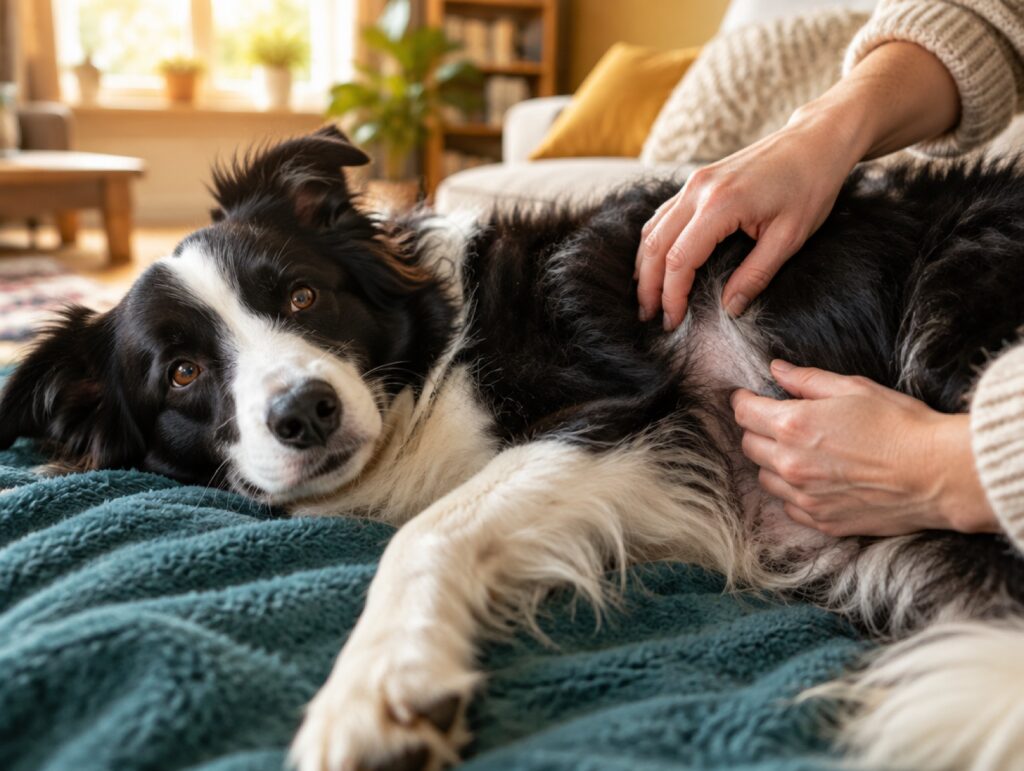
In the evening on the sofa you hear the familiar scratching, and in the morning you find that the poop is softer than usual again. Two separate problems that, in some dogs, show up in the same week. No wonder owners ask whether they are connected. Researchers ask too, and their answer is interesting: there is probably a link, but nobody yet knows which one influences which.
- The gut-skin axis is the idea that gut bacteria and the substances they make influence the immune system, and through it the skin. In dogs it is so far a hypothesis with moderately strong evidence.
- Some small studies found a different composition of gut bacteria in dogs with atopic dermatitis than in healthy dogs, while another study found no difference.
- A link is not a cause: gut bacteria may influence the skin, but it may also work the other way round, and the gut may be changed by the illness itself or by its treatment.
- Shared triggers, for example an allergy to an ingredient in the food, may also connect the gut and the skin.
- Scratching, red skin or repeated digestive problems belong with a vet. Supplements and food changes on your own do not address the cause.
What is the gut-skin axis and why might it exist?
The gut-skin axis is the idea that gut microorganisms and the substances they produce influence the immune system of the whole body, and with it the condition of the skin. A dog’s gut microbiome is the community of bacteria and other microorganisms in its gut. You can read what it is and why it matters in the article Dog gut microbiome: what it is and why it matters.
The reason the gut and the skin might be connected is simple: both are a border between the body and the outside world, and both are populated by microorganisms. The gut also houses a large part of the immune system. According to a 2026 review (Andrzejczak et al.), the gut produces substances, for example short-chain fatty acids, that help the immune system keep its balance. According to the authors, a disturbed balance of gut bacteria can amplify inflammation in the body.
One important note here. That review draws mainly on human data and experiments in mice, not on studies of dogs. The authors themselves state that many of these ideas remain rather theoretical for now and need confirmation in long-term studies. So for dogs the rule is: this is an interesting direction of research, not settled truth.
What do studies in dogs say about the gut-skin axis?
Studies in dogs so far focus mainly on atopic dermatitis, a long-term inflammatory skin disease that some dogs are born prone to and that shows up mainly as itching. The results are interesting, but the small studies do not agree with each other.
| Study | How many dogs | What it found | How much to trust it |
|---|---|---|---|
| Rostaher et al., 2022 | 3 atopic and 4 healthy Beagles | Atopic dogs had lower diversity of gut bacteria | Very low, the authors state the study has low statistical power |
| Sugita et al., 2023 | 12 atopic and 20 healthy dogs | The composition of gut bacteria differed between the groups | Low to moderate, a comparison of two groups at one point in time |
| Felten et al., 2025 | 12 allergic and 9 healthy West Highland White Terriers | No significant difference in the composition of bacteria or in the dysbiosis index | Low, few dogs and a single breed |
Rostaher et al. (2022) compared the stool of 3 atopic and 4 healthy Beagles. According to the authors, the atopic dogs had significantly lower diversity of gut bacteria (p = 0.033). The study is really small, though, and the authors themselves note its low statistical power.
Sugita et al. (2023) compared 12 dogs with atopic dermatitis and 20 healthy dogs. The composition of gut bacteria differed significantly between the groups. By contrast, Felten et al. (2025) found no significant difference in 12 allergic and 9 healthy West Highland White Terriers. So it may depend on the breed, or it may simply be down to small samples.
- 12 vs 20 dogswere in the Japanese study in which the gut bacteria of atopic and healthy dogs differed.Sugita et al., 2023
- 12 vs 9 dogswere in the comparison of West Highland White Terriers that found no difference in bacteria.Felten et al., 2025
- 40 dogscompleted a randomised 2026 study that looked at an intervention in gut bacteria in atopic dermatitis.Felten et al., 2026
- 35% vs 5%of dogs in the intervention group versus the placebo group had a lasting improvement of half or more in skin lesions.Felten et al., 2026
Can changing a dog’s gut bacteria affect its skin?
There is early evidence that it can, but these are experiments supervised by veterinary dermatologists, not advice for home use. The strongest is a randomised 2026 study in which dogs with atopic dermatitis received capsules of dried stool from a healthy donor, or a placebo.
The Felten et al. (2026) study enrolled 46 dogs. Half received capsules for 90 days and three rectal doses of stool from a healthy donor, the other half received a placebo. 40 dogs completed it, 20 in each group. Skin lesions (CADESI-04 score) were lower in the second month in the intervention group (7 ± 6 versus 16 ± 12; p = 0.006). The dogs in the intervention group also needed less medication for the skin. However, itching did not differ between the groups, the dogs were allowed to keep taking their usual medication, and in most of the dogs that were followed up, the problems returned within the year.
The pilot study by Sugita et al. (2023) was small and had no control group: 12 dogs received a single oral dose of stool from a healthy donor, and the skin score after 56 days fell from a median of 16.5 to 8. Without a placebo, though, it is impossible to say how much of that was caused by the intervention and how much by time or the owners’ expectations.
Older work is even more cautious. Marsella (2009) followed 2 adult Beagles with severe atopic dermatitis and 16 of their puppies from two litters. The probiotic Lactobacillus rhamnosus GG was given only to the dam during her second pregnancy and to the puppies of the second litter from 3 weeks to 6 months of age. Those puppies had lower levels of IgE antibodies against mites and a weaker reaction in the skin allergy test than the puppies of the first litter, but the skin signs did not differ between the litters. It was also a single breeding pair, so even this proves nothing.
For you, one thing follows from this: a targeted intervention in gut bacteria is for now a matter for research, and probiotics are not a proven help for a dog’s skin. We write about probiotics in general in the article Probiotics for dogs: what they are and how to choose.
Why can skin and gut problems appear together?
Skin and gut problems can appear together in a dog even without one causing the other. A possible shared trigger is an allergy to an ingredient in the food (technically an adverse food reaction). It can show up as itching, worse digestion or both.
- A shared trigger. In a review of 47 articles, Mueller and Olivry (2018) report that among the non-skin signs of adverse food reactions in dogs, the ones most often influenced by diet are diarrhoea and frequent bowel movements.
- Medication. Antibiotics can temporarily upset gut bacteria. The article Dog after antibiotics: how to support your dog’s tummy is about that.
- Stress. Long-lasting itching and lack of sleep put strain on the whole dog, including the gut. We write about the effect of stress on the tummy in the article Stress diarrhoea in dogs: how the mind affects digestion.
- Coincidence. Both problems are common in dogs, so they can occur together without any connection.
An elimination diet supervised by a vet is so far the most practical way to find a shared trigger. The authors of the Lewis et al. (2025) study state that the gold standard is an elimination diet lasting 6 to 12 weeks, and in practice they recommend at least 8 weeks. In the same study, more than half of the dogs with a diagnosed food allergy needed longer than 4 weeks for the first improvement. So patience pays off. Further reasons why a dog scratches are summarised in the article Why is my dog scratching? 8 causes and when to see a vet.
What can you do for a dog with both skin and gut problems?
You can help your dog by keeping careful notes of the problems and letting your vet find the cause. None of this requires supplements or a change of food on your own.
- Keep a shared diary. Write down itching, the condition of the skin, stool and what your dog ate. Your vet can then more easily tell whether the problems are tied to food.
- Examination first. Itching has a number of other causes, for example fleas, mites or a skin infection. These must be ruled out by a vet.
- Do not change the food because of the skin on your own. The gut needs time for a new diet. You can find out how to make the switch in the article Switching dog food: a 7 to 10 day plan.
- Do not start supplements or human medicines. Without an examination you do not know what will help the skin, and you may distort the results of the examination.
- Stick with the elimination diet. If your vet proposes one, keep to it strictly for the whole time, with no extra treats.
- Consider a stool analysis as an add-on. A microbiome analysis shows the composition of gut bacteria, but it does not diagnose skin problems and does not tell you why your dog scratches. You can find out what it shows and what it does not in the article Dog microbiome test: what a stool analysis can show.
What do we still not know about the gut-skin axis in dogs?
About the gut-skin axis in dogs we do not yet know what is cause and what is effect, in which breeds it applies and whether gut bacteria can be influenced in a way that improves the skin. The evidence is moderately strong because good studies are few.
- The direction of the link. We do not know whether changed gut bacteria make the skin worse or are merely its consequence.
- Breeds. Results differ in Beagles, in dogs of various breeds from Japan and in West Highland White Terriers. There is no general rule yet.
- The size of studies. Studies in dogs have only a handful to a few dozen dogs, not hundreds.
- Practical guidance. No study has yet shown how to adjust gut bacteria with food or supplements in a targeted way so that a dog’s skin improves.
That is fine. An honest “we do not know” is better than a promise nobody can keep. Take away one thing today: watch the skin and the stool together and let your vet find the cause.
Frequently asked questions
Is a dog’s gut connected to its skin?
Probably yes, but the evidence is moderately strong. Some studies found different gut bacteria in dogs with atopic dermatitis than in healthy dogs, while another found no difference. Whether the gut influences the skin or is instead its consequence, nobody knows yet. The strongest dog study, from 2026, showed that an intervention in gut bacteria may reduce skin lesions, but itching did not improve.
Can poor digestion cause itching in a dog?
That has not been shown directly. Both itching and digestive problems can be caused by the same thing, for example an allergy to an ingredient in the food. If both appear together, have your dog examined and do not try changing the food or giving supplements on your own. Itching has a number of other causes, for example fleas, mites or a skin infection, and these must be ruled out by a vet.
Will a probiotic help a dog with itchy skin?
Verified evidence is still missing. In an older study, the puppies of atopic Beagles that received the probiotic Lactobacillus rhamnosus GG had lower immune markers of allergy, but the same skin signs as puppies without the probiotic. Always talk to your vet about using probiotics. That study also followed a single breeding pair, so it proves nothing.
Is a microbiome analysis worth doing when a dog scratches?
A stool analysis shows the composition of gut bacteria, but it does not diagnose skin problems and does not explain why your dog scratches. The cause of itching is determined by a vet through an examination. The analysis can be an add-on, not a substitute for an examination. If your dog scratches, first have it examined for fleas, mites, a skin infection and allergy. A microbiome analysis also does not replace the elimination diet that a vet runs when a food allergy is suspected.
How long does an elimination diet take in a dog?
According to the authors of the Lewis et al. (2025) study, an elimination diet for a suspected food allergy takes 6 to 12 weeks, and in practice at least 8 weeks. In that study, more than half of the dogs with a diagnosed allergy needed longer than 4 weeks for the first improvement. A vet always runs the diet.
Should I change the food of a dog with atopic dermatitis because of the gut?
Not on your own. No study has yet shown what composition of diet improves the skin of an atopic dog through the gut. A food change may even make the problems worse. The diet is decided with a vet, who may propose an elimination diet. When a food allergy is suspected, it lasts at least 8 weeks and your dog must not get anything else during it, not even treats.
Sources
- Rostaher A, Morsy Y, Favrot C, Unterer S et al. (2022). Comparison of the Gut Microbiome between Atopic and Healthy Dogs: Preliminary Data. Animals. doi.org/10.3390/ani12182377
- Sugita K, Shima A, Takahashi K et al. (2023). Pilot evaluation of a single oral fecal microbiota transplantation for canine atopic dermatitis. Scientific Reports. doi.org/10.1038/s41598-023-35565-y
- Felten V, Turck JL, Unterer S et al. (2025). An insight into the gut microbiota of healthy and allergic West Highland White Terrier dogs. PLOS One. doi.org/10.1371/journal.pone.0328100
- Felten V, West EA, Martini F et al. (2026). Faecal Microbiota Transplantation Reduces Lesion Severity and Medication Use in Canine Atopic Dermatitis: A Randomised, Placebo-Controlled, Double-Blinded Clinical Trial. Veterinary Dermatology. doi.org/10.1111/vde.70092
- Marsella R (2009). Evaluation of Lactobacillus rhamnosus strain GG for the prevention of atopic dermatitis in dogs. American Journal of Veterinary Research. doi.org/10.2460/ajvr.70.6.735
- Andrzejczak K, Kucharczyk E, Sternak A et al. (2026). Gut Dysbiosis and the Molecular Landscape of the Gut-Skin Axis: Comparative Insights and Therapeutic Implications for Atopic Dermatitis and Psoriasis (data from humans and mice). Cells. doi.org/10.3390/cells15070594
- Mueller RS, Olivry T (2018). Critically appraised topic on adverse food reactions of companion animals (6): prevalence of noncutaneous manifestations of adverse food reactions in dogs and cats. BMC Veterinary Research. doi.org/10.1186/s12917-018-1656-0
- Lewis TP, Moore GE, Laporte C et al. (2025). Evaluation of hydrolyzed salmon and hydrolyzed poultry feather diets in restrictive diet trials for diagnosis of food allergies in pruritic dogs. Frontiers in Veterinary Science. doi.org/10.3389/fvets.2025.1560806
This article is educational and does not replace a veterinary examination. If you are not sure, ask your vet.
This article was proofread with the help of AI. This is a translation from Czech, so it may contain inaccuracies.