Blog · Digestion
Probiotics for dogs after antibiotics: what studies say
Probiotics for dogs after antibiotics: what small studies show, when to give them, which strains the EU authorises and when they are not enough. Ask your vet.
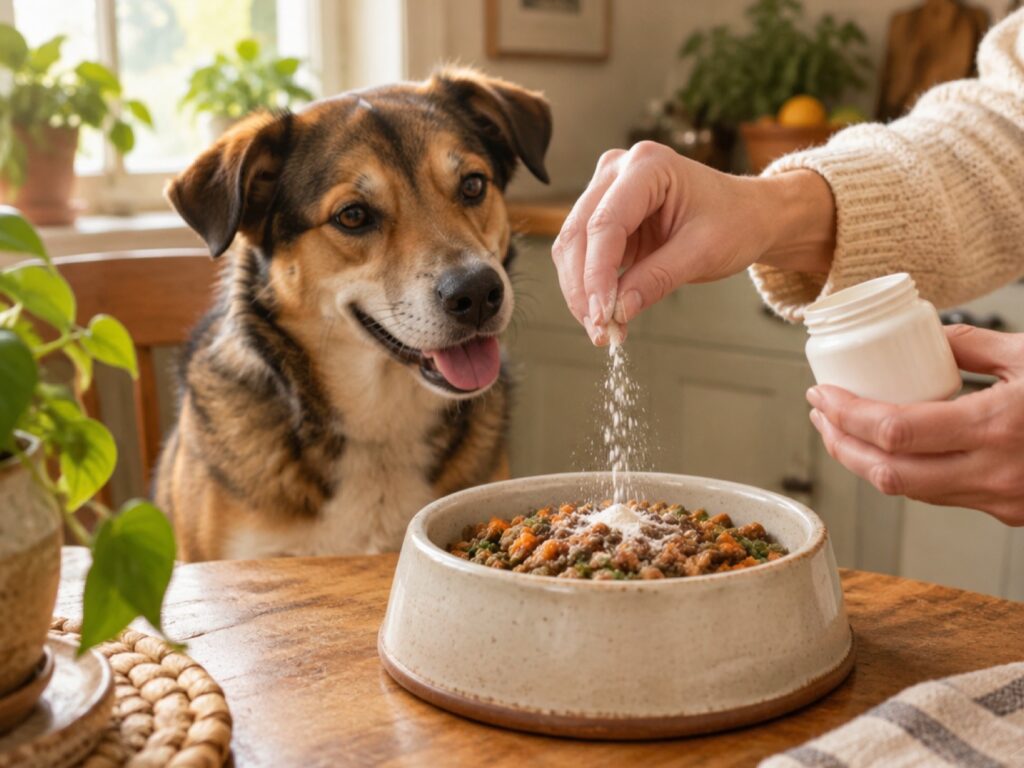
Your dog has finished the antibiotics, the tummy is still not cooperating and you are wondering whether to add probiotics. Probiotics for a dog after antibiotics have shown promising results in a few small studies, but the evidence is weak. This article is about the studies. The general approach after treatment, that is the routine, watching the stool and a plan for the weeks after the last tablet, is in the wider guide Dog after antibiotics: diarrhoea, probiotics, gut recovery.
- In a study of 22 healthy dogs given enrofloxacin and metronidazole, all 22 dogs had diarrhoea, including those given a synbiotic. The synbiotic reduced the swings in food intake (Whittemore et al., 2019).
- Two small studies with the antibiotic cefovecin showed that dogs given a probiotic had a more stable diversity of gut bacteria than dogs without one (Han et al., 2025; Kim et al., 2025).
- In the best-described study the synbiotic was given one hour after the antibiotic. Whether and when to give a probiotic is something to decide with your vet, following the manufacturer’s label.
- Authorisation of a strain in the EU means safety, not a therapeutic effect.
Why are probiotics for a dog discussed after antibiotics?
Antibiotics hit not only the cause of the illness but also the beneficial bacteria in the gut. The problem is real: in a study of 22 healthy dogs given enrofloxacin with metronidazole for three weeks, 100 percent of the dogs had diarrhoea in the first period and 77 percent vomited (Whittemore et al., 2019). After 14 days of metronidazole in 16 healthy dogs, the overall composition of bacteria had still not fully returned 4 weeks after stopping (Pilla et al., 2020). You can find more about the disturbed balance in the article Dysbiosis in dogs: causes, signs and what to do and Dog gut microbiome: what it is and why it matters.
What do studies of probiotics in dogs on antibiotics show?
The studies show a modest benefit, mainly in markers in the bacteria, not in how the dog feels. Five studies in the table followed dogs on antibiotics given a probiotic or synbiotic directly. All of them are small.
| Study | Dogs and antibiotic | What the dogs were given | What came out |
|---|---|---|---|
| Whittemore et al., 2019 | 22 healthy dogs, 3 weeks of enrofloxacin with metronidazole | A mix of bacteria and yeast, or placebo | All had diarrhoea. With the product there were smaller swings in food intake. |
| Whittemore et al., 2021 | 22 healthy dogs, the same combination of antibiotics | The same type of product, or placebo | Within 8 weeks after treatment the overall composition of bacteria and the dysbiosis index returned only in the group given the product. |
| Fenimore et al., 2017 | Shelter dogs with diarrhoea, 7 days of metronidazole | Enterococcus faecium SF68 or placebo | With the probiotic the dogs had more days with normal stool (66 versus 47 percent of days, P = 0.0496). Normal stool on day 7 did not differ significantly. |
| Han et al., 2025 | 12 healthy dogs after neutering, antibiotic cefovecin | 7 dogs a probiotic for 2 weeks, 5 dogs nothing | Bacterial diversity fell without the probiotic and stayed stable with it (P = 0.025). |
| Kim et al., 2025 | 14 healthy young dogs after neutering, one injection of cefovecin | 7 dogs a probiotic complex for 2 weeks, 7 dogs nothing | Bacterial diversity was higher with the probiotic. |
Another study in healthy dogs looked at the yeast Saccharomyces cerevisiae during metronidazole. According to it, the disturbance of gut bacteria resolved in both groups by day 24, that is a week after the antibiotic ended (Arghavani et al., 2025).
Whittemore et al. (2019) used a product with several strains of bacteria including Enterococcus faecium and the yeast Saccharomyces boulardii with the prebiotic beta-glucan. A follow-up study showed that 8 weeks after treatment the overall composition of bacteria and the dysbiosis index had returned in the synbiotic group, but not with placebo, and diversity stayed lower in both (Whittemore et al., 2021).
Fenimore et al. (2017) did not look at prevention but at shelter dogs with diarrhoea who were given metronidazole as treatment. According to a taxonomic study, strain SF68 is listed in the EU as Enterococcus lactis NCIMB 10415 (Franz et al., 2024). Both Korean studies share authors and have a similar design (healthy dogs after neutering, one injection of cefovecin), so do not count them as two independent pieces of evidence. Han and colleagues themselves describe their work as a preliminary report.
How strong is the evidence for probiotics after antibiotics?
The evidence is weak and suggests a benefit rather than proving it. Reviews that assess probiotics for canine gut problems in general are cautious:
- 17 of 165studies found on probiotics in dogs with gut disease met the conditions of the review. The authors summarised that the effect in preventing and treating acute illness is very limited.Jensen, Bjørnvad, 2019
- 6 studieswith prebiotics, probiotics and synbiotics in acute diarrhoea in dogs found no clinically significant shortening of the diarrhoea, and the certainty of the evidence ranged from very low to moderate.Scahill et al., 2024
- 5 of 7conference abstracts on probiotics in dogs and cats that reported a clinical effect were published in a journal. For abstracts with no effect it was only 1 of 5.Weese, 2025
- 4 of 15probiotics for animals that promised a specific number of live bacteria actually contained it.Weese, Martin, 2011
Studies on antibiotics have their own weaknesses: small groups of healthy dogs instead of sick ones with an infection, different products and markers in the bacteria rather than in how the dog digests. The study by Whittemore et al. (2021) was funded by the product’s manufacturer through a grant, and an employee of its manufacturer took part in the study with the yeast (Arghavani et al., 2025).
Probiotics during antibiotics or only after them?
The studies used both, and none of the studies discussed compared timing with each other. The exact gap from the antibiotic therefore cannot be determined from the data, so follow the recommendation of your vet and the manufacturer of the product.
Whittemore et al. (2019) gave the synbiotic throughout the 3 weeks of antibiotics, always an hour after the dose. Kim et al. (2025) and Han et al. (2025) started on the day of neutering and the cefovecin injection and continued for 2 weeks. Arghavani et al. (2025) started 11 days before metronidazole and continued to day 31.
There is therefore no single verified scheme. Do not mix anything with the antibiotic on your own and do not stop anything.
Which probiotic strains are authorised for dogs in the EU?
Authorisation of a strain as a feed additive concerns safety and conditions of use, not a therapeutic effect. You will find the number on the label, and for probiotics it usually starts with 4b.
| Strain | Number and regulation | Studies with antibiotics in dogs |
|---|---|---|
| Enterococcus lactis NCIMB 10415 (also E. faecium SF68 in the literature) | 4b1705ii, Regulation (EU) 2024/2394 | Fenimore et al. (2017): shelter dogs with diarrhoea and metronidazole, more days with normal stool |
| Limosilactobacillus reuteri DSM 32203 | 4b1850, Regulation (EU) 2023/256 | No study with antibiotics in this overview |
| Saccharomyces cerevisiae MUCL 39885 | 4b1710, Regulation (EU) 2022/272 | No study with antibiotics in this overview |
| Saccharomyces cerevisiae DSM 34246 | 4b1873, Regulation (EU) 2025/154 | No study with antibiotics in this overview |
The studies on antibiotics were mostly done with products other than the authorised strains: Whittemore used a mix of several strains and Arghavani a commercial yeast product, for which we do not know whether it is one of the authorised strains. Do not transfer the results to just any probiotic. You can find how to read a label in the article Probiotics for dogs: what they are and how to choose.
How long should a dog be given a probiotic after antibiotics?
There is no rule on the length of giving it to dogs after antibiotics. The studies gave probiotics for 7 days (Fenimore et al., 2017), 2 weeks (Han et al., 2025; Kim et al., 2025), 21 days (Whittemore et al., 2019) and 31 days (Arghavani et al., 2025), but nobody compared the optimal length.
In practice, the manufacturer’s instructions and your vet’s advice apply. Remember two things:
- The poop does not reveal everything. In 7 of 16 dogs the conversion of bile acids stayed disrupted 4 weeks after stopping metronidazole (Pilla et al., 2020). Better stool therefore does not mean recovery is complete.
- If things get worse, stop and phone. If problems get worse after giving it, stop the probiotic and call your vet.
A dog has diarrhoea after antibiotics: will lactic acid bacteria for a dog help?
Lactic acid bacteria make lactic acid, and they include Enterococcus and the genera that arose from splitting the genus Lactobacillus (Zheng et al., 2020). They can be part of a probiotic for dogs, but diarrhoea during antibiotics has several causes, including the illness itself. You can find more in the articles Diarrhoea in dogs: what to do and when to see a vet and Soft stool in dogs and puppies: causes and what to do.
Yoghurt and a human probiotic will not replace one. Kefir did not affect stool consistency in a study of 12 healthy dogs (Metras et al., 2023), and according to the Merck Veterinary Manual dairy products should not be given to dogs with diarrhoea because of possible lactose intolerance. Chewable vitamins and supplements for people may contain xylitol, which is poisonous to dogs (FDA).
When is a probiotic not enough and your dog belongs at the vet?
A probiotic does not treat an infection, does not replace the antibiotic and solves nothing if the problems have another cause. If diarrhoea lasts longer than 24 to 48 hours or gets worse, do not wait for the probiotic to work and contact your vet.
- There is blood in the stool or it is black and tarry: call immediately.
- Diarrhoea lasts longer than 24 to 48 hours or gets worse.
- Your dog vomits repeatedly, vomits blood or cannot keep water down.
- He is lethargic, has a fever or refuses food for more than 24 hours.
- He has a swollen hard belly, a swollen face, hives or trouble breathing.
- He staggers, trembles, has seizures or twitching eyes.
- A puppy, an older dog or a dog with a chronic illness has problems.
How do you talk about a probiotic after antibiotics with your vet?
Go to the check-up with specific questions, because your vet knows the antibiotic, the length of treatment and the condition of your dog.
- Say what your dog took. The name of the antibiotic, for how long and in what form (tablets, injection), plus the state of the stool and appetite.
- Ask about timing. Whether a probiotic makes sense, when to start and what gap from the antibiotic to keep.
- Choose a product for dogs by its label. The exact name of the strain, the number of live bacteria and the 4b number. Give it according to the manufacturer’s instructions, without dosing it yourself.
- Keep notes. Stool, appetite and energy. If problems return, bring the notes.
Frequently asked questions
Should dogs be given probiotics after antibiotics?
They can be, but it is not compulsory. Small studies in healthy dogs suggest that a probiotic may help maintain the diversity of gut bacteria, but the certainty is not high. Whether your dog needs one, which product for dogs to choose and when to give it is something to decide with your vet. Do not give human probiotics.
When should I give my dog probiotics during antibiotics?
The exact gap cannot be determined from the data. In the study by Whittemore et al. (2019) the synbiotic was given an hour after the antibiotic, while other studies started on the day of the antibiotic injection or even before treatment. None compared the timing. Follow your vet’s instructions and the label of the product, and do not mix it with the antibiotic on your own.
My dog has diarrhoea after antibiotics. Will a probiotic help?
It may help, but it is not certain. In a study with a combination of two antibiotics all the dogs had diarrhoea, including those given a synbiotic (Whittemore et al., 2019). If it lasts longer than 24 to 48 hours, gets worse or contains blood, contact your vet.
How long should I give my dog a probiotic after antibiotics?
There is no general rule. Studies gave probiotics from 7 days to 31 days, but did not compare the lengths. Follow the manufacturer’s instructions and your vet’s recommendation. If problems get worse after giving it, stop the product and call your vet. Problems that last longer are a reason for an examination, not for more supplements.
Are lactic acid bacteria for a dog the same as yoghurt?
No. Lactic acid bacteria in a probiotic for dogs have a named strain and a number of live bacteria. With yoghurt or kefir you do not know what your dog is getting, and they contain lactose. Kefir did not affect stool consistency in a study of 12 healthy dogs (Metras et al., 2023). Choose a product made for dogs.
Which probiotics are authorised for dogs in the EU?
Authorised, for example, are Enterococcus lactis NCIMB 10415 (4b1705ii), Limosilactobacillus reuteri DSM 32203 (4b1850) and the yeasts Saccharomyces cerevisiae MUCL 39885 (4b1710) and DSM 34246 (4b1873). Authorisation concerns safety, not a therapeutic effect. You will find the number on the label. More in the article Probiotics for dogs.
Sources
- Whittemore JC, Moyers TD, Price JM (2019). Randomized, controlled, crossover trial of prevention of antibiotic-induced gastrointestinal signs using a synbiotic mixture in healthy research dogs. Journal of Veterinary Internal Medicine 33(4):1619–1626. doi.org/10.1111/jvim.15553
- Whittemore JC et al. (2021). Effects of synbiotics on the fecal microbiome and metabolomic profiles of healthy research dogs administered antibiotics: a randomized, controlled trial. Frontiers in Veterinary Science 8:665713. doi.org/10.3389/fvets.2021.665713
- Fenimore A, Martin L, Lappin MR (2017). Evaluation of metronidazole with and without Enterococcus faecium SF68 in shelter dogs with diarrhea. Topics in Companion Animal Medicine 32(3):100–103. doi.org/10.1053/j.tcam.2017.11.001
- Han DW et al. (2025). Preliminary report: Protective effects of probiotics on cefovecin-induced gut dysbiosis in dogs. Canadian Journal of Veterinary Research 89(1):32–35. PMID 39744464
- Kim SJ et al. (2025). Beneficial effects of probiotics on dysbiosis of gut microbiota induced by antibiotic treatment in healthy dogs. Research in Veterinary Science 191:105674. doi.org/10.1016/j.rvsc.2025.105674
- Arghavani S et al. (2025). Impact of Saccharomyces cerevisiae on the intestinal microbiota of dogs with antibiotic-induced dysbiosis. Frontiers in Veterinary Science 12:1462287. doi.org/10.3389/fvets.2025.1462287
- Pilla R et al. (2020). Effects of metronidazole on the fecal microbiome and metabolome in healthy dogs. Journal of Veterinary Internal Medicine 34(5):1853–1866. doi.org/10.1111/jvim.15871
- Jensen AP, Bjørnvad CR (2019). Clinical effect of probiotics in prevention or treatment of gastrointestinal disease in dogs: a systematic review. Journal of Veterinary Internal Medicine 33(5):1849–1864. doi.org/10.1111/jvim.15554
- Scahill K et al. (2024). Efficacy of antimicrobial and nutraceutical treatment for canine acute diarrhoea: a systematic review and meta-analysis for European Network for Optimization of Antimicrobial Therapy (ENOVAT) guidelines. The Veterinary Journal 303:106054. doi.org/10.1016/j.tvjl.2023.106054
- Weese JS (2025). Evaluation of publication bias in the assessment of probiotic treatment for gastrointestinal disease in dogs and cats. Canadian Veterinary Journal 66:250–254. PMID 40084240
- Weese JS, Martin H (2011). Assessment of commercial probiotic bacterial contents and label accuracy. Canadian Veterinary Journal 52(1):43–46. PMID 21461205
- Franz CMAP et al. (2024). An update on the taxonomy and functional properties of the probiotic Enterococcus faecium SF68. Beneficial Microbes 15(2):211–225. doi.org/10.1163/18762891-bja00005
- Zheng J et al. (2020). A taxonomic note on the genus Lactobacillus: description of 23 novel genera. International Journal of Systematic and Evolutionary Microbiology 70(4):2782–2858. doi.org/10.1099/ijsem.0.004107
- Metras BN, Oba PM, Miller MJ, Swanson KS (2023). Effects of commercial and traditional kefir supplementation on apparent total tract macronutrient digestibility and the fecal characteristics, metabolites, and microbiota of healthy adult dogs. Journal of Animal Science 101:skad316. doi.org/10.1093/jas/skad316
- Merck Veterinary Manual. Malabsorption Syndromes in Small Animals (section on lactose intolerance). merckvetmanual.com
- U.S. Food and Drug Administration. Paws Off Xylitol; It’s Dangerous for Dogs. fda.gov/consumers/consumer-updates/paws-xylitol-its-dangerous-dogs
- Commission Implementing Regulation (EU) 2024/2394 of 9 September 2024, renewal of the authorisation of Enterococcus lactis NCIMB 10415 (4b1705ii) as a feed additive for cats and dogs. eur-lex.europa.eu
- Commission Implementing Regulation (EU) 2023/256 of 6 February 2023, authorisation of Limosilactobacillus reuteri DSM 32203 (4b1850) as a feed additive for dogs. eur-lex.europa.eu
- Commission Implementing Regulation (EU) 2022/272 of 23 February 2022, authorisation of Saccharomyces cerevisiae MUCL 39885 (4b1710) as a feed additive for dogs, among other species. eur-lex.europa.eu
- Commission Implementing Regulation (EU) 2025/154 of 29 January 2025, authorisation of Saccharomyces cerevisiae DSM 34246 (4b1873) as a feed additive for dogs and cats. eur-lex.europa.eu
This article is educational and does not replace a veterinary examination. If you are not sure, ask your vet.
This article was proofread with the help of AI. This is a translation from Czech, so it may contain inaccuracies.