Blog · Senior
Senior dog: 9 changes you should not overlook
Is your old dog slowing down, drinking more, losing weight or wandering at night? 9 senior dog changes that are not just age, and when to see a vet right away.
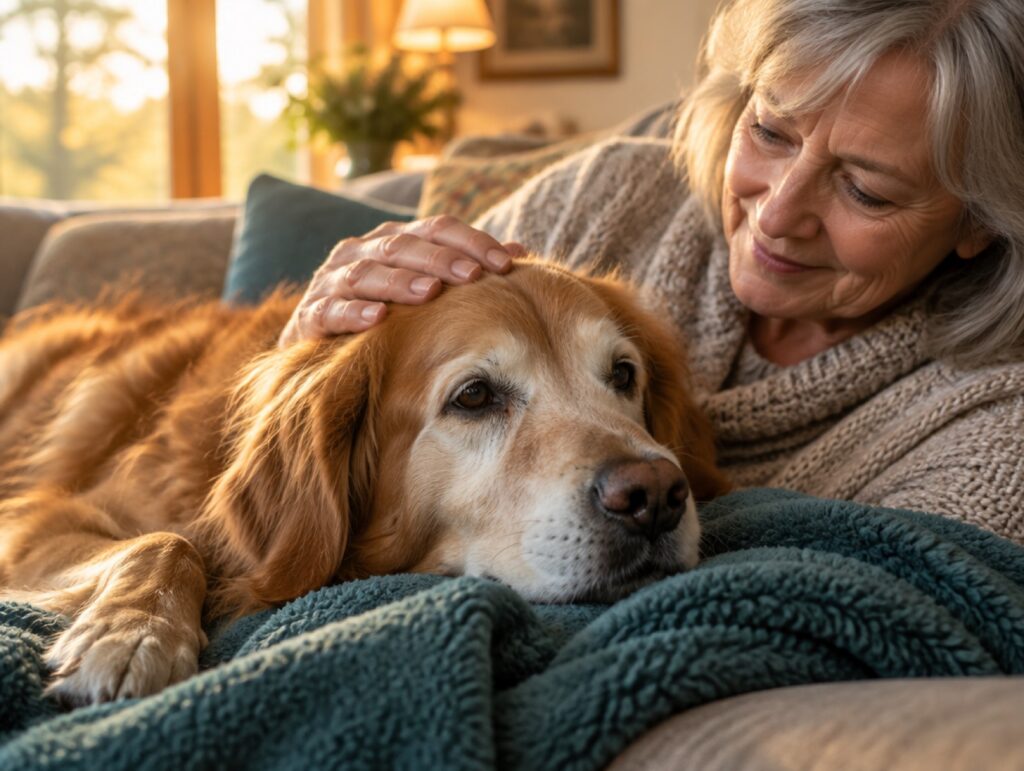
Your old dog no longer jumps onto the sofa in one go, but tries twice. On walks it lags behind, and at night it wanders around the flat. It is easy to put all of this down to age, but age is not a disease. Some of these changes can be eased if you notice them in time, and here you will find the nine most important ones.
- According to the American Animal Hospital Association (AAHA), a senior dog is a dog in the last quarter of its estimated lifespan, so giant breeds age earlier than small ones.
- Ageing itself is not a disease. Stiffness, greater thirst, weight loss, restlessness at night or toothache often have a treatable cause.
- A veterinary check-up twice a year for a senior is the usual recommendation, because changes develop slowly and owners notice them late.
- Laboured breathing, collapse, sudden weakness or blood in the stool or urine are reasons to go to the vet straight away. Have a new lump examined soon, even if it does not hurt your dog.
At what age is a dog a senior?
A senior dog is a dog in the last quarter of its estimated life. AAHA does not give an exact age. Lifespan depends on the breed and size of the dog. According to VCA Animal Hospitals, giant breeds are seniors from roughly 5 to 6 years, while small breeds usually only from 10 to 12 years.
A Chihuahua at eight years old may not be slowing down yet, while a Great Dane of the same age should already be watched closely. The best rule is to compare your dog with how it used to be: the change since last year matters more than the age.
Which 9 changes in an old dog should you not overlook?
In an old dog, the main things not to overlook are stiffness, slowing down, greater thirst, weight loss or weight gain, toothache, new lumps, restlessness at night, accidents in the flat and poorer sight or hearing. Subtle little things are often the first sign. Dogs hide pain, so when you can see it, it has often been going on for a while already.
| Change | What may be behind it | What to do |
|---|---|---|
| Stiffness, hesitating on stairs | Osteoarthritis, pain | Book an examination |
| Tires quickly, slows down | Pain, heart, other illnesses | Book an examination |
| Drinks more and wees more | Diabetes, kidneys, Cushing’s disease | Book soon |
| Loses or gains weight | Muscle loss, illness, too little exercise | Weigh your dog, book an appointment |
| Bad breath, eats on one side | Tartar, gum inflammation, toothache | Book a dental check |
| A new lump or a wound that does not heal | Benign or malignant tumour | Have it examined, do not wait |
| Restless at night, wandering | Cognitive dysfunction, pain | Book an examination |
| Poop or a puddle indoors | Illness, pain, cognitive changes | Book an examination |
| Poorer sight or hearing | Ageing, eye or ear disease | Book an examination |
1. Why is my dog stiff and hesitating on the stairs?
Stiffness after getting up, hesitating before stairs and reluctance to jump onto the sofa are among the most common signs of joint pain. According to VCA Animal Hospitals, the five main signs of osteoarthritis are stiffness or limping, reluctance to use stairs and jump, slowing down on walks, weight gain and a change in posture.
- 2.5%of dogs in UK veterinary practices were diagnosed with osteoarthritis of the limbs within a year. The risk rose in dogs older than 8 years.Anderson et al., 2018, 455,557 dogs
- 11.4%of their lives, on average, was spent with osteoarthritis in dogs whose dates of diagnosis and death were both known.Anderson et al., 2018, 384 dogs
The figures come from veterinary practices and count only diagnosed cases, and according to the authors the real number of dogs with osteoarthritis is likely to be higher. According to VCA, people often interpret these signs as normal ageing, but age is not a disease, and moderate to severe osteoarthritis may be behind the slowing down. If you notice stiffness, have your dog examined, and leave the decision about pain treatment to your vet.
2. Why does my dog run out of energy so quickly?
When a dog tires sooner than usual or loses interest in play, it may be pain, heart disease or another health problem. AAHA lists gradual lethargy, changes in behaviour, reduced appetite and weight loss among the common signs of chronic diseases. Age alone is not enough as an explanation.
Note how far into a walk your dog starts to slow down. A specific figure tells your vet more than an impression.
3. What does it mean when my dog drinks more?
A dog that drinks clearly more than before needs an examination, because the most common causes are diabetes, Cushing’s disease and chronic kidney disease. According to the American Kennel Club, a dog normally drinks roughly 40 to 60 ml of water per kilogram a day, and more than 100 ml per kilogram counts as excessive thirst.
For a dog weighing 20 kg that means normally 800 to 1,200 ml a day, and above 2 litres is a warning. Measure it: in the morning pour a measured amount of water into the bowl, write down how much you top up during the day, and the next morning subtract what is left in the bowl. Never restrict your dog’s water without your vet’s instructions, as dehydration is a risk. Increased thirst is a reason to book an appointment, not to wait.
4. Why is my old dog losing or gaining weight?
An old dog often loses muscle and gains fat, and sometimes even loses weight overall. According to AAHA, dogs in older age usually lose muscle mass, gain fat, and in advanced age lose weight overall. Obesity in seniors is more common in dogs than in cats and worsens mobility.
AAHA lists gradual weight loss among the common signs of chronic diseases. Weigh your dog once a month and run your hands over its ribs and spine.
5. Why does my dog’s breath smell and why does it eat carefully?
Bad breath, drooling or chewing on one side often mean a dental problem that hurts your dog. According to AAHA, older dogs may have an increased risk of gum disease and tumours in the mouth. AAHA therefore recommends examining the mouth at every vet visit.
You may not recognise sore teeth, because a dog often keeps eating. Notice whether it drops a piece of kibble, tilts its head or avoids hard treats. We write about tartar in detail in the article Dog tartar: 4 stages and what actually works.
6. What should I do about a new lump on the body?
Have every new lump on a senior examined, because you cannot tell from its appearance whether it is harmless. AAHA warns that a malignant skin tumour (a mast cell tumour) can look the same as a harmless fatty lump (a lipoma). It therefore calls the “wait and see” approach risky.
The vet usually takes a sample from the lump with a needle and sends it for analysis.
7. Why does my dog walk around the flat at night as if it did not know where it is?
Canine cognitive dysfunction is an age-related brain disease in which a dog becomes disoriented and its daily rhythm and behaviour change. According to AAHA, the most common signs include sleeping during the day, restlessness at night, less interest in the family, disorientation and anxiety.
- 28%of eleven- to twelve-year-old dogs had problems in at least one of four areas (orientation, contact with people, house-training, sleep), according to their owners.Neilson et al., 2001, 180 dogs
- 68%of fifteen- to sixteen-year-old dogs had problems in at least one of these areas.Neilson et al., 2001
The study was based on telephone interviews with owners, not on brain examinations, so it is not a diagnosis. AAHA states that roughly 14 to 22.5% of dogs older than 8 years suffer from cognitive impairment. According to AAHA, care is more effective when started early, so do not wait. Restlessness at night can also be caused by pain, though, and your vet rules that out first.
8. Why has my dog started to wee or poop indoors?
Accidents in the flat in a previously house-trained senior are not a “bad habit” but a symptom. AAHA lists loss of learned house-training among the signs of cognitive dysfunction. It may equally be pain, an infection or another illness.
Do not punish your dog for an accident, as it does not understand why. Write down when and where it happened and tell your vet. For changes in the stool, our overview Dog poop: what colour, shape and consistency reveal is also handy.
9. How can I tell if my dog’s sight or hearing is failing?
A dog that bumps into furniture, does not notice you behind it or does not react when called may have failing sight or hearing. VCA Animal Hospitals lists a noticeable decline in sight among the reasons for an examination. AAHA counts sight and hearing among the areas that the vet asks about when taking a senior’s medical history.
Most dogs adapt to weaker senses if you do not rearrange the furniture at home. Speak to your dog where it can see you, and do not wake it with a touch from behind while it sleeps. Poorer sight can have a treatable cause, though, so have it checked.
How should I adjust walks for an old dog?
An old dog does better with shorter, more frequent walks at a calm pace, not one long one. Exercise maintains muscle and helps keep weight down, and lower weight spares the joints. AAHA states that obesity worsens mobility.
- Split the exercise. Three short walks are better than one long one. Your dog sets the pace.
- Let your dog sniff. Sniffing occupies and tires a dog more than a brisk pace.
- Watch after the walk. Stiffness in the evening or the next morning shows whether the walk was too long.
How do I get an old dog through winter?
In winter, an old dog benefits from a warm, non-slip place to sleep, shorter outings and calm games at home. It has not been reliably shown that cold makes dogs’ joints worse. Some dogs do look stiffer in the morning, though, so do not rush them in winter.
VCA Animal Hospitals advises a comfortable bed for seniors, ramps or steps to the bed and sofa, and staying indoors in extreme weather. On slippery floors, carpets or non-slip runners help. Outside, snow and salt may irritate the paws, and you will find more in the article Winter paws: salt, licking and cracked pads.
How often should I take a senior for a check-up?
Have a healthy senior examined by a vet at least twice a year, advises VCA Animal Hospitals. AAHA recommends blood and urine tests once or twice a year in older dogs, so that diseases are found before you notice them.
- Film a video. Your dog walking, getting up and on the stairs. According to AAHA, videos help assess mobility and pain.
- Keep a record. The date, what changed, how much your dog drank and how it eats. It helps your vet a lot.
- Ask about pain. Ask your vet how to recognise and ease pain. Do not give human medicines, as they can seriously harm your dog.
Ageing is natural, but most of the changes in this article can be eased if you catch them early. Today, film your dog getting up and walking on the stairs, and compare it in six months. Save the article or send it to the family members who look after your dog with you.
Frequently asked questions
At what age is a dog a senior?
It depends on size. AAHA defines a senior as a dog in the last quarter of its estimated life. According to VCA, for giant breeds that is usually from 5 to 6 years, for small breeds usually from 10 to 12 years. Your vet will determine the exact age according to the breed and condition.
Is it normal for an old dog to sleep a lot?
A little more sleep comes with ageing, but a sharp change is not normal. If your dog has become weaker, stopped playing, sleeps during the day and wanders at night or avoids movement, it may be pain or illness. Have it examined, as sleep on its own explains nothing.
How can I tell that something hurts my old dog?
In an old dog, pain shows mainly as a change in movement and behaviour. Watch for stiffness, limping, reluctance to climb stairs or get on the sofa, slowing down on walks, a change in posture and mood. According to VCA, dogs hide pain until it is severe, and people often interpret these signs as old age. If you suspect pain, go to the vet sooner and do not give your dog human medicines.
Can an ageing dog’s brain be supported in any way?
Yes, but first the vet must rule out other causes, for example pain, which also causes restlessness at night. AAHA states that care for cognitive dysfunction works best when started early, so do not dismiss changes in behaviour. The specific approach, diet and any medicines are always chosen by the vet. Do not try supplements or medicines on your own.
Sources
- Dhaliwal R et al. (2023). 2023 AAHA Senior Care Guidelines for Dogs and Cats. Journal of the American Animal Hospital Association. doi.org/10.5326/JAAHA-MS-7343
- Neilson JC, Hart BL, Cliff KD, Ruehl WW (2001). Prevalence of behavioral changes associated with age-related cognitive impairment in dogs. Journal of the American Veterinary Medical Association. doi.org/10.2460/javma.2001.218.1787
- Anderson KL et al. (2018). Prevalence, duration and risk factors for appendicular osteoarthritis in a UK dog population under primary veterinary care. Scientific Reports. doi.org/10.1038/s41598-018-23940-z
- VCA Animal Hospitals. Senior Dog Care. vcahospitals.com/know-your-pet/senior-dog-care
- VCA Animal Hospitals. Five signs your pet has osteoarthritis. vcahospitals.com/resources/conditions/five-signs-your-pet-has-osteoarthritis
- American Kennel Club. Why Is My Dog Drinking So Much Water? akc.org/expert-advice/health/why-is-my-dog-drinking-so-much-water
This article is educational and does not replace a veterinary examination. If you are not sure, ask your vet.
This article was proofread with the help of AI. This is a translation from Czech, so it may contain inaccuracies.