Blog · Health
Kennel cough in dogs: symptoms, course and when to see a vet
Kennel cough, a contagious dry cough, usually lasts 10 to 20 days and often clears up on its own. See a vet at once for fever, discharge or breathing trouble.
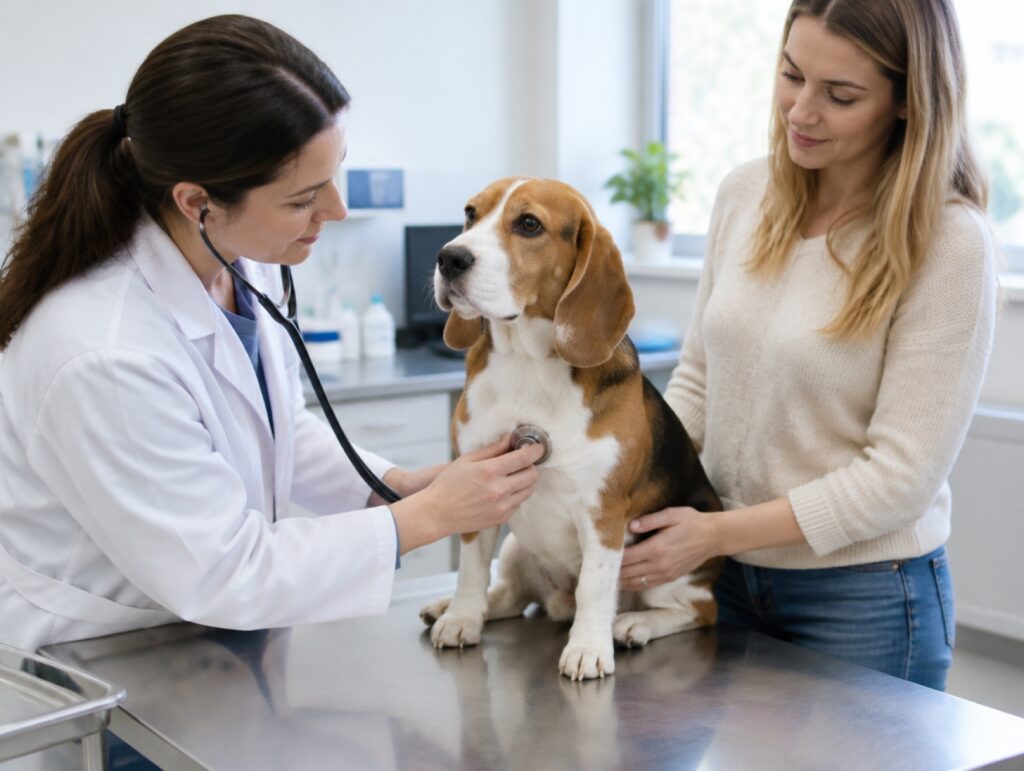
Imagine a dog that has just come home from a boarding kennel. In the evening he stops in the middle of the room and starts coughing so loudly and harshly that it sounds as if he were choking. Then he swallows and cheerfully runs off for a toy. This is the typical scene of kennel cough: it sounds frightening, but it is usually a mild illness. It is just worth knowing how to tell when it is no longer mild.
- Kennel cough (infectious tracheobronchitis) is a contagious disease of a dog’s windpipe and bronchi. It causes a dry, harsh cough that sounds like a “goose honk”, sometimes ending in retching (Merck Veterinary Manual).
- Symptoms usually appear 5 to 10 days after contact with a sick dog (Merck), while the AKC gives a range of 2 to 14 days. The illness usually lasts 10 to 20 days, but the severity of the cough already fades within the first 5 days (Merck).
- Mild cases often clear up by themselves, and according to Merck antibiotics are usually not needed unless there is pneumonia.
- Fever, pus-like nasal discharge, lethargy, a wet cough or breathing difficulty are reasons to contact a vet straight away. Puppies are more prone to a more severe course.
- WSAVA (2024) classes vaccination against Bordetella and parainfluenza as non-core, meaning it depends on the risk for the individual dog. Core vaccination protects against distemper and adenovirus. Vaccines do not protect against every cause, and a vaccinated dog can still fall ill (AKC).
What is kennel cough and what causes it?
Kennel cough is an inflammation of the windpipe and bronchi that several different pathogens can cause, often more than one at once. Medically it belongs to the canine infectious respiratory disease complex (CIRDC). According to the Merck Veterinary Manual, the causes include the bacterium Bordetella bronchiseptica, canine parainfluenza virus (CPIV), canine adenovirus 2 (CAV-2), canine influenza and, less often, canine distemper virus. The illness can also be complicated by a secondary bacterial infection after a virus has damaged the airways.
An American laboratory study shows how often the individual pathogens occur. Maboni and colleagues (2019) evaluated PCR results from 559 dogs whose samples came to a university diagnostic laboratory between 2011 and 2017. The laboratory only started testing for parainfluenza and two species of mycoplasma in 2017, so for those the figures cover just 114 to 144 dogs. All the pathogens studied were detected more often in dogs with symptoms than in dogs without them. Dogs with several pathogens at once had a severe course significantly more often, and the strongest indicator of a severe course was young age.
| Pathogen | Type | Share of tested dogs in which it was detected |
|---|---|---|
| Canine parainfluenza (CPIV) | Virus | 29% (33 of 114) |
| Mycoplasma cynos | Bacterium | 24.5% (28 of 144) |
| Mycoplasma canis | Bacterium | 23.6% (27 of 144) |
| Influenza type A | Virus | 11.2% (63 of 559) |
| Bordetella bronchiseptica | Bacterium | 9% (51 of 559) |
| Canine respiratory coronavirus (CRCoV) | Virus | 4.6% (26 of 559) |
Mycoplasma canis also lives in the airways of healthy dogs and its role is still disputed, but in this study the authors detected it more often in dogs with symptoms. The table shows dogs that ended up in a laboratory, not ordinary pet dogs. It is therefore not an exact picture of what circulates among dogs where you live. It does show one important thing: there is not just one pathogen behind “kennel cough”. That is also why you cannot always tell by looking what exactly is going on in your dog.
What does kennel cough look like and how do you recognise it?
A typical sign is a fit of dry, harsh coughing, which may be followed by retching. According to the Merck Veterinary Manual, most sick dogs have few other symptoms besides the cough, sometimes just a slightly reduced appetite. Temperature and white blood cell count usually stay normal.
- Dry, harsh cough. It sounds like a goose honking and can come in fits.
- Retching. After a fit of coughing the dog may retch even if he does not vomit.
- Sneezing and discharge from the eyes and nose. According to the AKC, a low fever and tiredness can also appear. But according to Merck, fever may point to pneumonia, so if there is a fever, call your vet at once.
- Slightly reduced appetite. Otherwise the dog is often lively and plays.
A dog coughing like this does not necessarily have kennel cough. According to Merck, the vet bases the diagnosis on the clinical picture and an X-ray, to rule out other causes.
How does kennel cough spread and how long does it last?
Kennel cough spreads very quickly among dogs that are close together. According to the AKC, dogs catch it through direct contact, through droplets when coughing and sneezing, or through objects such as bowls and toys. Merck names veterinary clinics, dog daycares, boarding facilities and kennels as the places where the illness spreads most easily.
- 5 to 10 daysafter contact with a sick dog is when symptoms usually appear, and the AKC gives a range of 2 to 14 days.Merck Veterinary Manual, AKC
- 10 to 20 daysis how long the illness usually lasts, though the severity of the cough already fades within the first 5 days.Merck Veterinary Manual
- 2 weeksafter the cough ends is how long the AKC recommends keeping a sick dog away from other dogs.AKC
- 29%of the dogs tested for parainfluenza had it in the American laboratory study, making it the most frequently detected pathogen (114 dogs tested in 2017).Maboni et al., 2019
The practical conclusion: a sick dog belongs at home, not among other dogs. According to Merck, a dog with kennel cough should be kept apart from other dogs and usually does not need to be hospitalised, because the illness is highly contagious. So phone your vet beforehand and agree how to come, so that your dog does not meet other dogs in the waiting room.
When is kennel cough serious? A traffic light
Kennel cough is mild as long as the dog is lively, eating and has no fever. Fever, pus-like nasal discharge, lethargy or a wet cough with coughing up of phlegm are considered warning signs. According to Merck, they may point to pneumonia (bronchopneumonia).
| Status | How the dog looks | What to do |
|---|---|---|
| Green | The dog is lively, eating and drinking, with a dry cough and no fever or discharge | Let him rest at home, keep him away from other dogs and phone your vet beforehand so he can be examined |
| Yellow | The cough does not improve after the first few days, lasts longer than 3 weeks (that is, longer than usually stated) or keeps coming back | Book your dog in for an examination |
| Red | Fever, pus-like nasal discharge, lethargy, a wet cough, refusing food or breathing difficulty | Contact a vet straight away |
| Higher risk | A puppy, an older dog or a dog with a chronic illness | Do not wait. Contact a vet straight away, even if the dog only coughs |
How is kennel cough managed and what can you do at home?
Most dogs recover without hospital care. Merck states that the illness often clears up by itself and antibiotics are usually not needed unless there is pneumonia. According to Merck, cough suppressants are prescribed only for a persistent dry cough and must not be given in pneumonia.
Do not give your dog any human cough medicine or anyone else’s medicine. Your vet decides about medicines, including antibiotics. The International Society for Companion Animal Infectious Diseases (ISCAID) points out that respiratory illnesses are a common reason for giving antibiotics, including inappropriate or unnecessary use. If your vet does prescribe antibiotics, the article Dog after antibiotics describes how they can affect the gut.
- Rest and water. According to the AKC, the basics are rest, plenty of fluids and time.
- Harness instead of a collar. For the duration of the illness the AKC recommends a harness, because it presses less on the windpipe.
- Distance from other dogs. Do not take your dog to daycare, training or group meetups until the cough has gone and for at least two weeks after it (AKC).
- Hygiene. Wash the bowl and toys, and wash your hands after contact with the sick dog (Merck, AKC).
Does vaccination help and does a dog have to be vaccinated?
WSAVA (2024) classes vaccination against the bacterium Bordetella bronchiseptica and canine parainfluenza as non-core. It is chosen according to the risk for the individual dog, for example boarding stays, attending shows or contact with many dogs. Merck also describes a vaccine with Bordetella and parainfluenza that is given into the nose. Against distemper and canine adenovirus, which are also among the causes of kennel cough, protection comes from core vaccination, which WSAVA recommends for all dogs. According to the AKC, a vaccinated dog can also fall ill, because vaccines do not protect against every cause, but the course tends to be milder. In sick vaccinated dogs, Maboni et al. (2019) rarely detected the pathogens the dogs had been vaccinated against, and according to the authors this shows that the available vaccines work.
In the study by Maboni et al. (2019), Bordetella was fairly rare among the detected pathogens (9%), and the authors suggest this may be linked to widespread vaccination in the USA. However, there is no common vaccine for dogs against the mycoplasmas, which were detected more often. Ask your vet whether vaccination is worthwhile for your dog.
Frequently asked questions
How long does kennel cough last in a dog?
According to the Merck Veterinary Manual, the severity of the cough usually fades within the first 5 days, but the illness lasts 10 to 20 days. The AKC states that most dogs recover within 1 to 3 weeks. If the cough lasts longer or gets worse, have your dog examined.
Is kennel cough contagious to people?
In rare cases, yes. According to the AKC, some of the pathogens associated with kennel cough can rarely be passed on to people, especially those with a weakened immune system. After contact with a sick dog, wash your hands, and regularly wash his bowl and toys too. If your immune system is weakened, talk to your doctor.
Do I have to see a vet with kennel cough?
Yes, an examination is worthwhile, because other illnesses can cause a similar cough and, according to Merck, the vet rules them out, including with an X-ray. Most dogs recover without hospitalisation. Phone before the visit so that your dog does not meet others in the waiting room. If there is fever, pus-like discharge, lethargy or breathing difficulty, call at once. For a puppy, a senior and a chronically ill dog, call at once even if he only coughs.
How long is a dog with kennel cough contagious?
Count on the whole period of symptoms and at least two more weeks after the cough ends. According to the AKC, the dog should stay away from other dogs for that whole time, so no daycare, training or group meetups. The illness usually lasts 10 to 20 days (Merck). Your vet will tell you the exact period for your dog.
Can a dog get kennel cough even if he has not been in a kennel?
Yes. The name is misleading. According to the AKC, dogs catch it through direct contact with a sick dog, through droplets or through shared bowls and toys. According to Merck, the illness spreads mainly where many dogs are together, such as dog daycares, boarding facilities or clinics.
Should I give my dog cough medicine?
Not on your own. According to Merck, cough-suppressing medicines are prescribed only to selected dogs and must not be given in pneumonia. Human cough medicines can harm dogs. Your vet decides about any treatment after an examination. At home, what mainly helps is rest, plenty of water and a harness instead of a collar, which presses less on the windpipe (AKC).
Sources
- Merck Veterinary Manual. Kennel Cough (Canine Infectious Tracheobronchitis) (professional version, revised February 2022, updated September 2024). merckvetmanual.com
- Merck Veterinary Manual. Tracheobronchitis (Bronchitis) in Dogs, section Infectious Tracheobronchitis of Dogs (Kennel Cough) (owner version). merckvetmanual.com
- American Kennel Club. Kennel Cough in Dogs. akc.org/expert-advice/health/common-dog-health-issues/kennel-cough-in-dogs
- Maboni G, Seguel M, Lorton A, Berghaus R, Sanchez S (2019). Canine infectious respiratory disease: New insights into the etiology and epidemiology of associated pathogens. PLoS ONE. doi.org/10.1371/journal.pone.0215817
- Squires RA, Crawford C, Marcondes M, Whitley N (2024). 2024 guidelines for the vaccination of dogs and cats, compiled by the Vaccination Guidelines Group (VGG) of the World Small Animal Veterinary Association (WSAVA). Journal of Small Animal Practice. doi.org/10.1111/jsap.13718
- Lappin MR et al. (2017). Antimicrobial use guidelines for treatment of respiratory tract disease in dogs and cats: Antimicrobial Guidelines Working Group of the International Society for Companion Animal Infectious Diseases. Journal of Veterinary Internal Medicine. doi.org/10.1111/jvim.14627
This article is educational and does not replace a veterinary examination. If you are not sure, ask your vet.
This article was proofread with the help of AI. This is a translation from Czech, so it may contain inaccuracies.