Blog · Teeth
Dog tartar: 4 stages and what actually works
A toothbrush won’t remove a dog’s tartar; it only stops plaque hardening. The 4 stages of dental disease (AVDC), what really helps and what only looks good.
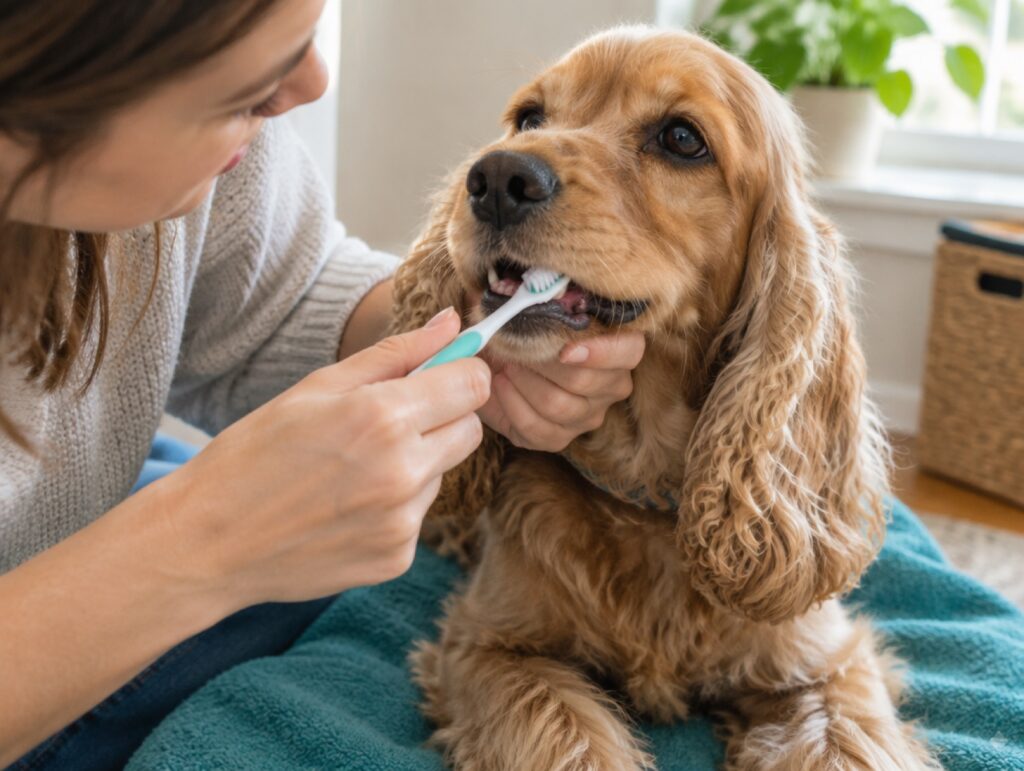
Your dog leans towards you, licks you, and you pull back a little. The smell from its mouth is no longer “dog breath” but something you can smell from half a room away. You can see a brown coating on the back teeth and it occurs to you that it could just be “scraped off”. But tartar is only the visible part of the problem, and the important part happens under the gum.
- Tartar is hardened dental plaque. According to the American Animal Hospital Association (AAHA), tartar itself is mostly an irritant, and the main trouble is caused by bacterial plaque and gum inflammation below the gum line.
- The American Veterinary Dental College (AVDC) divides periodontal (dental) disease, that is disease of the gums and the tissues around the tooth, into 4 stages according to the loss of the tooth’s attachment: from gum inflammation (1) to advanced periodontitis (4). A vet determines the stage using X-rays, under anaesthesia.
- The best-documented home care is daily tooth brushing. It removes plaque, but not tartar that has already formed. Among treats and foods, those with the VOHC seal have a documented effect.
- Scraping tartar off without anaesthesia is only cosmetic. Real cleaning takes place under anaesthesia, above and below the gum.
What is tartar and why does it matter?
Tartar is bacterial dental plaque that has hardened with minerals from saliva. According to AAHA, tartar itself mainly irritates and does little to cause disease directly. Removing it is still necessary, because plaque and harmful substances cling to it. The real damage is done by the bacteria under the gum, which trigger inflammation and gradually destroy the tissues that hold the tooth.
According to AAHA, gum inflammation (gingivitis) is reversible and can be prevented by consistently removing plaque. Periodontitis, inflammation with loss of the tissues that hold the tooth, is no longer reversible. It can be stabilised, but not turned back. That is exactly why it makes sense to catch dental problems early.
- 9.3 to 18.2%of dogs have dental disease in routine veterinary practices, where the vet assesses the mouth of a conscious dog.Wallis and Holcombe, 2020, review of studies
- 44 to 100%of dogs have dental disease on a detailed examination under anaesthesia.Wallis and Holcombe, 2020, review of studies
The difference is large, because the space under the edge of the gum cannot be examined in a conscious dog. According to this review, disease becomes more common with the dog’s age and in dogs of lower body weight. But it always depends on the individual dog and its care.
What are the 4 stages of dental disease in a dog?
AVDC distinguishes four stages of periodontal disease, from PD1 to PD4, according to how much of the tooth’s attachment has been lost. The stages are not about the amount of tartar, but about the condition of the gum and the bone around the tooth. Stage PD0 means a healthy tooth. Each tooth has its own stage, so a dog may have one tooth healthy and another in an advanced state.
| Stage | What it means | What you may see at home | How it is dealt with |
|---|---|---|---|
| PD1 | Gum inflammation without loss of attachment | A red edge of the gum, sometimes a slight smell | Cleaning and home care, the inflammation is reversible |
| PD2 | Early periodontitis, attachment loss under 25% | Smell, tartar, a red or bleeding gum | Veterinary cleaning under anaesthesia, home care |
| PD3 | Moderate periodontitis, attachment loss 25 to 50% | A strong smell, exposed tooth necks, soreness | Cleaning, X-ray, possibly treatment or extraction of a tooth |
| PD4 | Advanced periodontitis, attachment loss over 50% | Loose teeth, pus, chewing on one side | X-ray and treatment or extraction of the affected teeth |
The table is simplified. The exact stage is determined by a vet with a probe and an X-ray, and only under anaesthesia. You cannot determine the stage at home and the signs overlap between stages, but you can tell that it is time for an examination.
How can I tell that my dog has a dental problem?
A dental problem is revealed by bad breath, drooling, red or bleeding gums, chewing on one side and a change in appetite. Among the signs of oral disease, AAHA lists pain when touched, bad breath, drooling, loose teeth, discoloured teeth and bleeding from the gums. According to AAHA, hidden dental pain may also show as teeth chattering, weight loss or a change in behaviour.
Bear in mind that bad breath does not always come from the teeth. According to the UK charity PDSA, the most common cause is dental disease, but an ammonia-like smell can accompany kidney disease, and a sweet one, like nail varnish remover, can accompany diabetes. A lodged object or an inflamed growth in the mouth can also smell.
What really works for tartar and plaque?
The best-documented option is daily mechanical care, that is a toothbrush and dog toothpaste. AVDC calls it the most effective form of care between vet visits. AAHA adds that brushing removes plaque, but not tartar, and has to be done daily to be worthwhile. No home method replaces regular examinations under anaesthesia.
| Method | What we know about it | Verdict |
|---|---|---|
| A toothbrush and dog toothpaste, daily | Removes plaque, not tartar (AAHA). AVDC calls it the most effective home care. | The best choice |
| Chews and food with the VOHC seal | Products with the seal have met set criteria for reducing plaque or tartar. Without the seal it is a manufacturer’s promise. | A good addition when your dog will not accept a toothbrush |
| Water additives | In an eight-week study they improved gum health only in combination with brushing once a week or a daily chew, not on their own. | A possible addition, not a replacement |
| Bones, antlers, hooves, hard toys | Neither AAHA nor AVDC recommends them, because they can break a tooth or injure the gum. | Better not |
| Scraping tartar without anaesthesia | Inflammation remains under the gum, it is only cosmetic (AVDC, AAHA). | Do not do it |
| Cleaning under anaesthesia at the vet | Removes plaque and tartar above and below the gum, including an examination and X-ray. | The only way to really remove tartar |
In an eight-week study by Gawor et al. (2025) in dogs whose teeth had not been cleaned by a vet before the study, deposits were reduced by a daily chew or by brushing every other day. Gum health improved significantly compared with the control group only with a combination of a daily water additive with brushing once a week or with a daily chew, and the water additive alone did not help. The study tested commercial products and was funded by their manufacturer, so its results do not apply to every treat.
How do I start brushing my dog’s teeth?
Start slowly and without pressure, because a dog learns to have its teeth brushed over weeks. According to AVDC, almost all dogs eventually accept brushing when the procedure is patient and gradual. Use only dog toothpaste. Human toothpastes often contain substances that a dog should not swallow or inhale.
- Let your dog taste the toothpaste. Put it on your finger and let your dog lick it. Dog toothpastes often taste of poultry or fish.
- Get your dog used to touch. For a few days, gently stroke the lips and feel the teeth, always finishing with a treat.
- Add a toothbrush or a finger brush. According to AVDC, brush mainly the outer side of the back teeth under the upper lip.
- Brush every day. According to AAHA, brushing helps only when it is daily. A short session is enough: what matters is regularity.
- Watch for pain. AVDC points out that a dog that resists brushing may have a sore spot in the mouth. AAHA adds that brushing inflamed gums hurts the dog. In that case, go to the vet first.
Which treats and chews help and which do harm?
Treats and foods with the seal of the Veterinary Oral Health Council (VOHC) have an independently assessed effect. VOHC does not test products itself: the manufacturer sends it clinical data, and experts in veterinary dentistry assess them. AAHA states that only products accepted by VOHC have met the predetermined standards. You will find the list at vohc.org.
Hard things are not recommended for teeth. AAHA sees no strong reason to offer hard treats made of antlers, synthetic materials or bones, because they can damage a tooth and cause pain and infection. AVDC adds hooves and hard nylon to that. While your dog chews, keep an eye on it, as it may swallow a large piece.
What should I do if my dog has a broken tooth?
A broken tooth is a reason to visit the vet, even if your dog looks content. According to AAHA, in a complicated fracture, where the tooth pulp is exposed, bacteria from the mouth get into the tooth, an infection develops and the tooth dies. Do not wait for blood or for your dog to refuse food, as dogs often hide pain.
Do not try anything at home. Do not treat or pull the tooth yourself: a broken tooth often needs an X-ray and the vet’s decision on whether to treat it or extract it. According to AAHA, broken teeth can often be prevented by choosing the right chew toys.
What does teeth cleaning at the vet involve?
Teeth cleaning at the vet takes place under general anaesthesia with a breathing tube, so that the teeth can be cleaned above and below the edge of the gum and examined safely. According to AAHA, cleaning “without anaesthesia” is unacceptable, because it does not guarantee cleaning under the gum. AAHA also says that removing tartar only on the visible side of the tooth is purely cosmetic and does not stop the disease.
Anaesthesia frightens many owners, especially with older dogs. AAHA recommends assessing the risk individually for every dog and paying special attention to preparation in seniors. You can find out more about seniors in the article Senior dog: 9 changes you should not overlook. Your vet will explain how to reduce the risk.
You cannot remove tartar at home, but with daily brushing you slow down the build-up of new plaque. Today, look at your dog’s gums and teeth, lift its lips and remember what they look like. Next time you are at the vet, ask for a mouth check. If the article helped you, save it or send it to someone who has a dog at home.
Frequently asked questions
Can I remove a dog’s tartar at home?
No, tartar that has already formed cannot be removed safely at home. A toothbrush and toothpaste remove only plaque, before it hardens. Tartar and the inflammation under the gum are dealt with by a vet under anaesthesia. Scraping at home risks injuring the gums, and you cannot reach under the gum anyway. Even scraping off tartar without anaesthesia by a professional is only cosmetic, because the inflammation under the gum remains.
How often should I brush my dog’s teeth?
Ideally every day. AAHA states that brushing helps only when it is daily. If that is not possible, do it at least as often as you can and combine it with treats or food with the VOHC seal. A short session is enough: what matters is regularity. Even with daily brushing, a dog needs a regular dental examination.
Do chews help with tartar?
Some do, but not all. Products with the VOHC seal help: the seal means they have met set criteria for reducing plaque or tartar. VOHC does not test products itself. Experts assess clinical data from the manufacturer. You will find the list at vohc.org. For the others you have no proof that they work. None of this replaces tooth brushing and a veterinary check-up.
Does bad breath in a dog always come from the teeth?
No. The most common cause is dental disease, but the smell can also signal kidney disease, diabetes or an object lodged in the mouth. That is why you should always have bad breath examined. If your dog is also listless or vomiting, or refuses to eat and drink, go to the vet straight away.
Are bones good for dogs’ teeth?
No, neither AAHA nor AVDC recommends them. Hard bones, antlers, hooves and hard nylon can break a tooth and so cause pain and infection. A safer option is a treat with the VOHC seal that suits your dog’s size. While your dog chews, keep an eye on it, as it may swallow a large piece. Have a broken tooth examined by a vet, even if your dog looks content.
Sources
- Bellows J et al. (2019). 2019 AAHA Dental Care Guidelines for Dogs and Cats. Journal of the American Animal Hospital Association. doi.org/10.5326/JAAHA-MS-6933
- Wallis C, Holcombe LJ (2020). A review of the frequency and impact of periodontal disease in dogs. Journal of Small Animal Practice. doi.org/10.1111/jsap.13218
- Gawor J et al. (2025). Effectiveness of Dental Homecare Protocols in Unscaled Dogs. Journal of Veterinary Dentistry. doi.org/10.1177/08987564241292769
- American Veterinary Dental College. Nomenclature: stages of periodontal disease. avdc.org/avdc-nomenclature
- American Veterinary Dental College. Companion Animal Dental Scaling Without Anesthesia (position statement). avdc.org
- American Veterinary Dental College. Home Care for Dogs. copy on the MVMA website
- Veterinary Oral Health Council. vohc.org
- PDSA. Bad breath in dogs. pdsa.org.uk
This article is educational and does not replace a veterinary examination. If you are not sure, ask your vet.
This article was proofread with the help of AI. This is a translation from Czech, so it may contain inaccuracies.