Blog · Season
Winter paws: salt, licking and cracked pads
Road salt dries out and irritates a dog’s paws. Wipe them with lukewarm water and dry them after each walk. When do licking, cracks or a dry nose need a vet?
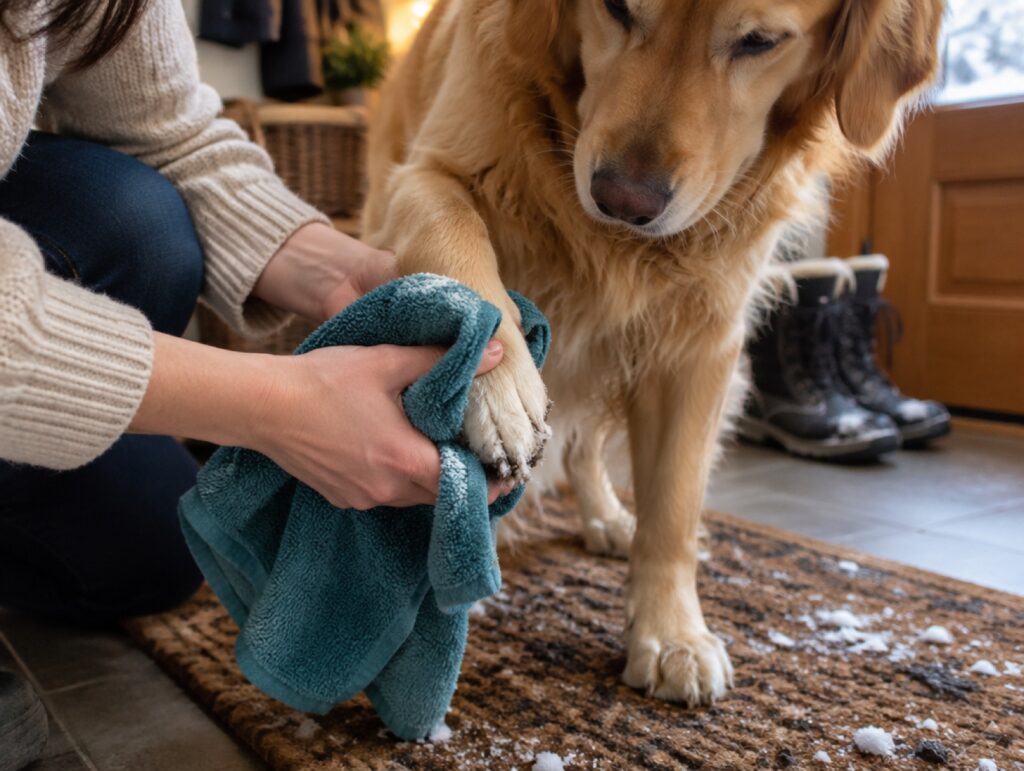
It is a frosty morning, the pavement is dusted with white crystals and your dog walks on them as it would on any other path. At home it then starts licking its paws, and that is often not just a habit. Road salt, ice and dry air can give paws a really hard time within a few weeks of winter. I will show you what to do after every walk and when to go to the vet.
- Road salt and other de-icers dry out a dog’s pads and the skin between the toes, and when licked they also get into the mouth and stomach.
- The simplest prevention is to wipe or wash the paws with lukewarm water after every walk on treated paths.
- Paw licking has several causes, from allergies to foreign bodies and stress, and when it lasts longer than a few days, it is time to see a vet.
- A dry nose does not mean illness in itself. Other signs and the state of the gums matter more.
- Antifreeze from a car can be fatal to a dog, and if your dog licks any, go to the vet straight away.
What does road salt do to a dog’s paws?
Road salt and other de-icers dry out and irritate paws. According to VCA Animal Hospitals, salt-based de-icers are very drying for the pads and for the delicate skin between the toes. The ASPCA adds that dry cold air, rain, sleet and snow can cause cracked paws and itchy, flaky skin.
But what your dog does afterwards also causes trouble: it licks off what is left on its paws. According to Pet Poison Helpline, a small amount of salt usually causes only stomach upset, for example vomiting or diarrhoea, but a large amount can raise the sodium level in the blood and lead to neurological signs, and in serious cases to death.
- Vomiting and diarrhoeaare usually the only problems when a dog swallows a smaller amount of salt.Pet Poison Helpline
- Neurological signsand a high sodium level in the blood are a risk only after a large amount of salt, together with dehydration, overheating and fast breathing and heart rate.Pet Poison Helpline
A dog will not usually lick off that much from its paws. The bigger risk is an open bag or a pile of grit. Paw licking mainly risks irritating the mouth and stomach.
Are some de-icers worse than others?
Yes, de-icers differ in composition and in how much they bother a dog’s stomach and skin. According to Pet Poison Helpline, calcium salts are the most dangerous, and all types of de-icers can potentially be dangerous.
| Ingredient | What may be the risk |
|---|---|
| Sodium chloride (common salt) | In a large amount, a high sodium level in the blood and neurological signs |
| Potassium chloride | Strong irritation of the digestive tract, up to bloody vomiting or diarrhoea |
| Magnesium chloride | Usually stomach upset |
| Calcium salts | The most dangerous: strong digestive problems and irritation of the skin and paws |
| Urea | Often labelled as safe for animals; it usually causes drooling and mild digestive irritation, but a large amount can cause weakness and tremors |
The sources disagree on one point: VCA lists potassium chloride among the gentler alternatives, while Pet Poison Helpline calls it a strong irritant. So do not trust a “pet-safe” label blindly.
What should I do with the paws after every walk?
After every walk on treated paths, wipe and dry the paws. The ASPCA recommends washing and drying your dog’s paws and belly after every walk to remove ice, salt and chemicals.
- Wipe straight away at home. Before your dog has time to lick its paws.
- Use lukewarm water and a cloth. VCA recommends warm water, a cloth or pet wipes, while Cornell suggests a lukewarm washcloth.
- Dry the skin between the toes. So that no moisture or salt residue stays there.
- Inspect the pads. Look for cracks, redness, small injuries and foreign bodies.
- Remove lumps of ice. The ASPCA advises picking out snowballs between the pads, so that the skin is not irritated further.
- Apply a balm made for dogs. Cornell recommends it before and after walks, so that the paws do not dry out.
How can I prepare the paws for winter in advance?
The best time to protect paws is before salt and frost start doing damage.
- Trim the hair between the pads. Cornell advises trimming the hair between the pads, so that lumps of ice do not form there.
- Put booties on your dog. According to the ASPCA, booties cover the paws and stop grit and salt getting between the toes. Cornell recommends them mainly for small and short-haired dogs when they are outside for longer periods. Get your dog used to them at home.
- Trim the claws more often. Cornell points out that in winter claws wear down less on concrete.
- Avoid heavily salted paths. Cornell recommends keeping your dog away from roads and pavements treated heavily with salt and chemicals.
- Watch the length of the walk. Cornell advises using common sense, shortening walks in frost and watching whether your dog shivers, is anxious or slows down. These are signs of hypothermia.
Why does my dog lick its paws? 6 causes
A dog often licks its paws because of itching from an allergy, but there are more causes, and without an examination you cannot tell them apart. The AKC lists allergies among the most common causes.
- Allergies. Food allergies or allergies to pollen and other substances from the environment. According to the AKC, itching from an allergy leads to licking and biting, which injure the paws and often infect them. You will find more about itching in the article Why is my dog scratching? 8 causes and when to see a vet.
- Irritation from the environment. Salt, chemicals and dry winter air.
- A foreign body or injury. A splinter, glass or a thorn. When a dog licks just one paw, vets mainly suspect a foreign body, according to the AKC.
- Infections and parasites. VCA lists bacteria, yeasts, fungi and parasites. According to VCA, a rusty brown colouring of the coat is caused by pigments from saliva or by yeast overgrowth.
- Other diseases. The AKC lists hormonal and autoimmune disorders or a zinc deficiency. With these, licking is only one of the signs.
- Stress and anxiety. The AKC lists anxiety and compulsive behaviour among the causes. We look at stress in dogs in the article Stress diarrhoea in dogs: how the mind affects digestion.
| Situation | What to do |
|---|---|
| Your dog briefly licks its paws after a walk, the skin has no redness | Wipe, dry and watch |
| Licking lasts longer than a few days or keeps returning | Book an examination |
| The paws are red, swollen, have small sores, or the hair between the toes turns brown or falls out | Book an examination |
| Your dog licks only one paw and steps carefully | Check the paw, and if you find nothing, book an appointment |
| A paw bleeds heavily or your dog suddenly limps and refuses to put weight on it | Contact your vet straight away |
What should I do about cracked pads?
For minor dry cracks, protection from salt, wiping and a balm made for dogs help. Deep, bleeding or painful cracks need a vet.
Choose a balm made for dogs, because your dog will lick it. Do not use creams made for people. When the skin is open or inflamed, do not try anything else at home. Such a paw needs an examination and treatment from a vet.
Is a dry nose in winter a reason for concern?
A dry nose does not mean illness in itself. According to the AKC, a warm and dry nose can be a sign of fever, dehydration or, for instance, dry eye, but often it is just the result of sleep, heating or cold air.
According to the AKC, the gums are more reliable than the nose: healthy gums are pink and moist. Very dry or sticky gums can mean dehydration, pale ones anaemia or low blood pressure. According to the AKC, bright red-purple or bluish gums need a vet straight away, and do not wait if the gums are pale either. Watch for a nose that changes colour, cracks or bleeds. According to the Merck Veterinary Manual, loss of pigment, ulcers, crusts or bleeding of the nose may be related to autoimmune diseases, infections or tumours, so have them examined. The Merck Veterinary Manual adds that nasal hyperkeratosis, a thickened and frayed upper part of the nose in older dogs, is painless and not inflamed and usually needs no treatment.
When should I go straight to the vet after a winter walk?
- your dog ate salt or de-icer from a bag or a pile of grit, even if it has no signs yet
- after swallowing salt or de-icer your dog vomits repeatedly, shivers, is weak or confused
- your dog licked antifreeze from a car or a puddle under a car, even if it has no signs yet (the ASPCA calls it deadly)
- a paw bleeds heavily or your dog suddenly limps and refuses to put weight on it
- your dog has pale, bluish or bright red-purple gums
On the phone, say what your dog ate, roughly how much and how long ago. Do not induce vomiting and do not give your dog anything until your vet tells you to.
What should I take away for the next walk?
Winter paws do not need complicated care, just a few habits: avoid heavily salted paths, wipe the paws with lukewarm water and dry them when you get back, inspect them and keep a balm to hand. Licking that persists and a nose that cracks need a vet’s attention.
This evening, leave a cloth and a towel ready in the hallway, and next time wipe the paws straight after you come in. Save the article and also read Why is my dog scratching? 8 causes and when to see a vet.
Frequently asked questions
Is road salt dangerous for a dog’s paws?
Salt dries out and irritates the paws, especially the pads and the skin between the toes. When licked, it gets into the mouth and stomach and can cause vomiting or diarrhoea. A large amount of salt from a bag or a pile of grit is dangerous and a reason to call the vet straight away. The way to prevent this is to wipe the paws after every walk.
Should I wash my dog’s paws after a walk?
Yes, after a walk on treated paths it is good to wipe or wash the paws with lukewarm water and dry them thoroughly. The ASPCA advises washing and drying the belly too, to remove salt and chemicals from the skin. Do it straight away when you come in, before your dog has time to lick its paws. Check for cracks and lumps of ice.
Why does my dog lick its paws after a winter walk?
Often salt, chemicals or dry air irritate the paws, but it can also be an allergy, a foreign body, an infection or stress. If the licking lasts longer than a few days, the paws turn red or the hair between the toes turns brown, have your dog examined. Only your vet can find the cause.
Will booties help my dog?
According to the ASPCA, booties cover the paws and stop grit and salt getting between the toes. Cornell recommends them mainly for small and short-haired dogs when they are outside for longer periods. They must fit well and your dog needs to get used to them at home.
Is a dry nose in a dog a sign of illness?
Usually not. According to the AKC, a dry nose after sleep, in a dry heated flat or in old age is completely normal. If it comes with lethargy, vomiting, diarrhoea, a change in appetite, ulcers or loss of pigment on the nose, talk to your vet. The gums, which should be pink and moist, show more reliably than the nose how your dog is doing.
Is a de-icer labelled “pet-safe” really safe?
Not always. According to Pet Poison Helpline, all types of de-icers have the potential to be dangerous, and most exposures end in stomach upset and skin irritation. Calcium salts are the most dangerous. It is safer to clean the paws and put the bag away. If your dog eats de-icer from a bag or a pile of grit, call the vet straight away, even if it has no signs yet.
Sources
- VCA Animal Hospitals. How to keep your dog’s paws safe in winter. vcahospitals.com
- Chambers C. Pet Poison Helpline. Is there really a “safe” ice melt? petpoisonhelpline.com
- ASPCA. Cold Weather Safety Tips. aspca.org/pet-care/general-pet-care/cold-weather-safety-tips
- Cornell University College of Veterinary Medicine (2021). Keeping your furry friends safe during winter weather. vet.cornell.edu
- Johnstone G. (2024). Pododermatitis in Dogs: What to Know. American Kennel Club. akc.org/expert-advice/health/pododermatitis-in-dogs
- VCA Animal Hospitals. Pododermatitis in Dogs. vcahospitals.com/know-your-pet/pododermatitis-in-dogs
- Reisen J. (2021). Why Is My Dog’s Nose Dry? American Kennel Club. akc.org/expert-advice/health/why-is-my-dogs-nose-dry
- Merck Veterinary Manual. Nasal Dermatoses of Dogs. merckvetmanual.com
This article is educational and does not replace a veterinary examination. If you are not sure, ask your vet.
This article was proofread with the help of AI. This is a translation from Czech, so it may contain inaccuracies.