Blog · Health
Dog losing weight and not eating: when to see a vet
Dog losing weight and not eating? Tell apart a dog that refuses food from one that loses weight despite eating. Causes, BCS weighing and when to see a vet.
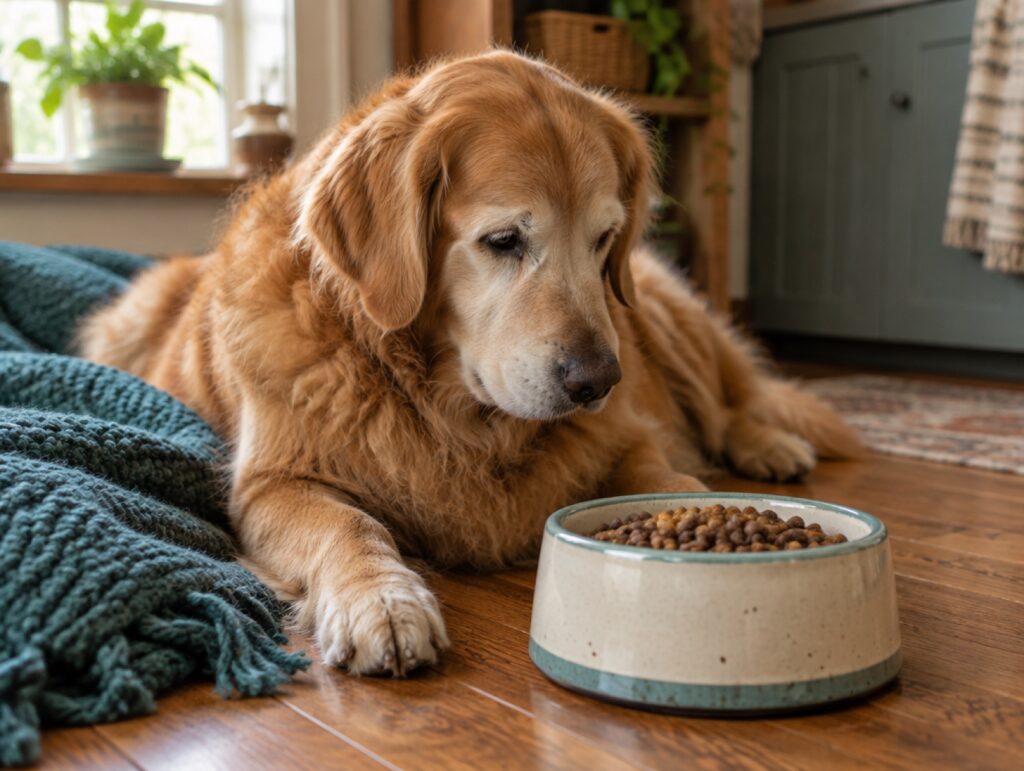
The bowl stays full, your dog sniffs it and walks away. A few weeks later you notice that the ribs show and the paws look thinner. When a dog loses weight and does not eat, it is a signal worth investigating, because behind it there is often pain, illness or trouble absorbing nutrients. First, though, tell two different situations apart: your dog does not want to eat, or your dog loses weight even though he eats.
- A dog that is not eating (loss of appetite, medically anorexia) and a dog that loses weight even though he eats are two different situations with different possible causes.
- A dog that is not eating may truly have no appetite, or may want to eat but cannot, for example because of pain in the mouth. VCA distinguishes true anorexia and pseudoanorexia.
- A dog losing weight even though he eats? The Merck Veterinary Manual describes weight loss with an increased appetite as a typical sign of malabsorption, that is poor absorption of nutrients.
- No source gives a fixed time limit that applies to every dog. VCA recommends contacting a vet when a dog has not eaten for more than 12 hours. With a puppy, a small, old or chronically ill dog, do not wait at all.
- Do not force your dog to eat and do not give him appetite medicines meant for people.
How does a dog that is not eating differ from a dog that loses weight even though he eats?
Two common questions look similar but mean something different. A dog does not want to eat: food intake drops and weight loss comes only with time. A dog loses weight even though he eats: intake is normal or even higher, but the body does not make use of the nutrients or uses them up elsewhere.
- A dog that is not eating. VCA defines anorexia as a reduction or loss of appetite. If a dog simply does not want food, it is true anorexia. If he would like to eat but cannot pick up, chew or swallow the food, it is pseudoanorexia.
- A dog that loses weight and eats. Weight loss with a good appetite is a typical picture of absorption disorders or some metabolic diseases. The Merck Veterinary Manual states that diarrhoea and weight loss despite an increased appetite are the main signs of malabsorption.
Tell your vet right at the start which situation it is: “eating normally but losing weight” points in a different direction than “has not wanted anything for three days”.
How long can a dog go without eating before you see a vet?
Expert sources do not give a single number that would apply to every dog. The fact that an adult dog can survive a few days without food does not mean you should wait. VCA Urgent Care lists as a reason for a visit that an animal has not eaten for more than 12 hours. A dog with diabetes who refuses even a single meal should go to the vet straight away.
| Dog | What to do |
|---|---|
| Healthy adult dog, otherwise lively, drinking, poop fine | Observe. If he has not eaten for more than 12 hours (the VCA limit) or things get worse, call your vet |
| Puppy, small dog (weight loss is quick in them) | Do not wait. Contact your vet the same day as soon as he refuses food |
| Old dog or dog with a chronic illness | Do not wait. A change in appetite is often the first sign, see Senior dog: 9 changes you should not overlook |
| Dog with diabetes | Vet straight away if he refuses even one meal (VCA) |
| Not eating and vomiting, has diarrhoea, pain or is lethargic | Vet straight away, see the red box below |
The advice for a puppy and a small dog is a general rule of caution, not a number from a specific study. A small body has few reserves, so it is better to have it examined sooner.
- Your dog is not eating and at the same time vomits repeatedly or has bloody or black diarrhoea.
- The belly is tight, swollen or painful, your dog retches without bringing anything up or is restless.
- He is lethargic, weak, dehydrated (dry gums, skin that goes back slowly when lifted) or not drinking.
- Your dog cannot swallow, drools a lot or has blood in the mouth.
- A puppy, small dog, senior or a dog with diabetes or another chronic illness refuses food.
- Your dog may have eaten something (a foreign object, a poisonous substance, medicines).
Do not wait to see whether it sorts itself out. Call your vet or an emergency clinic and describe what is happening.
Why is a dog not eating? The most common causes
There are many causes. VCA divides them into those that affect appetite and those that prevent eating itself. The table will help you get your bearings, but your vet has to decide.
| Cause | What you can observe |
|---|---|
| Pain in the mouth (teeth, gums, inflammation) | Your dog is hungry but chews on one side, drops food, has bad breath, see Dog tartar: 4 stages and what actually works |
| Disease of the digestive tract | Vomiting, diarrhoea, belly pain, nausea, see Dog vomiting: when to wait and when to see the vet |
| Stress and a change of environment | A new place, the arrival of a baby or an animal, travel, see Stress diarrhoea in dogs: how the mind affects digestion |
| New food or a less tasty feed | Your dog eats only treats and “goodies”, but not his usual food |
| Chronic illness (kidneys, liver, diabetes) | Drinks and urinates more, is tired, loses weight gradually |
| Pain elsewhere (back, joints) | Reluctance to bend down to the bowl, a change in gait |
| Cancer | Gradual weight loss, loss of muscle, lack of appetite. Only a vet can determine this |
| Medicines, poison, a foreign object | Sudden onset, vomiting, restlessness |
Among the causes of true anorexia, VCA lists systemic diseases (such as diabetes or kidney disease), infections, stress and changes of environment, poisoning, side effects of medicines, nausea and painful conditions including tumours. Among the causes of pseudoanorexia it names inflammation in the mouth, advanced disease of the gums and tooth attachments, and pain in the jaw or chewing muscles.
Why does a dog lose weight even though he eats? What can be behind it
If your dog eats well, or even more than before, and still loses weight, your vet looks for reasons why nutrients are being lost or not used.
Malabsorption and a lack of digestive enzymes (EPI)
Malabsorption means that the body absorbs nutrients poorly. The Merck Veterinary Manual describes the main sign as diarrhoea and weight loss despite an increased appetite. One cause is exocrine pancreatic insufficiency (EPI), when the pancreas does not make enough digestive enzymes. According to the Merck Veterinary Manual it can develop after the loss of roughly 85 to 90 percent of the exocrine tissue of the pancreas and it disturbs the digestion of fats most of all. That is why the stool can be greasy. You can find more in the article Greasy stool in dogs: causes, EPI and when to see a vet. EPI can be confirmed by a blood test carried out by your vet.
Diabetes
The Merck Veterinary Manual states that the clinical signs of diabetes in dogs and cats include increased appetite, increased thirst and urination, and weight loss. If your dog eats a lot, drinks a lot and loses weight, that is a reason for blood and urine tests. You do not deal with diabetes by changing the diet on your own.
Gut disease, parasites, tumours
Chronic gut problems, intestinal parasites and tumours can reduce the use of nutrients or increase their consumption. With repeated diarrhoea, have your dog examined by your vet. It is also worth reading Chronic diarrhoea in dogs: causes, tests and what to do. For dogs with chronic gut disease, studies describe an altered composition of gut bacteria (dysbiosis), as summarised by Pilla and Suchodolski (2020). It cannot be concluded from this, however, that dysbiosis is the cause of the weight loss.
What about the thyroid?
An overactive thyroid leads to weight loss with an increased appetite. According to the Merck Veterinary Manual it is much less common in dogs than in cats, and in a dog the most common cause is a thyroid tumour. A blood test will decide.
Muscle loss in older dogs
Freeman (2012), in a review, describes cachexia (loss of muscle mass in illness) and sarcopenia (loss of muscle with age) as conditions that often occur together in older dogs and cats and are linked to higher illness and mortality. An old dog losing weight? Do not automatically put it down to “old age”.
How do you tell that your dog is really losing weight? Weighing and the body condition scale
The impression that “he looks a bit thinner” is easy to get wrong, because coat and posture deceive. So measure the changes.
- Weigh him. A small dog can be weighed on a kitchen scale in a box, or on a bathroom scale with him in your arms and your own weight subtracted. A large dog is weighed at the vet. Always at the same time, for example in the morning before feeding.
- Write down the date and weight. One number says little, the trend is what matters.
- Find out the body condition (BCS, body condition score). A nine-point scale is used, where 1 is an emaciated dog and 9 an obese one. According to WSAVA, values of 4 to 5 are considered ideal. You can find a detailed description and pictures in the article Overweight dog: the ideal weight on a 1–9 scale.
- Feel the muscles. Muscle condition (spine, shoulder blades, skull, hips) is assessed separately. According to WSAVA, body condition and muscle condition are not directly related. A dog can even be overweight and still be losing muscle.
- Watch the trend for 2 to 4 weeks. Weight loss that continues is a reason to see a vet even without other signs.
Sources do not agree on the exact percentage of loss at which action is necessary. A simple rule: any unplanned and continuing weight loss is a reason for an examination.
What should you write down for your vet?
Good notes speed up the diagnosis. Write down:
- when the loss of appetite began and whether it was sudden or gradual,
- whether your dog wants the food but cannot manage it (chews differently, drops food) or is not interested at all,
- how much he drinks and how many times he urinates,
- what the poop looks like (colour, shape, amount, smell) and how many times a day,
- vomiting (when, what, how many times),
- changes of environment, food, medicines and worming,
- weight and BCS over the last few weeks, and if possible photos of your dog from the side and from above.
A fresh poop sample in a clean bag can save an extra visit.
What can you do at home and what not?
If your dog is otherwise lively and you keep an eye on the time, you can try simple things. VCA mentions that it pays to make food tastier: offer several different tinned foods, warm the food slightly to body temperature or add a little unsalted broth. Check anything you change with your vet, especially for a dog with an illness.
- Do not force him to eat. Give him peace, fresh water and offer food in a calm environment. If your dog still does not eat, your vet will choose suitable nutritional support.
- Do not force-feed with a syringe. There is a risk of food being inhaled and of making his aversion to food worse.
- Do not give human appetite medicines or supplements without your vet’s recommendation. Medicines to stimulate appetite are prescribed only by a vet.
- Do not add anything to the food just for taste without advice: onions, garlic, grapes and chocolate are dangerous for dogs.
- When changing food, do it gradually, as a sudden switch can make his appetite worse.
Frequently asked questions
Why is my dog losing weight and not eating?
Most often because of pain, nausea, stress or an illness that suppresses appetite. It can be the teeth, the digestive tract, the kidneys, the liver, diabetes or a tumour. Only a vet can determine the cause from an examination, blood tests and possibly imaging. Do not wait long, especially with a puppy or a senior.
How long can a dog go without eating?
There is no single limit. VCA recommends contacting a vet after more than 12 hours without food. The fact that a dog can survive a few days without food does not mean you should wait. A puppy, a small dog, a senior and a dog with a chronic illness need an examination much sooner, and a dog with diabetes straight away if he refuses even one meal.
Why is my dog losing weight even though he eats?
Because nutrients are not absorbed or the body uses them differently. Typically it is malabsorption, a lack of digestive enzymes (EPI), diabetes, chronic gut disease, parasites or a tumour. The Merck Veterinary Manual lists weight loss with an increased appetite as the main sign of malabsorption. Book an appointment with your vet.
An old dog is losing weight. Is that normal?
Slow changes do occur in old age, but weight loss is not automatically normal. It can be loss of muscle or an illness, as Freeman (2012) describes. Write down his weight regularly and take your dog for a check-up. You can find more in the article Senior dog: 9 changes you should not overlook.
My dog does not want to eat but drinks. What should I do?
Drinking is a good sign, but it does not mean you do not need to contact your vet. Watch the time, vomiting, poop and behaviour. Offer a calm environment and tasty food, and do not force him. If he has not eaten for more than 12 hours, or it is a puppy, a senior or a dog with an illness, call your vet.
Can a dog stop eating because of stress or his teeth?
Yes, both are a common cause. VCA lists stress and changes of routine among the reasons for true anorexia and pain in the mouth among the reasons for pseudoanorexia. Pain in the mouth is suggested when a dog goes to the bowl but chews carefully, on one side, or drops food. Deal with both teeth and stress with your vet, so that another cause is not overlooked.
Sources
- VCA Animal Hospitals. Anorexia in Dogs. vcahospitals.com/know-your-pet/anorexia-in-dogs
- VCA Animal Hospitals. Loss of Appetite (Urgent Care). vcahospitals.com/urgent-care/health-concerns/loss-of-appetite
- Collier A. Malabsorption Syndromes in Small Animals. Merck Veterinary Manual (updated 2026). merckvetmanual.com/digestive-system/diseases-of-the-small-intestine-in-small-animals/malabsorption-syndromes-in-small-animals
- Buishand F. Diabetes Mellitus in Dogs and Cats. Merck Veterinary Manual (updated 2026). merckvetmanual.com/endocrine-system/the-pancreas/diabetes-mellitus-in-dogs-and-cats
- WSAVA Nutritional Assessment Guidelines Task Force Members (2011). WSAVA Nutritional Assessment Guidelines. Journal of Small Animal Practice 52:385-396. doi.org/10.1111/j.1748-5827.2011.01079.x
- Freeman LM (2012). Cachexia and sarcopenia: emerging syndromes of importance in dogs and cats. Journal of Veterinary Internal Medicine 26:3-17. doi.org/10.1111/j.1939-1676.2011.00838.x
- Peterson ME, Kritchevsky JE. Disorders of the Thyroid Gland in Dogs. Merck Veterinary Manual, owner version (updated 2024). merckvetmanual.com/dog-owners/hormonal-disorders-of-dogs/disorders-of-the-thyroid-gland-in-dogs
- Pilla R, Suchodolski JS (2020). The Role of the Canine Gut Microbiome and Metabolome in Health and Gastrointestinal Disease. Frontiers in Veterinary Science 6:498. doi.org/10.3389/fvets.2019.00498
This article is educational and does not replace a veterinary examination. If you are not sure, ask your vet.
This article was proofread with the help of AI. This is a translation from Czech, so it may contain inaccuracies.