Blog · Coat
Dog coat: shedding, dull fur, dandruff and winter baths
Shedding is normal, but bald patches, dandruff and a dull coat are not. What the coat reveals, when omega-3 may help and winter bathing, brushing and clothes.
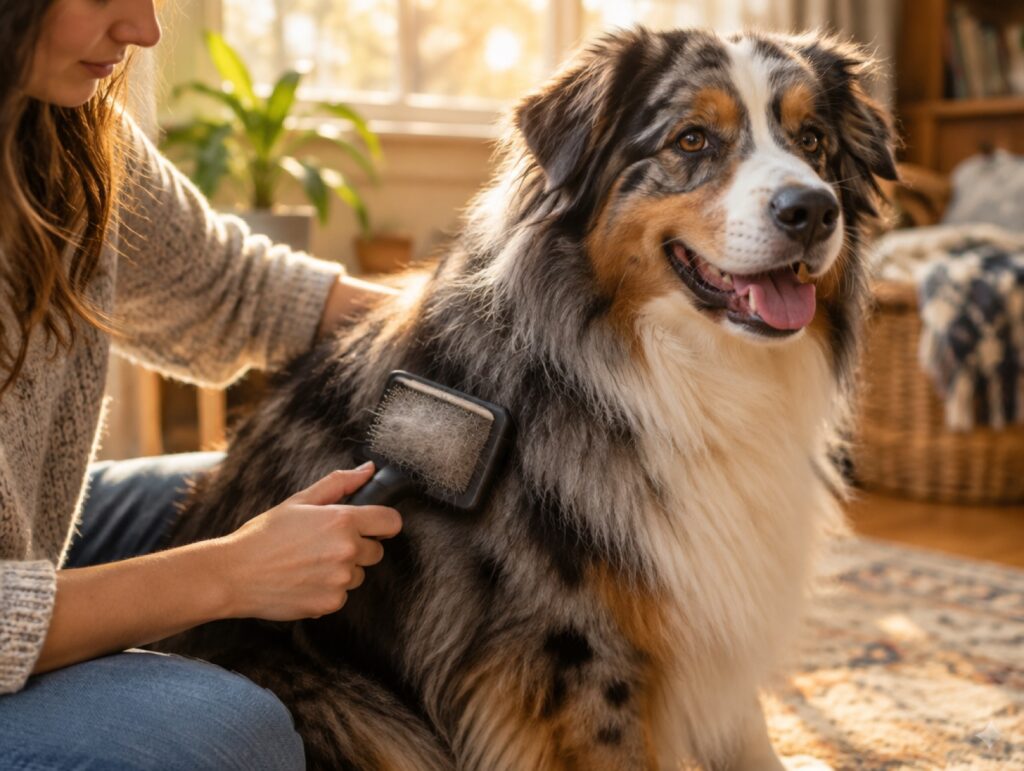
In the evening you sit down on the sofa, your dog snuggles up to you and leaves a grey layer of hair on your black trousers. In the morning you fill a whole brush with hair and find white flakes on your pillow. Is it just the cold and the heating, or is your dog’s coat telling you something? I will show you how to read it, and also what no shampoo can fix.
- According to VCA Animal Hospitals, a healthy dog coat is shiny and smooth, and the skin is supple and clean, without grease, flakes and lumps.
- Shedding is normal as long as your dog has no bald patches or symmetrically thinned areas. According to the AKC, dogs that shed seasonally shed most in spring and autumn, because of the change in light and temperature.
- A dull coat and dandruff are usually a symptom, not a separate disease. Behind them may be diet, parasites, allergies, the thyroid or seborrhoea.
- Omega-3 fatty acids may support coat quality, but they are a supplement, not a substitute for looking for the cause. The dose is determined by a vet.
- It is enough to bathe your dog as needed, using a dog shampoo. In winter your dog has to stay warm after a bath until completely dry, because a wet dog quickly gets chilled.
What does a healthy coat look like and when is shedding normal?
A healthy dog coat is smooth and shiny, not coarse or brittle, and the skin underneath is clean and supple, without grease, flakes and lumps. That is how VCA Animal Hospitals describes it. A dog with such a coat and skin is usually in good condition.
Shedding is the normal replacement of old hairs with new ones. In dogs that shed seasonally, according to the AKC, the coat change is strongest in spring and autumn, and the trigger is the change in day length and temperature. According to the AKC, dogs with a thick double coat, such as golden retrievers, often shed all year round. According to VCA, they also get heavy shedding of the undercoat in spring and autumn.
The Merck Veterinary Manual gives a simple guide: if shedding is not accompanied by bald patches or symmetrical hairless areas, it is most likely just a change of coat. According to the AKC, a bald patch, inflamed skin or a sudden increase in hair loss is a reason to have your dog examined.
Why does my dog have a dull coat?
A dull and dry coat is often the first visible sign that something is going on in the body or on the skin that needs attention. VCA lists the causes as poor-quality food, intestinal parasites, fleas, ticks and mites, thyroid disorders, allergic skin diseases, long-term digestive problems, and also joint problems or obesity, which can stop a dog from grooming itself. The coat therefore reflects the health of the whole dog, not just the skin.
| What you see | What may be behind it | What to do |
|---|---|---|
| A dull coat, more shedding, the dog is otherwise fine | Unsuitable or poor-quality food | Check whether the food is complete, talk to your vet |
| A dull coat and scratching | Fleas, ticks, mites, allergy | Book an examination, do not wait |
| The coat is thinning, but the skin is not inflamed | Hormonal problems (for example thyroid problems), protein deficiency | Book an examination |
| Dandruff, greasy or smelly skin | Seborrhoea, allergy, infection | Book an examination |
| A worse coat in an old dog, stiffness | Joint pain, obesity | Have your dog examined |
The table is only a rough guide. The cause is identified by a vet through an examination, often from skin samples and blood tests. You will find more about the skin and gut in the article Tummy and skin: how a dog’s gut relates to its skin, and about scratching in the article Why is my dog scratching? 8 causes and when to see a vet.
Where do dandruff and greasy skin come from?
Dandruff in a dog is flaking skin cells that build up in the coat and in the places where your dog lies. VCA links it with seborrhoea, a disorder in which the sebaceous glands produce too much sebum. Seborrhoea can be dry or greasy, and in most dogs it is a combination of both. The skin often smells, especially when an infection sets in.
Seborrhoea is either hereditary (according to VCA, for example in cocker spaniels, West Highland white terriers and basset hounds) or secondary. Secondary seborrhoea is caused by hormonal problems, allergies, parasites, yeast and bacterial skin infections, a diet lacking omega-3 fatty acids or a dog being unable to groom itself because of excess weight or limited movement. Correct treatment therefore always starts with looking for the cause.
In winter, dandruff is often put down to the dry air from heating. VCA states that dry winter air in flats irritates the skin of some dogs. We have not found studies confirming this in dogs, though. It may be true, but do not postpone an examination because of it if the dandruff persists, itches or smells.
Do omega-3 fatty acids help a dog’s coat?
The omega-3 fatty acids EPA and DHA may support coat quality, but slowly. In one controlled study in dogs with a poor coat, the coat improved after roughly two months, and after the supplement was stopped the effect was lost. It is not a quick fix.
- 24 dogswith a poor coat received an omega-3 supplement or a placebo for 90 days. The clinical score of coat problems fell significantly from day 60 in dogs with the supplement and returned to the starting value by day 180.Combarros et al., 2020, double-blind study
- 30 healthy dogswere followed in a study of three plant oils with omega-3 (ALA) for 16 weeks. Softness and shine of the coat improved in all groups, but the study had no group without oil.Richards et al., 2023
The first study is of good quality, but small, and it tested one commercial supplement. In the second the coat improved with all three oils equally, so we cannot tell whether it would have improved without them as well. Both studies are in dogs, but they guarantee nothing for any individual dog.
We do not give doses here, because it depends on the weight, the food and the health of the dog. If you are considering a supplement, first ask your vet, especially if your dog has skin problems or is ill.
How should a dog’s diet support the coat?
The coat needs complete food with good-quality digestible protein, fats, minerals and vitamins. According to VCA, poor-quality food leads to a dull, dry coat and more shedding. The Merck Veterinary Manual lists protein deficiency among the non-inflammatory causes of hair loss.
When a dog is on good-quality complete food, home-made additions may not be needed. Change food gradually, as described in the article Switching dog food: a 7 to 10 day plan.
How often should I bathe my dog, and how in winter?
Most dogs only need a bath when they are dirty. VCA states that healthy dogs of non-shedding breeds need a bath roughly every 6 to 8 weeks. Use only a shampoo made for dogs. According to VCA, dogs have skin of a different thickness and with a different pH from people, and human shampoo therefore does not suit them.
In winter, the main rule is that your dog must not stay wet. VCA points out that a wet dog is a cold dog, and dogs can get hypothermia too. After a bath your dog must be thoroughly dried and kept warm, and only let outside when completely dry. If you do not have to, do not bathe your dog before a long winter walk.
How should I brush my dog, and does it need clothes in winter?
Brushing removes dead hair and skin and spreads natural oils through the coat. According to VCA, long-haired dogs should be brushed daily so that the coat does not mat. VCA adds that a matted coat traps moisture, so keep it free of clumps in winter.
Do not clip the winter coat: according to VCA, it insulates your dog and keeps it warm. Clothes are needed mainly by small dogs, slim short-haired dogs, puppies, seniors, dogs with chronic problems and newly clipped dogs. Short-legged dogs can also get chilled even with a thick coat, because their belly touches the snow. Nordic breeds with a thick coat, such as huskies or malamutes, mostly do not need clothes. Always measure your dog properly for a coat so that it can move freely. You will find more about winter and paws in the article Winter paws: salt, licking and cracked pads.
What can you do today?
- Inspect the coat. Part it right down to the skin on the back and by the tail. Look for red skin, dandruff, bald patches, parasites and any smell.
- Take a photo. A photo today and in a month shows the change better than memory.
- Brush regularly. A long-haired dog daily according to VCA, a short-haired one as needed, more often during shedding.
- Check the food. Make sure it is complete, and do not feed table scraps.
- Dry after a bath. In winter, your dog goes outside only when dry.
The coat is a good indicator of the health of the whole dog, but it does not tell the whole story. A shiny coat without dandruff does not need extra supplements. When the quality worsens, look for the cause, not just a shampoo. Save the article or send it to a friend whose sofa is covered in dog hair.
Frequently asked questions
Why does my dog have a dull and dry coat?
Most often because of diet, parasites, allergy or hormonal problems, such as thyroid problems. VCA also lists long-term digestive problems, joint problems and obesity. The coat reflects the health of the whole dog, and dullness is usually a symptom, not a separate disease. If care and complete food do not improve the coat within a few weeks, have your dog examined.
When do dogs shed the most?
In dogs that shed seasonally, in spring and autumn. According to the AKC, shedding is triggered by the change in light and temperature. Dogs with a thick double coat are more likely to shed all year round. If bald patches appear, the skin is inflamed or hair loss clearly increases, that is a reason for an examination.
How often should I bathe my dog in winter?
As needed, not by the calendar. VCA states that most dogs need a bath only when dirty or smelly, and healthy dogs of non-shedding breeds roughly every 6 to 8 weeks. In winter your dog must be thoroughly dry after a bath, because a wet dog quickly gets cold.
Does fish oil help a dog’s coat?
Fish oil contains the omega-3 fatty acids EPA and DHA. One controlled study with EPA and DHA capsules in dogs with a poor coat reports an improvement after roughly two months, and after the supplement was stopped the effect disappeared. A specific product was tested. The dose depends on the dog, so talk to your vet first. A supplement does not replace looking for the cause.
Does a dog need clothes in winter?
It depends on the dog. According to VCA, they are needed mainly by small dogs, slim short-haired dogs, puppies, seniors, dogs with chronic problems and freshly clipped dogs. Short-legged dogs can also get chilled. Nordic breeds with a thick coat mostly do not need them. If your dog shivers, whines or does not want to go on, take it somewhere warm.
Sources
- Combarros D et al. (2020). A prospective, randomized, double blind, placebo-controlled evaluation of the effects of an n-3 essential fatty acids supplement (Agepi ω3) on clinical signs, and fatty acid concentrations in the erythrocyte membrane, hair shafts and skin surface of dogs with poor quality coats. Prostaglandins, Leukotrienes and Essential Fatty Acids. doi.org/10.1016/j.plefa.2020.102140
- Richards TL et al. (2023). Effects of dietary camelina, flaxseed, and canola oil supplementation on inflammatory and oxidative markers, transepidermal water loss, and coat quality in healthy adult dogs. Frontiers in Veterinary Science. doi.org/10.3389/fvets.2023.1085890
- VCA Animal Hospitals. Coat and Skin Appearance in the Healthy Dog. vcahospitals.com/know-your-pet/coat-and-skin-appearance-in-the-healthy-dog
- VCA Animal Hospitals. Grooming and Coat Care for Your Dog. vcahospitals.com/know-your-pet/grooming-and-coat-care-for-your-dog
- VCA Animal Hospitals. Seborrhea in Dogs. vcahospitals.com/know-your-pet/seborrhea-in-dogs
- VCA Animal Hospitals. Do Dogs Need Coats In The Winter? vcahospitals.com
- VCA Animal Hospitals. Cold weather safety for your pets. vcahospitals.com
- Merck Veterinary Manual. Hair Loss (Alopecia) in Dogs. merckvetmanual.com
- American Kennel Club. Dog Shedding: What to Expect and How to Manage It. akc.org
This article is educational and does not replace a veterinary examination. If you are not sure, ask your vet.
This article was proofread with the help of AI. This is a translation from Czech, so it may contain inaccuracies.