Blog · Nutrition
Overweight dog: the ideal weight on a 1–9 scale
Check a dog’s weight by hand: ribs felt without pressure, a waist from above, a tucked belly from the side. Ideal is 4–5 of 9. How to do it, when to see a vet.
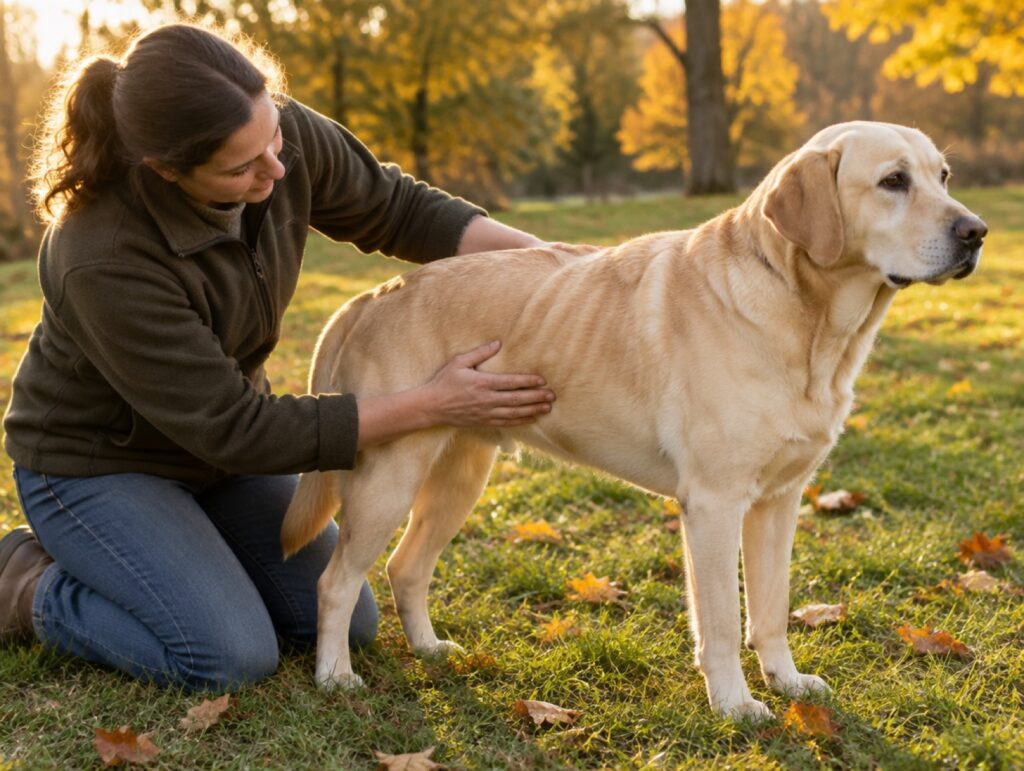
Your dog sits by the kitchen counter and looks at you with irresistible eyes. It gets a piece of cheese. Then another. It looks content and a little rounded. How can you tell whether that is just an impression, or already extra weight? Look for the answer not on the scales but on your dog. All you need is a minute, your hands and your eyes.
- A dog’s ideal weight is not set by a number of kilograms, but by the body condition score (BCS) scale from 1 to 9, on which the ideal values are 4 to 5.
- In a dog in ideal condition you can feel the ribs without pressure, see a waist from above and a tucked-up belly from the side.
- According to AAHA, each point above a score of 5 means roughly 10% overweight.
- Being overweight is linked with a shorter life: in a large North American study of more than 50,000 dogs, overweight dogs in all 12 breeds studied had a higher risk of death.
- Always plan your dog’s weight loss with your vet. At home you can measure portions by weight, keep treats to 10% of the daily intake and weigh your dog once a month.
How can you tell that your dog is at an ideal weight?
You can judge ideal weight in three ways: your hands on the ribs, a view from above and a view from the side. According to VCA Animal Hospitals, the ribs of a dog in good condition should feel to the touch like the back of your hand. When they feel more like the fleshy part of your palm, your dog is probably overweight. When they feel more like your knuckles, it may be too thin.
- Put your hands on the ribs. Place your fingers on the side of the chest and run them gently along it. According to the WSAVA scale, the ribs of an ideal dog should be palpable without excess fat.
- Look from above. Stand over your standing dog. Behind the ribs you should see a waist, that is a narrowing of the body.
- Look from the side. The belly should be tucked up towards the hind legs and must not form a straight line or a bulge.
- Feel through the coat. A thick coat fools the eyes. With long-haired and fluffy dogs, rely mainly on your hands.
- Write down the result. Compare it with the table below and check again in the same way in a month.
What is the 1–9 BCS scale?
The body condition score (BCS) scale is a nine-point system that vets use to assess body fat by looking at the ribs, waist and belly. It was described and validated in 1997 by Laflamme. According to AAHA, the score corresponds to the percentage of body fat measured by DEXA (a special X-ray examination of body composition).
| Score | What you see and feel | Category |
|---|---|---|
| 1–3 | Ribs, vertebrae and pelvic bones visible or easily felt, no palpable fat, a pronounced waist and tucked-up belly, with scores 1 and 2 also muscle loss | Below ideal |
| 4–5 | Ribs easily felt with minimal fat, a waist visible from above, belly tucked up from the side | Ideal |
| 6 | Ribs felt under a slightly thicker layer of fat, a waist visible from above but not pronounced | Overweight |
| 7 | Ribs felt with difficulty, fat over the loins and at the base of the tail, the waist almost disappears | Overweight |
| 8–9 | Ribs not felt under a thick layer of fat or only with strong pressure, no waist, belly not tucked up, with 9 fat also on the neck and limbs | Obese |
WSAVA groups scores 6 to 9 together as above ideal. The division into overweight and obese comes from the AAHA conversion (each point above 5 is roughly 10% above ideal weight) and from the VCA threshold, according to which a dog is obese when it weighs more than 20% above its ideal weight. The table is a simplified description, not a diagnosis. Your vet will always confirm the score at a check-up. AAHA recommends assessing condition at every visit and teaching owners to recognise the change themselves.
Why does a dog’s excess weight matter?
Excess weight in a dog is linked with a shorter life and a higher risk of a number of diseases. According to VCA Animal Hospitals, overweight dogs have a higher risk of tumours, diabetes, heart problems, high blood pressure, osteoarthritis, urinary stones and complications under anaesthesia. It is therefore not a cosmetic matter.
- 50,787 dogswere in a study of neutered dogs from North America. In all 12 breeds, dogs that were overweight at the age of 6.5 to 8.5 years had a higher risk of death than dogs in normal condition.Salt et al., 2019 (observational study)
- 13.7 vs. 16.2 yearswas the median lifespan of overweight and non-overweight Yorkshire Terriers. For German Shepherds it was 12.1 and 12.5 years.Salt et al., 2019
- 13 vs. 11.2 yearswas the median lifespan of Labradors that were fed a quarter less food from puppyhood and of their paired siblings without this restriction (48 dogs).Kealy et al., 2002
- 59%of dogs in the USA were overweight according to a 2022 survey.Association for Pet Obesity Prevention, cited by VCA
A word of caution: Salt et al. looked at an association, not a cause, and Kealy worked with a small group of one breed. Together, though, they show the same direction: a leaner dog lived longer, and according to Kealy’s study the signs of chronic diseases usually appeared later.
Why do dogs put on weight and what can you do about it at home?
Dogs put on weight when they take in more energy than they use, and what we give them plays a big role. According to AAHA, the risk factors for obesity lie both in the dog and in the people around it. The good news is that you can change some of them.
- Measure by weight, not with a scoop. A 2011 study by German et al. found that measuring dry food with a cup was imprecise, and the actual portion ranged from 18% smaller to 80% larger than it should have been. Kitchen scales are more reliable.
- Watch the treats. According to VCA and AAHA, treats should make up at most 10% of the daily energy intake.
- Count everything. The intake also includes table scraps, chews and a medicine wrapped in cheese.
- Replace food with attention. AAHA recommends adding activities without food to a weight-loss plan: walks, play and brushing.
- Weigh your dog once a month. According to VCA, during weight loss it is important to weigh your dog every month, as this tells you whether the plan is working.
Should a dog lose weight at home on its own?
No, always plan your dog’s weight loss with your vet. According to VCA Animal Hospitals, it is not enough just to reduce the portion of the current food, because over time your dog could lack important vitamins and minerals. Your vet will choose a suitable food, the specific portion and the number of feedings a day. Never put your dog on a starvation diet.
When changing food, keep to a gradual transition to give the gut time to adjust. You will find how in the article Switching dog food: a 7 to 10 day plan. Whether fibre helps is covered in the article Fibre for dogs: what it does and when to add it. With puppies and seniors, never start weight loss without a vet.
- Once a month: hands on the ribs, a look from above and from the side, weigh your dog.
- You can feel the ribs without pressure, see the waist from above and the belly is tucked up.
- Weigh the portions on scales, treats at most 10% of the daily intake.
- No starvation diets, weight loss always with your vet.
- A score of 6 or more or 3 or less: arrange an examination.
When should I go to the vet straight away?
Excess weight on its own is not an emergency, but an illness may also be behind a change in weight or body shape. If the belly has grown quickly or your dog has suddenly lost weight even though it eats as before, it is not ordinary excess weight and needs a vet.
- your dog breathes with effort even at rest, collapses or is suddenly very listless
- its belly has grown quickly, is hard or painful
- it vomits repeatedly or refuses food and water
Book an appointment with your vet if your dog gains or loses weight without a change in feeding, moves with more difficulty, tires quickly or has a score of 6 or more. Your vet will rule out diseases such as an underactive thyroid or Cushing’s disease (VCA) and propose a plan.
What should I take away from this?
A dog’s ideal weight can be judged by the ribs, waist and belly, not by the number on the scales. A score of 4 to 5 out of 9 is the goal, and a score of 6 or more is a reason for a plan with your vet. This evening, put your hands on your dog’s ribs and look at it from above. Put a monthly check in your calendar and save the article as a cheat sheet.
Frequently asked questions
How can I tell that my dog is overweight?
You can feel the ribs only with pressure or not at all, you cannot see a waist from above and from the side the belly is not tucked up. According to VCA, the ribs of an overweight dog feel like the fleshy part of the palm. A score of 6 or more out of 9 means overweight, and your vet can confirm it at a check-up.
What is a dog’s ideal weight on the 1–9 scale?
Scores of 4 and 5 are ideal. A dog should have easily felt ribs with minimal fat, a waist visible from above and a tucked-up belly. A number in kilograms differs by breed and build, so the body condition scale is more reliable than a weight table.
How many treats can a dog have a day?
According to VCA and AAHA, treats and other food outside the main food should make up at most 10% of the daily energy intake. Count table scraps, chews and a medicine wrapped in cheese as well. A smaller dog gets a larger share of its daily allowance from the same treat than a large one.
Is it better to measure food with a cup or to weigh it?
It is better to weigh it. A 2011 study by German et al. found that measuring dry food with a cup gave imprecise portions, from 18% smaller to 80% larger than they should have been. In the long term such errors could contribute to a dog slowly putting on weight. Kitchen scales are therefore more reliable.
Should I put my dog on a starvation diet to lose weight?
No. A dog’s weight loss should be led by a vet, who chooses a suitable food, the size of the portion and the number of feedings. According to VCA Animal Hospitals, it is not enough just to reduce the volume of the current food, as your dog could lack vitamins and minerals. A starvation diet is not a safe way to lose weight. With puppies and seniors, never start weight loss without a vet.
How often should I weigh my dog?
During weight loss, VCA recommends weighing your dog once a month, unless the vet says otherwise. That way you will see whether the plan is working. At the same time, check the ribs and waist with your hands, because the weight alone does not show whether a dog is gaining fat or muscle mass. Write down the result and compare it in a month.
Sources
- Laflamme DP (1997). Development and validation of a body condition score system for dogs. Canine Practice 22:10–15. Scale chart: WSAVA, Body Condition Score (dog)
- Cline MG et al. (2021). 2021 AAHA Nutrition and Weight Management Guidelines for Dogs and Cats. Journal of the American Animal Hospital Association 57(4):153–178. doi.org/10.5326/JAAHA-MS-7232
- Salt C et al. (2019). Association between life span and body condition in neutered client-owned dogs. Journal of Veterinary Internal Medicine 33(1):89–99. doi.org/10.1111/jvim.15367
- Kealy RD et al. (2002). Effects of diet restriction on life span and age-related changes in dogs. Journal of the American Veterinary Medical Association 220(9):1315–1320. doi.org/10.2460/javma.2002.220.1315
- German AJ et al. (2011). Imprecision when using measuring cups to weigh out extruded dry kibbled food. Journal of Animal Physiology and Animal Nutrition 95(3):368–373. doi.org/10.1111/j.1439-0396.2010.01063.x
- VCA Animal Hospitals. Obesity in Dogs. vcahospitals.com/know-your-pet/obesity-in-dogs
This article is educational and does not replace a veterinary examination. If you are not sure, ask your vet.
This article was proofread with the help of AI. This is a translation from Czech, so it may contain inaccuracies.