Blog · Digestion
Bland diet for dog diarrhoea: what to feed and for how long
Bland diet for dog diarrhoea: water and small portions of easily digestible food for a few days, then back to normal food. Puppies and blood: see a vet.
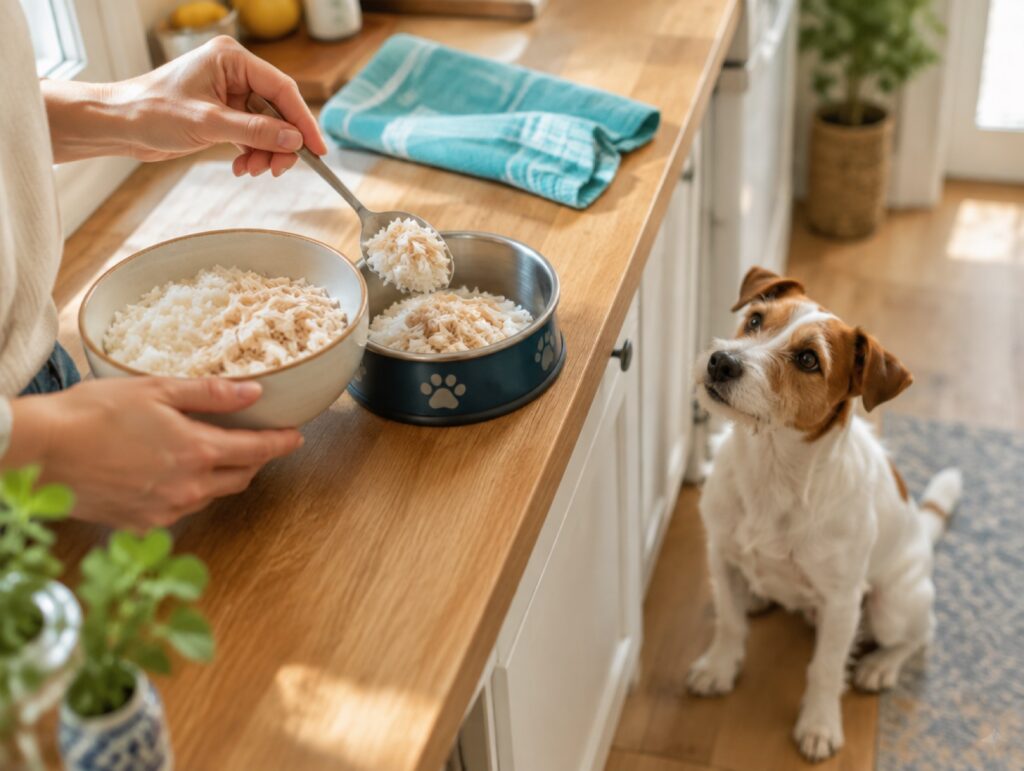
Your dog has diarrhoea and you are standing at the fridge wondering what to give. Rice with chicken? Nothing? Or should you call the vet straight away? A diet for a dog with diarrhoea is easily digestible food in small portions that does not burden the gut until the poop settles. It is, however, a short-term solution for a lively adult dog, not a treatment and not a menu for weeks. Discuss the type and length of the diet with your vet; a phone call is often enough.
- A diet for diarrhoea is easily digestible food with a moderate fat content, given in small portions only briefly, until the stool settles.
- Water matters most: according to the review by Candellone et al. (2020), water is the most important nutrient for a dog with acute diarrhoea.
- Home-cooked chicken with rice is not a complete food. According to VCA Animal Hospitals it lacks more than 10 essential nutrients, which is why a veterinary digestive food is often the better choice.
- You return to the regular food gradually, according to VCA Animal Hospitals over about 7 to 10 days.
- A puppy, a senior, or a dog with blood in the stool or vomiting does not belong on a home diet but at the vet.
What should you give a dog with diarrhoea?
With diarrhoea, give your dog fresh water and small portions of easily digestible food with a moderate fat content. The review of acute diarrhoea in dogs (Candellone et al., 2020) describes as the traditional first step a highly digestible, low-residue diet with a moderate amount of fat (less than 14% of dry matter) and protein from a quality source, such as meat or egg.
In practice that means two routes. The better one is a veterinary digestive food (more on it below), because it is complete. The emergency one is a home diet of boiled lean meat and white rice, which you should take only as a short bridge and discuss with your vet.
| Ingredient | Suitable? | Note |
|---|---|---|
| Boiled chicken or turkey without skin and fat | Yes | Boil in water, no salt, no seasoning, cook thoroughly |
| White rice, well cooked | Yes | The basis of the traditional home diet |
| Veterinary digestive food | Yes | Complete and easily digestible, chosen by your vet |
| Fried, fatty meat, skin, fatty leftovers | No | The diet should contain only a moderate amount of fat |
| Bones | No | According to the ASPCA they can injure or block the digestive tract |
| Milk and dairy products | No | According to the ASPCA they can cause diarrhoea or other digestive problems |
| Spices, salt, sauces, treats | No | They do not belong in a simple diet |
| Onion and garlic | Never | They are toxic to dogs, more in the article What dogs must not eat |
Is rice with chicken a good choice for a dog with diarrhoea?
Rice with lean boiled meat is a traditional short-term help, but it does not have all the nutrients a dog needs. The VCA Animal Hospitals article, written with veterinary nutrition specialists, says that boiled chicken breast with white rice lacks more than 10 essential nutrients and that it is no longer the best recommendation, because complete veterinary digestive foods now exist.
If your vet approves a home diet for a few days, keep it simple. Boil the meat thoroughly in unsalted water, remove the skin and visible fat and mix it with the rice. No butter, oil or sauce. Store leftovers in the fridge; VCA warns of the risk of bacteria in undercooked or badly stored meat. Your vet will tell you the ratio and the amount.
Should a dog fast when it has diarrhoea?
Do not start a fast on your own. According to the VCA Animal Hospitals article on nutrition for digestive upset, fasting used to be commonly recommended, but today it is no longer advised for most dogs, because the gut needs nutrients while recovering and fasting can delay healing. The review by Candellone et al. (2020) mentions the traditional “gut rest” of 24 to 48 hours and early feeding as an alternative, but points out that the comparative studies concern exclusively dogs with parvovirus.
A short break from food may be recommended by a vet for an otherwise healthy adult dog (VCA). Never let a puppy fast, because according to the American Kennel Club even mild diarrhoea dehydrates a puppy. Water must always be available.
How long should a dog stay on a diet for diarrhoea?
A diet usually lasts only a few days, until the poop starts to take shape. VCA recommends contacting your vet when frequent loose stool lasts longer than two days. The University of Guelph (2025) advises going to the vet if the diarrhoea does not improve within three days on a highly digestible diet. Stick to the shorter limit, that is, two days.
A useful guide is your dog’s condition: is it lively, drinking, not vomiting, and is the stool improving every day? Then the plan is fine. Is it stuck or getting worse? Time to call your vet. If your vet recommends a diet, the course looks roughly like this:
- Day 1: water and rest. Fresh water always at hand, no treats or chews. If your dog is not vomiting, offer the first small portion of the diet.
- Day 1 to 2: diet only, small portions. Split the daily amount into several small meals instead of two large ones, as VCA also advises.
- Is the stool firming up? If it is thicker and your dog is lively, start adding its usual food to the diet, a quarter at first.
- The following days: a gradual return to the regular food. Change the ratio in steps following the table below. If the diarrhoea returns, go back a step and contact your vet.
How do you switch back to the regular food?
A dog returns to its regular food gradually, over about 7 to 10 days from when the stool settles (VCA Animal Hospitals). The University of Guelph (2025) recommends the same principle for any change of food: steps of 75 : 25, 50 : 50, 25 : 75 and then the full food, a total of 7 to 10 days. The table adapts this for a return from the diet.
| Step | Diet | Regular food | When to move on |
|---|---|---|---|
| 1 | 100% | 0% | The stool is firming up, your dog is lively |
| 2 | 75% | 25% | After 2 to 3 days without getting worse |
| 3 | 50% | 50% | After 2 to 3 days without getting worse |
| 4 | 25% | 75% | After 2 to 3 days without getting worse |
| 5 | 0% | 100% | Done, keep a steady routine |
The table is a guide, not a rule. You can find the general principles in the article Switching dog food: a 7 to 10 day plan.
Why is diarrhoea riskier in a puppy?
A puppy has smaller fluid reserves and so dehydrates faster than an adult dog. The American Kennel Club warns that even mild diarrhoea dehydrates a puppy, and recommends calling the vet when it lasts longer than one day, and straight away with blood, fever, vomiting or pain.
Another reason for caution is parvovirus. According to the AKC it can end in death and requires immediate veterinary care. So with a puppy that has not finished its vaccinations, always get in touch when it has diarrhoea. Do not start a home diet for a puppy without advice from your vet.
Can a dog with diarrhoea have pumpkin or other fibre?
Fibre can firm up the stool, but the type and amount depend on the cause and are for your vet to decide. According to the review by Candellone et al. (2020), soluble fibre, such as psyllium or apple pectin, can be part of a highly digestible diet in a small amount. The Merck Veterinary Manual says that added fibre improves diarrhoea in many animals with inflammation of the large bowel. There, though, it is started by a vet after an examination.
Pumpkin is among the fibre foods that owners often try. We did not find a study that tested pumpkin specifically in dogs with diarrhoea, so it cannot be said to help. If you want to try it, ask your vet. Be careful: according to the University of Guelph, too much soluble fibre can lead to diarrhoea and too much insoluble fibre to constipation. You can find more about fibre in the article Fibre for dogs.
When is a veterinary digestive food better?
According to the University of Guelph, a veterinary digestive food is often the first choice for dogs with acute diarrhoea. Unlike a home diet, it is complete and easily digestible (VCA Animal Hospitals).
The review by Candellone et al. (2020) describes a highly digestible diet in numbers: protein digestibility of at least 87% and fat and carbohydrate digestibility of at least 90%. VCA Animal Hospitals says that veterinary digestive diets contain a balanced blend of fibre that feeds beneficial gut bacteria. Leave the choice of product and the length of feeding to your vet. A shop-bought food labelled “for sensitive digestion” is not automatically the same thing.
The milder form is covered in the article Soft stool in dogs and puppies, and the main procedure for diarrhoea is in the article Diarrhoea in dogs: what to do and when to see a vet.
Why does the microbiome take days to weeks to recover after diarrhoea?
The poop can settle before the gut bacteria do. In a pilot study by Chaitman et al. (2020), dogs with acute diarrhoea (18 dogs) had a markedly higher dysbiosis index, an indicator of imbalance in gut bacteria, and lower bacterial diversity than 14 healthy dogs. In dogs given metronidazole, the changes were still visible after 28 days, even though the stool had improved within a week. In dogs with a stool transplant from a healthy donor, bacterial diversity after 28 days no longer differed significantly from healthy dogs.
The study is small, without random allocation of the dogs, and concerns dogs treated by a vet, so it does not show how fast the microbiome recovers after diarrhoea without treatment. A similar picture in 24 healthy dogs was shown by the study by Pilla et al. (2020): metronidazole reduced bacterial diversity and the changes had not completely disappeared even four weeks after the end of treatment. You can find more about antibiotics in the article Dog after antibiotics.
The practical conclusion: nice-looking stool does not mean the gut is finished. Give it peace, that is, steady food, no new treats and no experiments. What gut bacteria are is covered in the article Dog gut microbiome: what it is and why it matters.
Frequently asked questions
How long should I give my dog rice with chicken for diarrhoea?
Only briefly, and ideally after agreeing with your vet. According to VCA, chicken with rice lacks more than 10 essential nutrients, so it is not for longer than that. If frequent loose stool lasts longer than two days (VCA), call your vet. Return to the regular food gradually.
Can I give my dog pumpkin for diarrhoea?
We did not find a study that tested pumpkin in dogs with diarrhoea. Pumpkin is a source of fibre, but do not set the amount or the length of feeding without your vet. Too much soluble fibre can make diarrhoea worse. It is safer to stick to a simple diet and discuss fibre with your vet.
Should a dog fast when it has diarrhoea?
Do not let it fast on your own. According to VCA, fasting is no longer recommended for most dogs with digestive upset, because the gut needs nutrients. A short pause may be recommended in a healthy adult dog only by a vet. Never let a puppy fast. Water must always be available.
How much should I feed a dog with diarrhoea?
Rather several small portions than two large ones, as VCA also advises. Your vet may recommend a smaller total amount than usual too. The exact amount depends on your dog’s weight, age and condition, so agree it with your vet. Grams per kilo cannot be given without an examination.
Is a veterinary diet better than a home one?
Yes. The University of Guelph lists it as a common first choice for acute diarrhoea, and according to VCA it is, unlike chicken with rice, complete and easily digestible. A home diet is only a short emergency solution that lacks a balanced composition of nutrients. Leave the specific product to your vet.
How long does it take for the microbiome to recover after diarrhoea?
There is no exact figure for every dog. In the small study by Chaitman et al. (2020), changes in the microbiome were still visible after 28 days in dogs treated with metronidazole, even though the stool had improved within a week. So give the gut peace, steady food and no new treats.
Sources
- VCA Animal Hospitals. Diarrhea in Dogs. vcahospitals.com/know-your-pet/diarrhea-in-dogs
- Canadian Academy of Veterinary Nutrition, Grant C, Buzhardt L. Nutrition for Dogs and Cats with Gastrointestinal Upset. VCA Animal Hospitals (2024). vcahospitals.com/know-your-pet/bland-diet-instructions-for-dogs-and-cats
- Candellone A et al. (2020). Acute Diarrhea in Dogs: Current Management and Potential Role of Dietary Polyphenols Supplementation. Antioxidants. doi.org/10.3390/antiox9080725
- University of Guelph, Pet Nutrition at OVC (2025). Tummy troubles: a guide to managing acute diarrhea in dogs. ovcpetnutrition.uoguelph.ca
- Chaitman J et al. (2020). Fecal Microbial and Metabolic Profiles in Dogs With Acute Diarrhea Receiving Either Fecal Microbiota Transplantation or Oral Metronidazole. Frontiers in Veterinary Science. doi.org/10.3389/fvets.2020.00192
- Pilla R et al. (2020). Effects of metronidazole on the fecal microbiome and metabolome in healthy dogs. Journal of Veterinary Internal Medicine. doi.org/10.1111/jvim.15871
- Merck Veterinary Manual. Colitis in Small Animals. merckvetmanual.com
- American Kennel Club. Puppy Diarrhea: Causes, Treatment, and Symptoms. akc.org/expert-advice/health/puppy-diarrhea
- ASPCA Animal Poison Control. People Foods to Avoid Feeding Your Pets. aspca.org
This article is educational and does not replace a veterinary examination. If you are not sure, ask your vet.
This article was proofread with the help of AI. This is a translation from Czech, so it may contain inaccuracies.