Blog · Movement
Winter dog walks in the dark: safety and games at home
In the dark, walk with lights and reflective gear, match exercise to age and fitness, and fill short days with scent games at home. Plus when to see a vet.
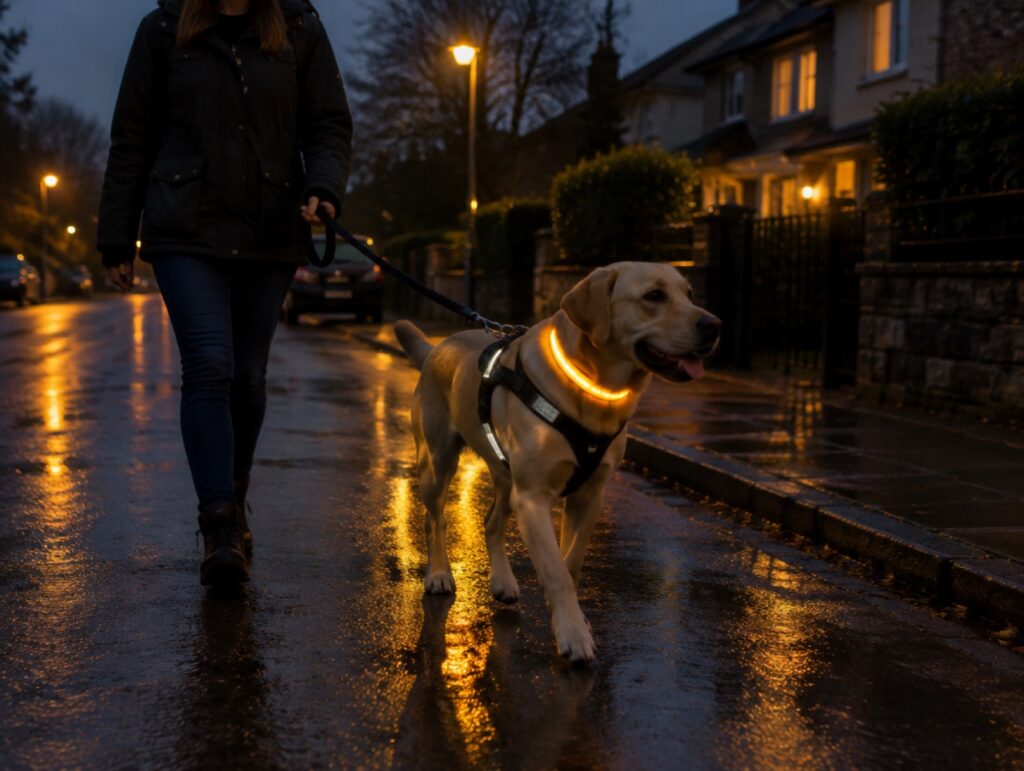
It is a quarter past four in the afternoon and it is pitch dark outside. Your dog sits by the door, you have unfinished work in your head, and the slippery pavement in front of the house does not help much. In winter, walks get shorter, the healthy routine falls apart and your dog then runs around the flat in the evening. This overview will help you manage three things: walking safely in the dark, getting a sensible amount of exercise and filling the short days with games at home.
- For walking in the dark, studies with drivers and pedestrians show that lights, flashing lights and reflective material help, but the review found no studies on their effect on collisions and injuries (Kwan and Mapstone, 2006).
- It has not been shown that cold harms dogs’ joints. In dogs with a herniated disc, it was an association with lower temperature, not proof of a cause (Barandun et al., 2020).
- There is no universal number of minutes of exercise for a dog: in a study of 28,562 dogs, dogs averaged 51 minutes of activity a day, but individual days ranged from 10 to 600 minutes (O’Rourke et al., 2025).
- On short days, scent work and games at home help, for example hunting for treats or a snuffle mat.
- A dog that has drunk or licked antifreeze belongs with a vet straight away, even without signs.
How do you walk a dog safely in the dark?
When walking in the dark, make sure drivers can see you in good time and that the path ahead of you and your dog is visible too. We found no studies on reflective aids for dogs, so the advice relies on research into the visibility of pedestrians.
A Cochrane review of 39 trials with drivers found that in the dark, torches, flashing lights and retroreflective materials in red and yellow help drivers spot a pedestrian sooner and recognise them. Retroreflective elements arranged in the shape of a moving figure (so-called biomotion) helped drivers recognise a person better. The review could not confirm whether this really reduces the number of accidents, because such studies were missing. The data are from people, not dogs (Kwan and Mapstone, 2006).
| What | What for | What it is based on |
|---|---|---|
| Reflective elements on you | Drivers spot you sooner | Studies with drivers and pedestrians (Kwan and Mapstone, 2006) |
| A reflective collar, lead or vest on your dog | A driver will see your dog too | Derived from human data, not verified in dogs |
| A flashing light on the collar | You and drivers can see your dog even from a distance | Flashing lights help drivers spot pedestrians (Kwan and Mapstone, 2006) |
| A head torch or torch | You will see ice, glass, puddles and what your dog picks up in its mouth | Practice |
| A short lead near the road | Your dog will not run into the road | Practice |
- Ice on water. VCA Animal Hospitals recommends not letting dogs onto frozen bodies of water until local authorities mark them as safe (VCA).
- Puddles by cars. Antifreeze with ethylene glycol is toxic to dogs, and according to Pet Poison Helpline even a small amount can lead to death if treatment is delayed (Pet Poison Helpline). So steer around puddles by parked cars and keep your dog away from them.
- When you get back. Dry your dog and check its paws. According to VCA, wind combined with damp can be dangerous, and most de-icing products irritate the pads (VCA).
Does cold harm dogs’ joints?
It has not been shown that cold harms dogs’ joints. In dogs we have only indirect hints, and in people with osteoarthritis the evidence comes mainly from what patients themselves report.
We found no joint study that tested cold in dogs directly. A retrospective study of 101 dogs from the Lake Geneva area (65% of them chondrodystrophic breeds, most often French Bulldogs and Dachshunds) found acute disc herniation more often at lower temperatures. But that was about a disc, not joints, and about an association, not a cause (Barandun et al., 2020).
In people with osteoarthritis, a 2025 review states that patients often report more pain and stiffness at lower temperatures and higher humidity (Jevotovsky et al., 2025). But the conclusion cannot be carried over from people to dogs.
- 101 dogswith a herniated disc were in the retrospective study that found an association with lower temperature. It is not proof of a cause.Barandun et al., 2020
- 51 minuteswas the average daily activity recorded by a collar with a motion sensor in 28,562 dogs. Individual days ranged from 10 to 600 minutes.O’Rourke et al., 2025
One practical thing follows from this: for a dog with osteoarthritis or back pain, talk to your vet about how winter affects it. VCA states that cold weather can make problems such as arthritis worse and that dogs with joint problems slip more easily on ice and snow, and it recommends discussing with your vet which winter activities are suitable for the particular dog (VCA).
How much exercise does a dog need in winter?
In winter a dog does not need a universal number of minutes: the need for exercise depends on age, breed size and fitness. According to a large study, daily activity varies greatly between dogs and between individual days.
A 2025 study followed 28,562 dogs in the USA using collars with a motion sensor. The dogs had on average 51 minutes of active time a day, and individual days ranged from 10 to 600 minutes (the authors excluded shorter and longer recordings as probably erroneous). Activity fell with age, faster in larger breeds, and dogs were slightly more active in the countryside, in spring and at weekends. In winter, the study’s model gave roughly 42 active minutes a day, and in spring 44 (O’Rourke et al., 2025).
| Factor | What the study found |
|---|---|
| Age | Activity falls with age |
| Breed size | Larger breeds are more active, but their activity falls faster with age |
| Environment | In the countryside dogs are slightly more active |
| Season and day | More exercise in spring and at weekends, slightly less in winter |
- Watch your own dog. After a walk, does your dog rest calmly, not limp and seem content? Then it probably has enough.
- Take more, shorter walks. In severe frost, VCA recommends short, frequent walks instead of long ones (VCA).
- Add exercise at home. Fill days without a longer walk with the games from the next section.
How can you keep your dog busy at home when it is dark outside?
At home, you can keep a dog busy with scent work, hunting for food and short exercises. Scent work is suitable as a replacement for part of a walk, not for all the exercise.
- Hunting for treats. In a study by Duranton and Horowitz, one group of dogs did scent work (nosework) every day for two weeks and the other practised heelwork. After those two weeks, the dogs from the scent group approached an ambiguous stimulus faster, which the authors interpret as greater optimism. In the other group the time did not change (Duranton and Horowitz, 2019).
- A snuffle mat. In an experiment with 38 dogs, the dogs were willing to work for food on a snuffle mat even when they had the same food freely available in a bowl, but they did not prefer this option (Rothkoff et al., 2024).
- Short tricks. A play bow, a turn, a touch to a target. The aim is your dog’s focus, not the number of repetitions.
A 10-minute plan for the evening
- 2 minutes of warm-up. A slow walk around the flat and a few play bows. You can find out more about warming up in the article Active dog in winter: warm-up, recovery and water.
- 5 minutes of hunting. Hide treats in one room and let your dog sniff.
- 3 minutes of calm. Your dog lies down on a blanket and settles.
Studies do not show a direct effect of these games on a dog’s health. Take them as enrichment for the day, not as treatment.
How do you get back into the rhythm after the holidays?
After the holidays, return to the usual walk times and the usual food gradually, not all at once.
- Bring back fixed times. Walks at roughly the same times as before the holidays.
- Increase gradually. After a period of less exercise, start with shorter walks and add length over the days. Direct studies in dogs have not measured this. It is a general approach when increasing load.
- Return to normal feeding. Leave out the treats from the Christmas table and return to your dog’s own food gradually. You can find out how in the article Switching dog food: a 7 to 10 day plan.
- Watch the poop. If it is soft after the holidays, read Soft stool in dogs: causes and what to do.
What should you do this evening?
Put the reflective items by the door, try the 10-minute plan with hunting for treats and send the article to other owners who walk in the dark. If back or joint problems are getting worse, contact your vet.
Frequently asked questions
How do I walk my dog in the dark?
Wear reflective elements yourself and put them on your dog, use a flashing light and a head torch so that you can see the path. Keep your dog on a short lead near the road. There are no studies on reflective aids for dogs, and we rely on research into the visibility of pedestrians (Kwan and Mapstone, 2006).
Does cold harm a dog’s joints?
It has not been shown. A retrospective study of 101 dogs found an association between lower temperature and disc herniation, not joint problems, and did not prove a cause (Barandun et al., 2020). According to VCA, cold can make problems such as arthritis worse and dogs with joint problems slip more easily on ice and snow, so talk to your vet about winter activities (VCA).
How much should a dog walk in winter?
There is no universal number of minutes. In a study of 28,562 dogs, dogs averaged 51 minutes of activity a day, individual days ranged from 10 to 600 minutes, and activity fell with age (O’Rourke et al., 2025). Go by your dog’s age and fitness, and in hard frost switch to shorter, more frequent walks (VCA).
What can I do to keep my dog busy at home when it is freezing?
Hunting for treats, a snuffle mat and short tricks. A study showed that two weeks of daily scent work changed dogs’ reaction to an ambiguous stimulus, which the authors interpret as greater optimism (Duranton and Horowitz, 2019). In the evening try the 10-minute plan: 2 minutes of warm-up, 5 minutes of hunting for treats and 3 minutes of calm. Studies have not shown a direct effect on a dog’s health, though.
How do I get back to regular walks after the holidays?
Bring back the usual walk times, increase their length gradually and return to your dog’s own food without sudden changes, leaving out treats from the Christmas table. If the poop is soft after the holidays and your dog is otherwise lively, keep watching it. With blood in the stool, repeated vomiting or if your dog is weak and stumbling, call your vet straight away.
Is antifreeze on the street dangerous?
Yes. Many antifreezes contain ethylene glycol, and according to Pet Poison Helpline, small volumes can lead to death if treatment is delayed after exposure. So steer around puddles by parked cars and keep your dog away from them. If your dog has licked or drunk antifreeze, contact your vet immediately, even if it has no signs.
Sources
- Kwan I, Mapstone J (2006). Interventions for increasing pedestrian and cyclist visibility for the prevention of death and injuries. Cochrane Database of Systematic Reviews. doi.org/10.1002/14651858.cd003438.pub2
- Barandun MA et al. (2020). Colder Ambient Temperatures Influence Acute Onset Canine Intervertebral Disc Extrusion. Frontiers in Veterinary Science. doi.org/10.3389/fvets.2020.00175
- Jevotovsky DS et al. (2025). Weathering the Pain: Ambient Temperature’s Role in Chronic Pain Syndromes. Current Pain and Headache Reports. doi.org/10.1007/s11916-025-01361-8
- O’Rourke A et al. (2025). Estimated activity levels in dogs at population scale with linear and causal modeling. Frontiers in Veterinary Science. doi.org/10.3389/fvets.2025.1572794
- Duranton C, Horowitz A (2019). Let me sniff! Nosework induces positive judgment bias in pet dogs. Applied Animal Behaviour Science. doi.org/10.1016/j.applanim.2018.12.009
- Rothkoff L et al. (2024). Domestic pet dogs (Canis lupus familiaris) do not show a preference to contrafreeload, but are willing. Scientific Reports. doi.org/10.1038/s41598-024-51663-x
- VCA Animal Hospitals. Tips to enjoy winter weather safely. vcahospitals.com/resources/lifestyle-dog/hazards-safety/tips-to-enjoy-winter-weather-safely
- Pet Poison Helpline. Antifreeze. petpoisonhelpline.com/poison/antifreeze
This article is educational and does not replace a veterinary examination. If you are not sure, ask your vet.
This article was proofread with the help of AI. This is a translation from Czech, so it may contain inaccuracies.