Blog · Behaviour
Why do dogs eat grass? What we know and what we don’t
Dogs mostly eat grass because it is normal dog behaviour, not an illness. Only some dogs vomit afterwards. Sprays and parasites are the risk. When to see a vet.
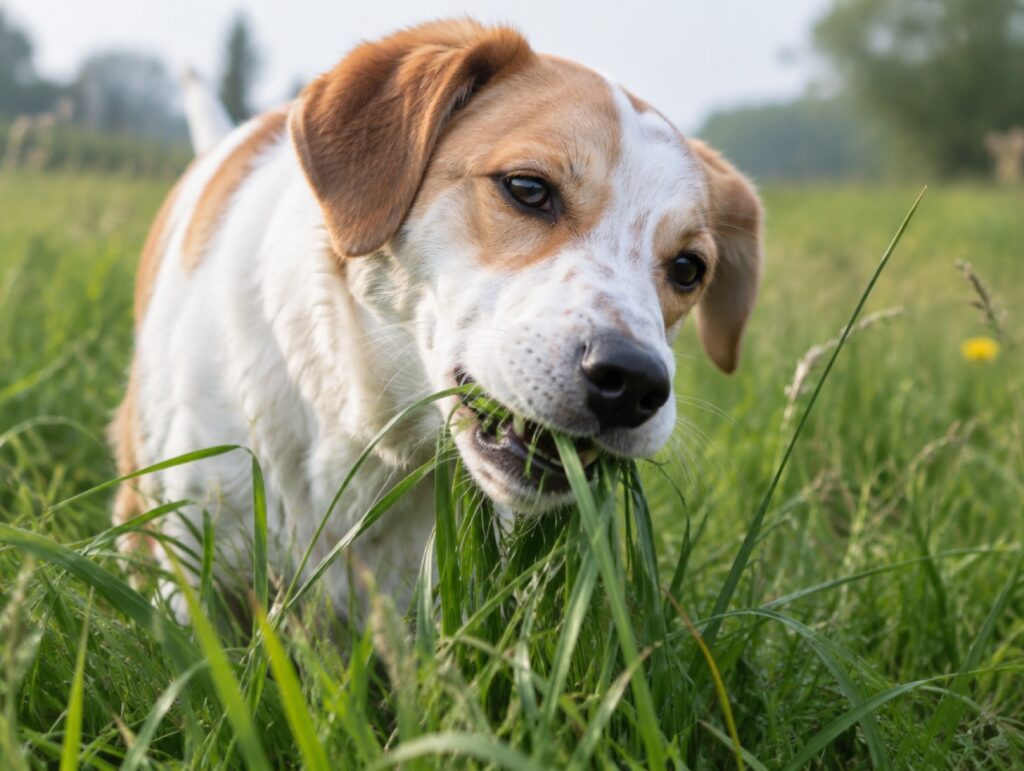
You are walking across a meadow and your dog suddenly stops, lowers its head and starts tearing up grass like a little cow. The questions come straight away: is it ill, is its food lacking something, is it going to be sick? The answer is surprisingly calm, with just two exceptions that are worth knowing.
- Grass eating is very common in dogs and experts regard it as normal behaviour, not an illness.
- In the study by Sueda et al. (2008), only 22% of dogs that eat plants often vomited afterwards, and only 9% often looked ill beforehand.
- Science does not know for certain why dogs eat grass. The ideas include taste, boredom, fibre, innate behaviour and nausea.
- It is not the grass itself that is dangerous, but what is on it (sprays, faeces of other dogs carrying parasites), and clumps of grass that can block the digestive tract.
- If your dog suddenly eats a lot of grass, vomits, has diarrhoea or has lost its appetite, it should see a vet.
Is it normal for a dog to eat grass?
Yes. Grass eating is common behaviour in dogs, which scientists describe as a normal part of a dog’s life. In a 2008 study (Sueda et al., California), 79% of 47 owners of healthy dogs said that their dog had at some point eaten grass or other plants.
The number comes from a small sample and concerns dogs that had daily access to plants. But it shows the main thing: if you have a dog that now and then nibbles grass, you are not an exception. It is more like the rule.
Wolves behave in a similar way. According to the introduction of the study by Sueda et al. (2008), researchers found plant remains in about 11% of samples from Latvian wolves and in about 74% of summer samples from grey wolves in Yellowstone. Some of the grass got there along with prey, but deliberate grass eating has also been described in wolves.
The practical conclusion: if your dog nibbles grass now and then and is otherwise fine, do not panic.
Does a dog eat grass to make itself vomit?
No, vomiting is not the main reason. According to the study by Sueda et al. (2008), which involved 1,571 owners of dogs that eat plants, only 22% of the dogs often vomited afterwards. The other 78% of owners said that their dog only rarely vomits after eating plants.
So most dogs only rarely vomit after grass. Dogs that already looked ill before eating plants vomited more often (Sueda et al., 2008). The study did not confirm that a dog eats grass deliberately in order to vomit.
In a 2010 experiment (McKenzie et al.), researchers temporarily induced soft stool in dogs by adding fructooligosaccharides (FOS) to their food, to imitate mild bowel problems. The dogs then spent less time eating grass than when their stool was normal. During the whole observation period the researchers saw only 2 cases of vomiting in 374 cases of grass eating. The experiment looked only at diarrhoea-type problems, not nausea or constipation, but it does not support the idea that a dog eats grass as a remedy for diarrhoea.
- 22%of dogs that eat plants often vomited afterwardsSueda et al., 2008, 1,571 owners
- 9%of dogs often looked ill before eating plantsSueda et al., 2008, 1,571 owners
Is a dog that eats grass ill?
Usually not. According to the same 2008 study, only 9% of dogs often looked ill before eating plants. The authors regarded a dog as ill if it was listless, did not want to eat and moved little. Most dogs that eat plants were fine beforehand.
Interestingly, younger dogs ate plants more often, and signs of illness before eating or vomiting afterwards were seen in them less often. In older dogs it was the other way round. The study found no link between how often a dog eats plants and its sex, neutering, breed group or type of food. In practice this means that an older dog that looks ill before eating grass or vomits after it deserves more attention.
What follows from this: daily or weekly grazing in a healthy, lively dog is common. A change from what is normal for your dog is a reason to keep watch.
Is your dog missing fibre or something in its food?
Possibly, but there is no evidence. Both VCA Animal Hospitals and the American Kennel Club list a lack of fibre among the possible reasons. At the same time, the 2008 study found no relationship between the type of food and how often a dog eats plants. It did not measure fibre or other nutrients, though, and the authors recommend further research on this.
If your dog is on a good-quality complete food, a missing nutrient is rather an unlikely explanation. Fibre in the diet is a different topic, covered in a separate article, Fibre for dogs: what it does and when to add it. Do not change the food on your own, though. How to switch safely is described in the article Switching dog food: a 7 to 10 day plan.
Does a dog eat grass out of boredom, for the taste or out of hunger?
Probably for several reasons at once. VCA Animal Hospitals lists four: taste, nausea, boredom and lack of fibre. The American Kennel Club adds instinct and points out that excessive grass eating can also be pica, that is, a compulsive urge to eat things that are not food.
Science has no single clear answer. But you can watch your dog, because every dog has its own pattern:
- Taste. The dog picks fresh grass and tears it off calmly.
- Boredom. The dog grazes when it has been alone for a long time or nothing is going on.
- Nausea. The dog licks its lips nervously, gulps, its tummy gurgles and it wolfs down the grass. In that case, watch its stool and whether it vomits.
- Habit. Puppies and young dogs explore the world with their mouths and often try grass.
For one week, write down when your dog eats grass and what came just before. From your notes you will see whether it is a habit or a change.
Is grass dangerous for a dog?
Grass itself is not dangerous for a dog: the risks lie around it. VCA Animal Hospitals lists three main ones: chemicals from sprays, intestinal parasites and blockage of the digestive tract. The American Kennel Club mentions the first two.
| Risk | Why it arises | What you can do |
|---|---|---|
| Herbicides and pesticides | Treated lawns, field edges and gardens can be toxic | Do not let your dog nibble grass on freshly treated areas |
| Intestinal parasites | Grass in places where many dogs go is often contaminated with faeces | Regular worming agreed with your vet; do not let your dog eat grass from places full of poop |
| Blockage of the digestive tract | Grass can clump together and get stuck, and surgery is sometimes needed | Watch the amount, and call your vet if there is repeated vomiting or belly pain |
| Poisonous plants | A dog can taste an ornamental plant or a weed too | Check your garden against the ASPCA list for poisonous species |
If your dog ate grass from a place where you do not know whether it was treated, and then vomits, call your vet. If you suspect spraying, call straight away.
What can you do if your dog eats grass often?
First find out whether it is a habit or a change. Then try to reduce the risks and offer your dog something better to do. You do not have to forbid grass eating if your dog is lively and the grass is clean.
- Watch and write it down. How many times a day, at what time and whether it vomits afterwards. Note the stool as well. It will help when you talk to your vet.
- Pick clean places. Avoid freshly treated lawns and places where many dogs go and there is plenty of poop.
- Give your dog a job on the walk. A sniffing game, fetch or a short training session can help if your dog grazes out of boredom. The American Kennel Club also recommends practising the “leave it” command.
- Arrange regular worming with your vet. The frequency and the product are always chosen by the vet.
- Do not start supplements on your own. If you feel that the grass is connected with digestion, discuss it with your vet. An overview of other digestive signs is in the article Soft stool in dogs: causes and what to do.
Myth or fact? A quick overview
| Claim | What we know |
|---|---|
| A dog eats grass to make itself vomit. | Myth. Vomiting after plants was common in only 22% of dogs (Sueda et al., 2008). |
| A dog eats grass because it is ill. | More of a myth. Only 9% of dogs often looked ill before eating plants (Sueda et al., 2008). |
| A dog eats grass because it is missing fibre. | Not proven. The study found no link with the type of food. |
| It is normal dog behaviour. | More of a fact. According to the study authors, the results support the view that it is normal behaviour of domestic dogs. |
| Grass is always safe. | Myth. The risks are sprays, parasites and blockage of the digestive tract. |
What should you take away from this?
Grass eating is common in dogs and mostly harmless. The two exceptions from the start are a change from the norm (your dog starts wolfing down grass, vomits or has other signs) and the risks around the grass (sprays and parasites). Today one thing is enough: notice where and how often your dog nibbles grass, and write it down. If you found this article useful, save it or send it to someone whose dog grazes on every meadow.
Frequently asked questions
Why does my dog eat grass and then vomit?
According to a 2008 study, vomiting after grass often occurred in only 22% of dogs that eat plants. Dogs that already looked ill before eating plants vomited more often. But if the vomiting repeats or your dog has other signs, have it examined.
Is it bad if a dog eats grass every day?
No, in a healthy, lively dog it tends to be normal behaviour. In the 2008 study, 68% of the dogs that ate plants ate them daily or weekly. Be careful if the frequency rises sharply, your dog starts wolfing down grass or other signs appear, such as vomiting, diarrhoea or loss of appetite.
Does a dog eat grass when its tummy hurts?
Science has not proven that a dog eats grass because of belly pain. In a 2010 experiment, dogs with temporarily soft stool spent less time eating grass than when their stool was normal. The authors of the 2008 study admit, however, that discomfort in the tummy may sometimes trigger grass eating. If your dog has a painful belly, vomits or is listless, call your vet.
Can a dog catch worms from grass?
It can. Both VCA Animal Hospitals and the American Kennel Club state that a dog can swallow intestinal parasites along with grass. The AKC names roundworms and hookworms from animal faeces. Take particular care with grass in places where many dogs go, because it is often contaminated with faeces. Regular worming as recommended by your vet helps.
How do you stop a dog eating grass?
It often works without a ban. If your dog grazes out of boredom, give it a job on the walk: a sniffing game, fetch or a short training session. The American Kennel Club recommends practising the “leave it” command. Avoid freshly treated lawns. If your dog wolfs down grass or has only just started behaving this way, consult your vet. If it vomits repeatedly, call your vet straight away.
Sources
- Sueda KLC, Hart BL, Cliff KD (2008). Characterisation of plant eating in dogs. Applied Animal Behaviour Science 111, 120–132. doi.org/10.1016/j.applanim.2007.05.018
- McKenzie SJ, Brown WY, Price IR (2010). Reduction in grass eating behaviours in the domestic dog, Canis familiaris, in response to a mild gastrointestinal disturbance. Applied Animal Behaviour Science 123, 51–55. doi.org/10.1016/j.applanim.2009.12.003
- VCA Animal Hospitals. Why Does My Dog Eat Grass? vcahospitals.com/resources/behavior-dog/concerns/why-does-my-dog-eat-grass
- American Kennel Club. Why Does My Dog Eat Grass? akc.org/expert-advice/health/why-does-my-dog-eat-grass
- ASPCA. Toxic and Non-Toxic Plants. aspca.org/pet-care/animal-poison-control/toxic-and-non-toxic-plants
This article is educational and does not replace a veterinary examination. If you are not sure, ask your vet.
This article was proofread with the help of AI. This is a translation from Czech, so it may contain inaccuracies.